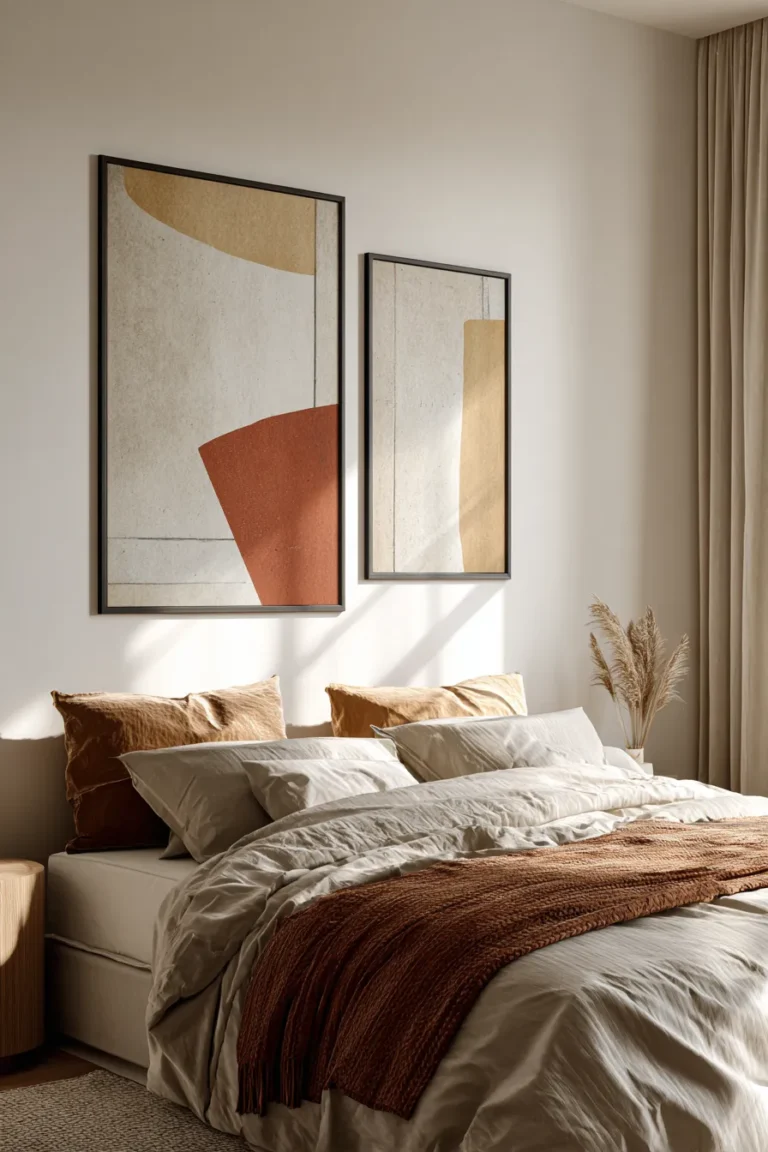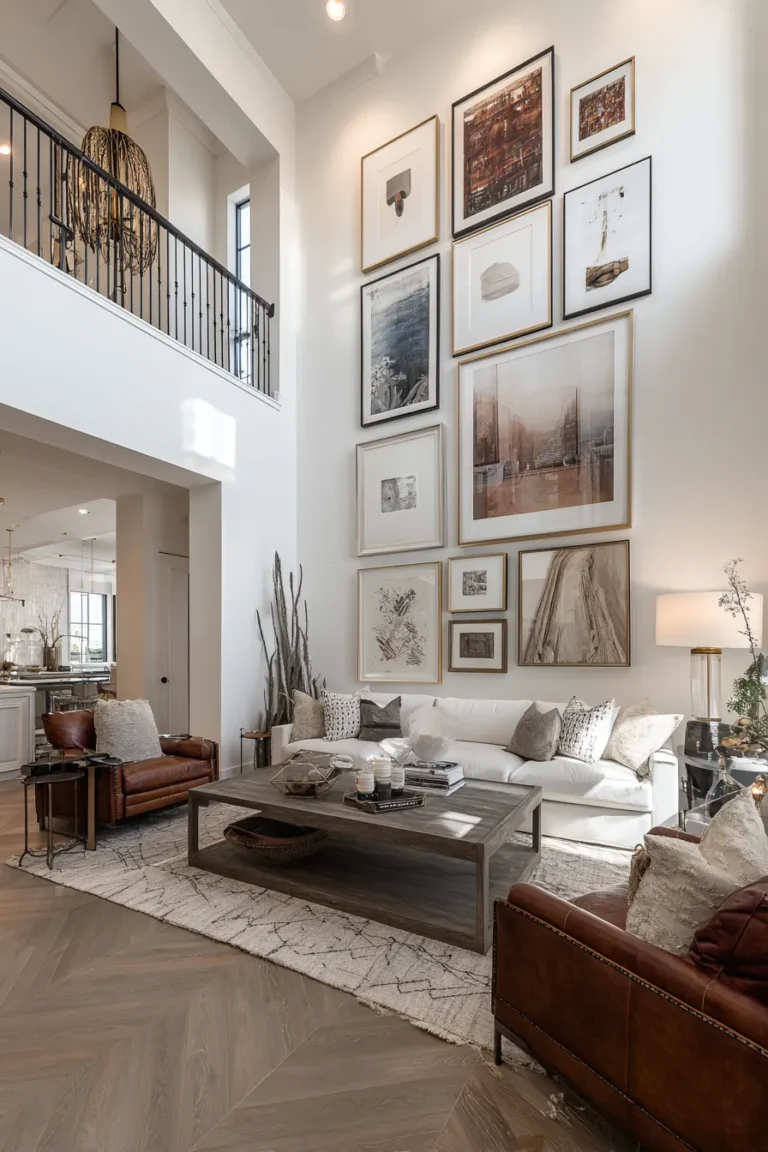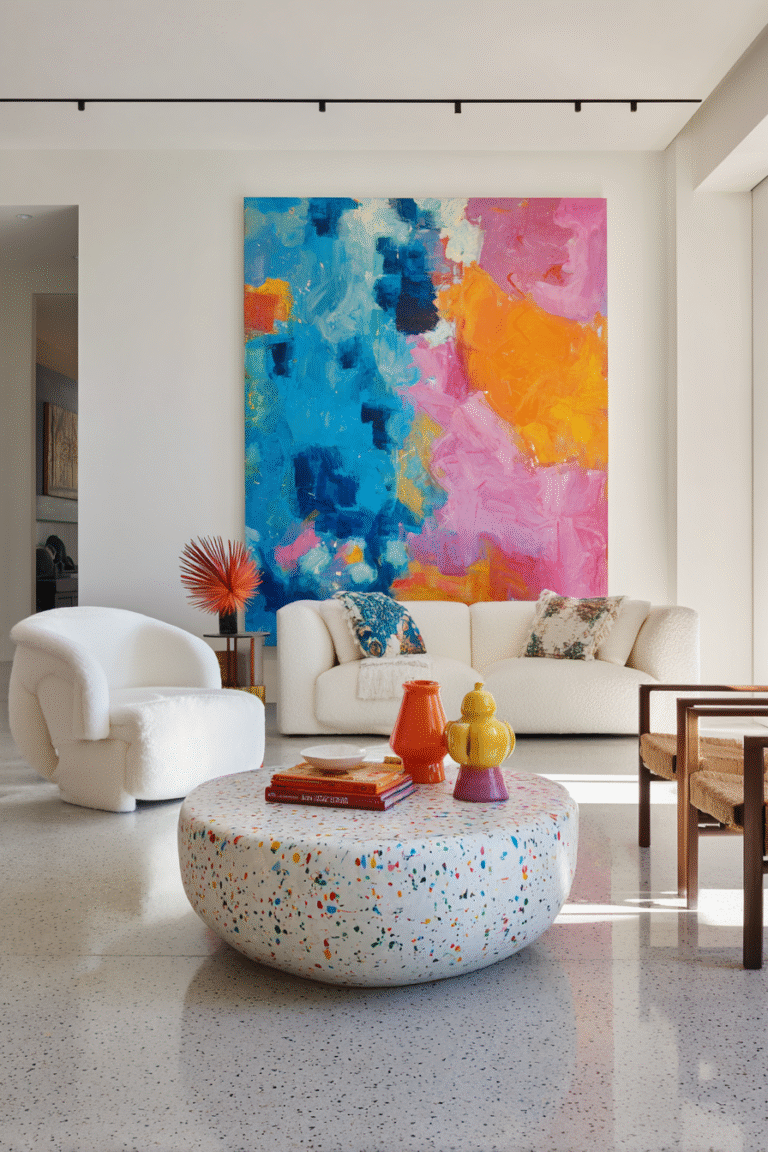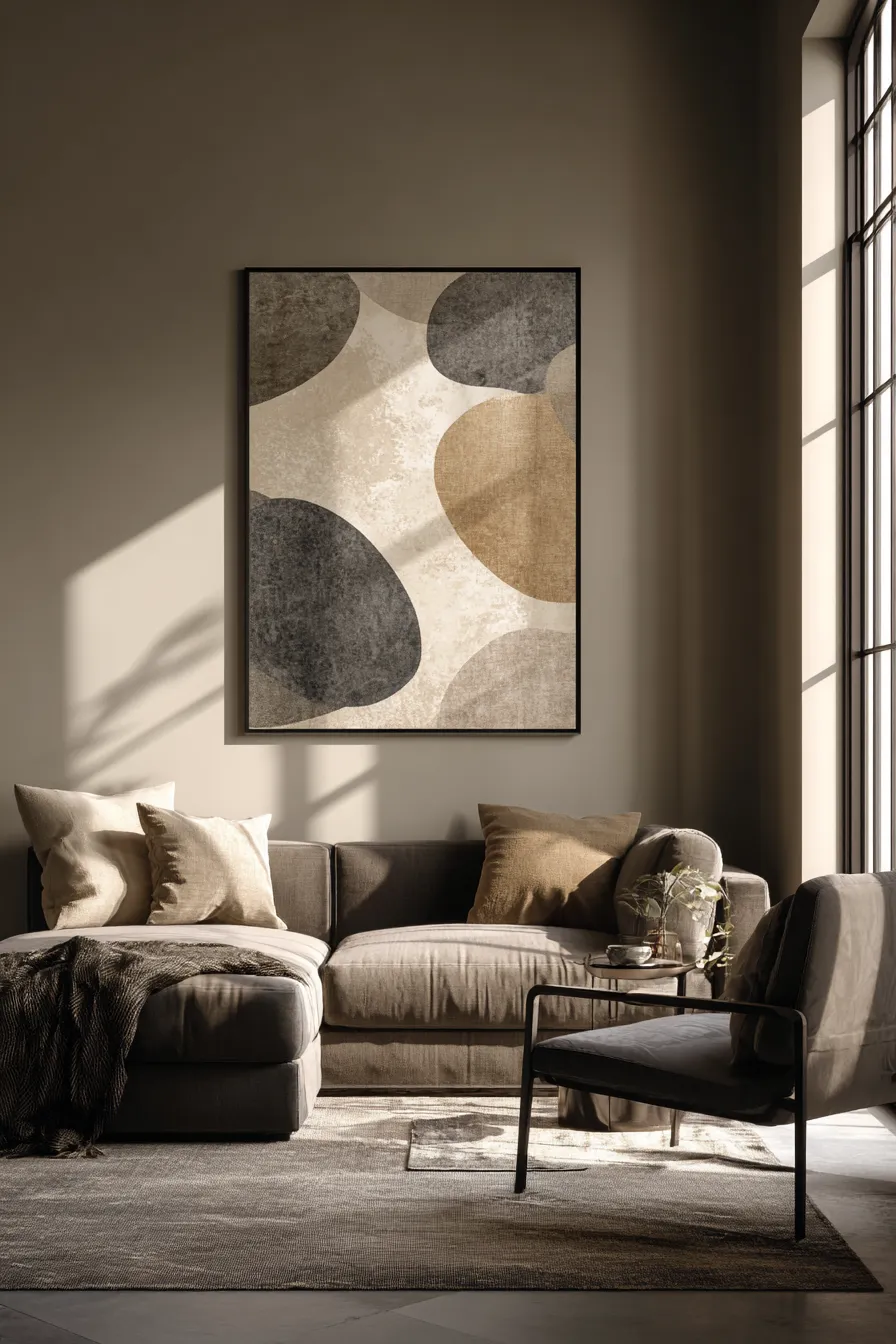
The 2026 wall art shift prioritizes large-format prints (36″+ width) with visible texture over traditional smooth finishes, driven by buyers seeking tangible authenticity in digital-dominated spaces.
After correcting hundreds of “too small” art purchases in client homes, I’ve identified the 15 print styles that consistently deliver professional-level results. Most homeowners approach wall art backwards—choosing pieces they like without considering scale, placement, or visual weight. The result? Beautiful prints that disappear on the wall or overwhelm the space they’re meant to enhance.
These 15 design ideas represent what’s actually working in 2026 interiors—not Pinterest fantasies, but tested configurations that balance trend-forward aesthetics with timeless appeal. Each style includes specific dimensions, material recommendations, and the technical details that separate amateur from professional installations.
Whether you’re styling a minimalist bedroom or transforming a living room wall, these formulas eliminate guesswork.
1. Oversized Abstract Earth Tones (Single Statement)
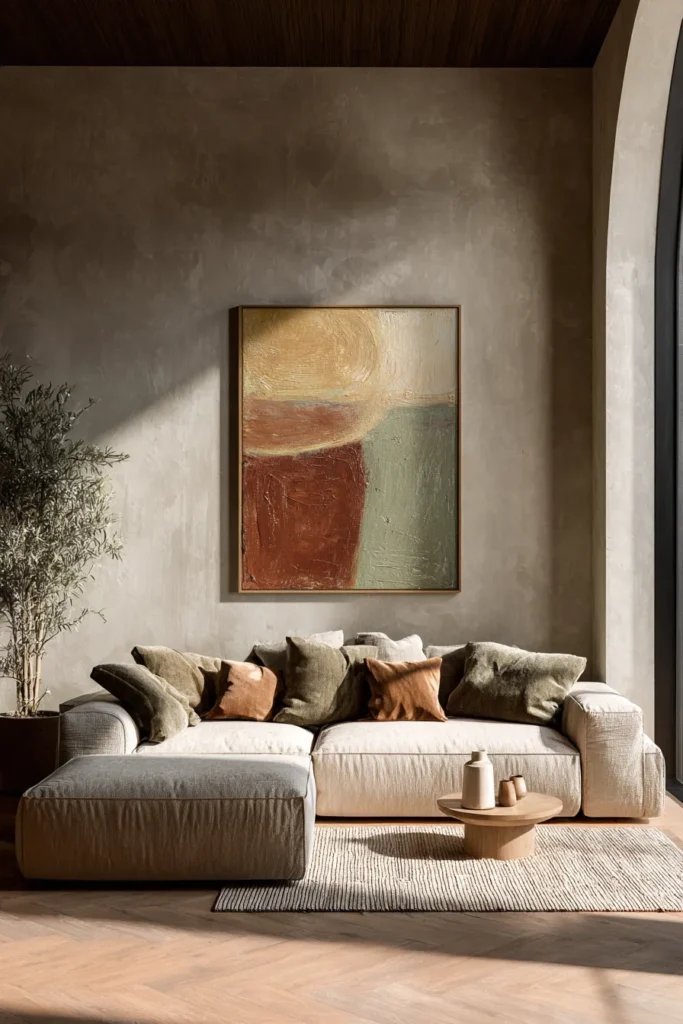
Large-scale abstract prints in terracotta, ochre, and sage dominate 2026 because they deliver maximum impact with minimal pieces. One 60″x40″ print eliminates the need for gallery walls while creating a sophisticated focal point.
Why It Works: The psychology of scale matters more than subject matter. Large abstracts command attention without overwhelming—the organic shapes and muted palette create calm rather than chaos. These prints work particularly well above sectionals where multiple smaller pieces would feel fragmented.
Design Breakdown:
- Minimum size: 48″x36″ for 7-foot sofas; 60″x40″ for sectionals or king beds
- Color palette: Terracotta as anchor (Pantone 16-1338), ochre and sage as secondaries
- Material: Textured wall art canvas with visible brushstroke texture (300gsm minimum)
- Frame: Floating natural oak or skip framing entirely for raw-edge modern look
- Placement: 6-8 inches above furniture top; center point at 57-60 inches in open walls
Best For: Modern living rooms, boho bedrooms, open-concept spaces needing visual anchors, high-ceiling rooms (10+ feet)
Budget Range: $180-$450
Designer’s Secret: Position these prints on walls perpendicular to windows rather than opposite them—direct light flattens abstract depth, while side lighting creates dramatic shadow play that changes throughout the day.
2. Black & White Architectural Photography (Museum Scale)
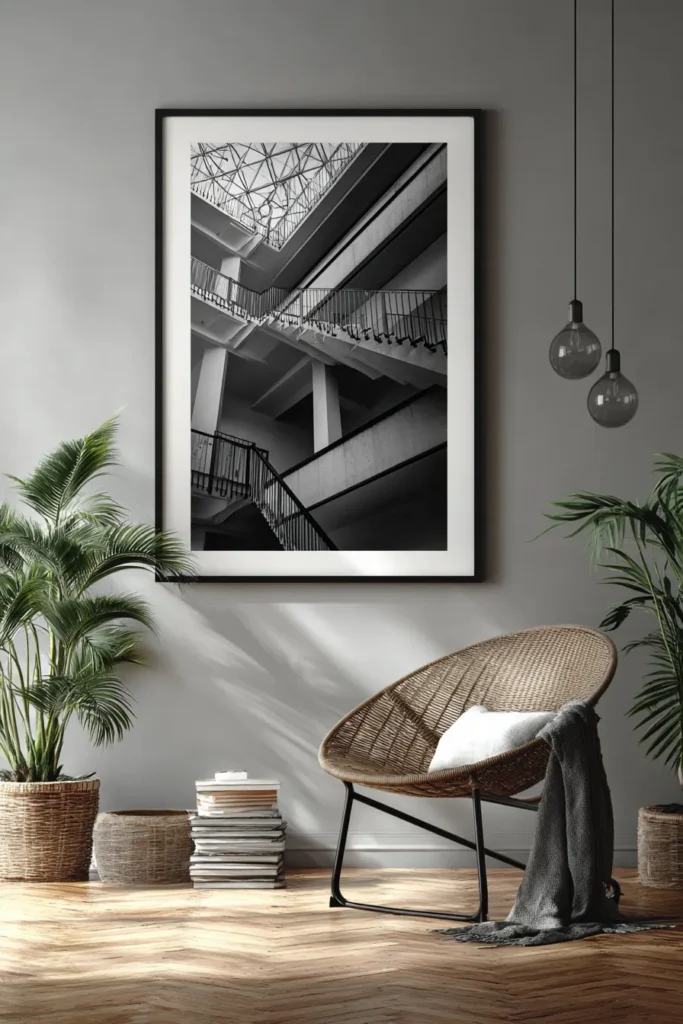
Monochromatic architectural prints—staircases, bridges, geometric buildings—bring gallery credibility to residential spaces. The high contrast creates instant sophistication without competing with colorful décor.
Why It Works: Black and white photography adapts to any color scheme while maintaining visual interest. The architectural subjects provide structure and geometry that balances organic furniture shapes. At museum scale (40″+ width), these prints command the same attention as original artwork.
Design Breakdown:
- Optimal sizes: 40″x30″ minimum; 50″x40″ for maximum impact
- Subject selection: Architectural details, urban landscapes, modernist structures
- Material: Black and white photography prints on heavyweight matte paper (300gsm+)
- Matting: 4-inch white border on all sides (museum standard)
- Frame: Thin black metal (0.5-1 inch profile) or gallery white wood
- Glass: UV-protective essential for longevity (97-99% UV blocking)
Best For: Contemporary living room designs, modern dining rooms, professional home offices, Scandinavian interiors
Budget Range: $150-$400
3. Minimalist Line Art Gallery Wall (5-7 Pieces)
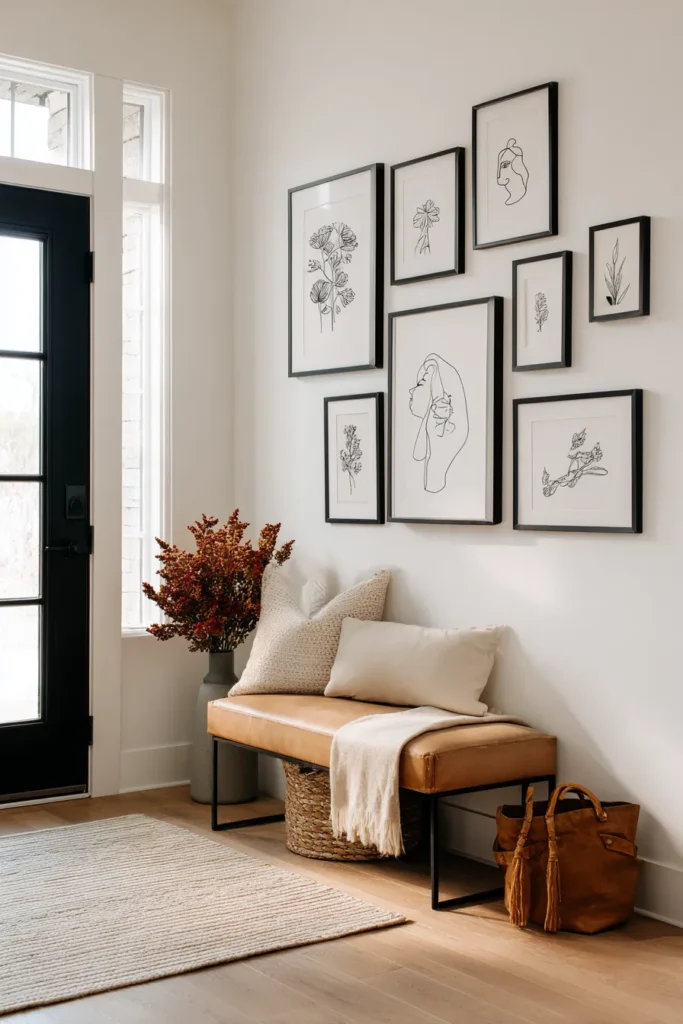
Single-line drawings—faces, bodies, botanical studies—deliver sophisticated style at accessible prices. The gallery wall approach allows you to create impact through repetition rather than investing in one expensive piece.
Why It Works: Line art reads as intentional minimalism when properly curated. The simplicity allows these prints to layer with existing art or stand alone. By keeping frames and subjects consistent, you avoid the “chaotic gallery wall” problem that plagues most attempts.
Design Breakdown:
- Configuration: 5-7 pieces in matching frames; odd numbers create better visual balance
- Individual sizes: Mix 11″x14″, 16″x20″, and one 24″x36″ as anchor piece
- Subject consistency: All portraits, all botanicals, or all abstract—never mixed themes
- Frame: Modern line art prints in thin black frames or natural wood
- Spacing: 2-3 inches between all frames; maintain consistent gaps
- Layout: Grid for formal spaces; organic cluster for casual rooms
Best For: Small spaces, rental properties, entryways, reading corners, budget-conscious designers
Budget Range: $200-$350 for complete 7-piece gallery
Explore affordable art prints under $100 to create full gallery walls without exceeding modest budgets.
4. Textured Neutral Abstract (Mixed Media Look)
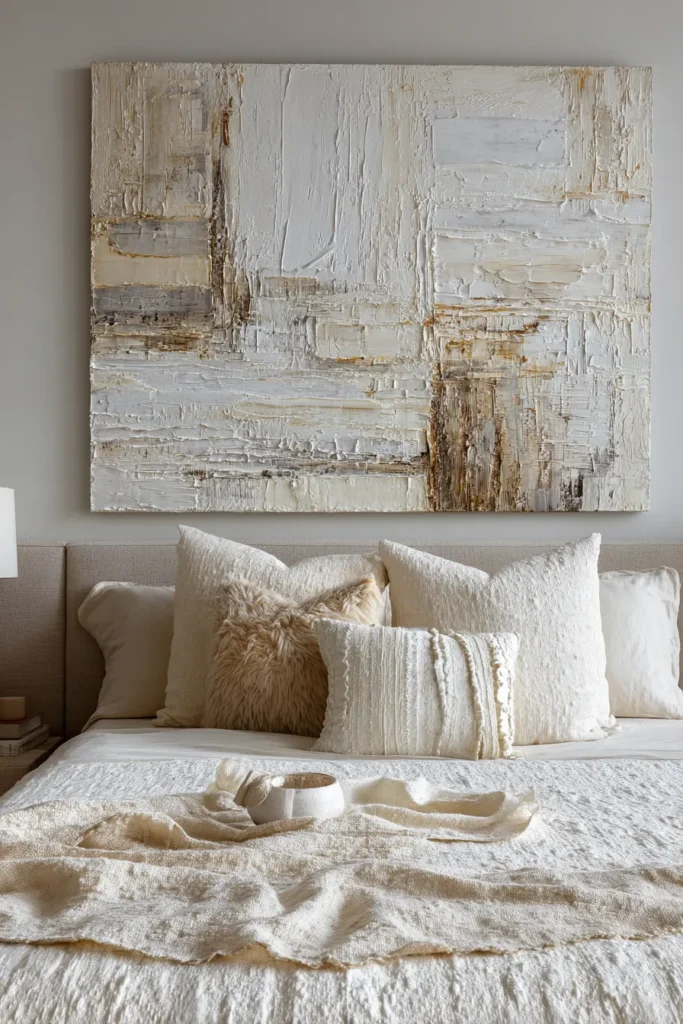
Prints with visible texture—embossed surfaces, impasto effects, layered materials—satisfy the 2026 demand for tactile authenticity. These pieces change appearance based on viewing angle and lighting, creating dynamic interest flat prints can’t match.
Why It Works: Screen fatigue drives buyers toward physical texture. After years consuming flat digital images, there’s active demand for art that catches light differently throughout the day. The three-dimensionality adds “visual weight” that grounds lighter furniture.
Design Breakdown:
- Size: 36″x24″ to 48″x36″ (texture reads best at close-to-medium viewing distance)
- Color palette: Cream, beige, taupe, soft gray—monochromatic neutrals
- Material: Canvas with hand-applied gel medium or heavyweight embossed paper (400gsm)
- Texture type: Palette knife strokes, impasto builds, or dimensional paint layers
- Lighting requirement: Picture lights or window placement to maximize shadow depth
- Frame: Skip it—raw edges emphasize the handcrafted quality
Best For: Modern spaces needing warmth, bedroom wall art above upholstered headboards, layered boho interiors, tactile design enthusiasts
Budget Range: $220-$500
Designer’s Warning: Avoid textured prints in high-humidity spaces (bathrooms, kitchens)—moisture causes dimensional elements to lift or peel over time. Stick to climate-controlled bedrooms and living areas.
5. Vibrant Abstract Color Blocks (Contemporary Statement)
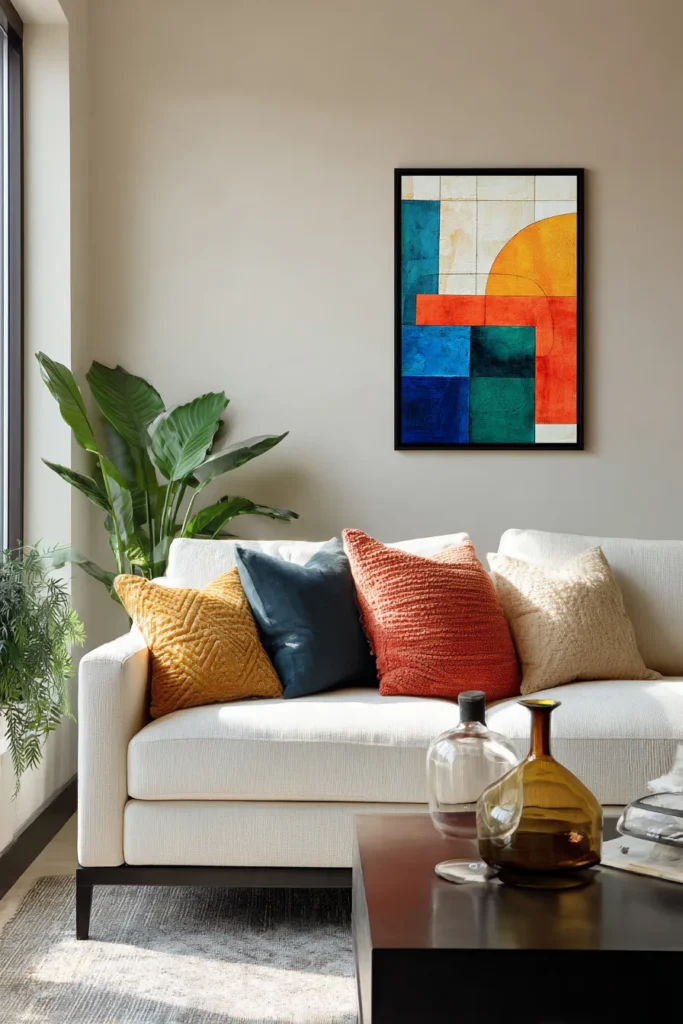
Bold geometric abstracts in saturated colors—cobalt, coral, emerald, mustard—energize neutral rooms. These prints work as “color anchors” that you can pull into smaller accessories (pillows, throws, vases) to create cohesive schemes.
Why It Works: Colorful abstracts solve the “all beige” problem without repainting or replacing furniture. One vibrant print introduces 3-4 accent colors you can repeat elsewhere, creating designer-level coordination with minimal investment.
Design Breakdown:
- Size: 40″x30″ to 60″x40″ depending on wall scale
- Color strategy: Choose prints with 3-4 distinct colors; repeat 2 colors in room accessories
- Material: Abstract art prints set on canvas for color saturation
- Style: Hard-edge geometric, color field, or organic color blocking
- Frame: Thin black floater frame or frameless for contemporary edge
- Placement: Feature walls, above neutral sofas, opposite entryways
Best For: Contemporary interiors, neutral rooms needing color injection, modern living spaces, young professionals seeking bold style
Budget Range: $180-$400
6. Botanical Line Drawings (Delicate Pairs or Trios)
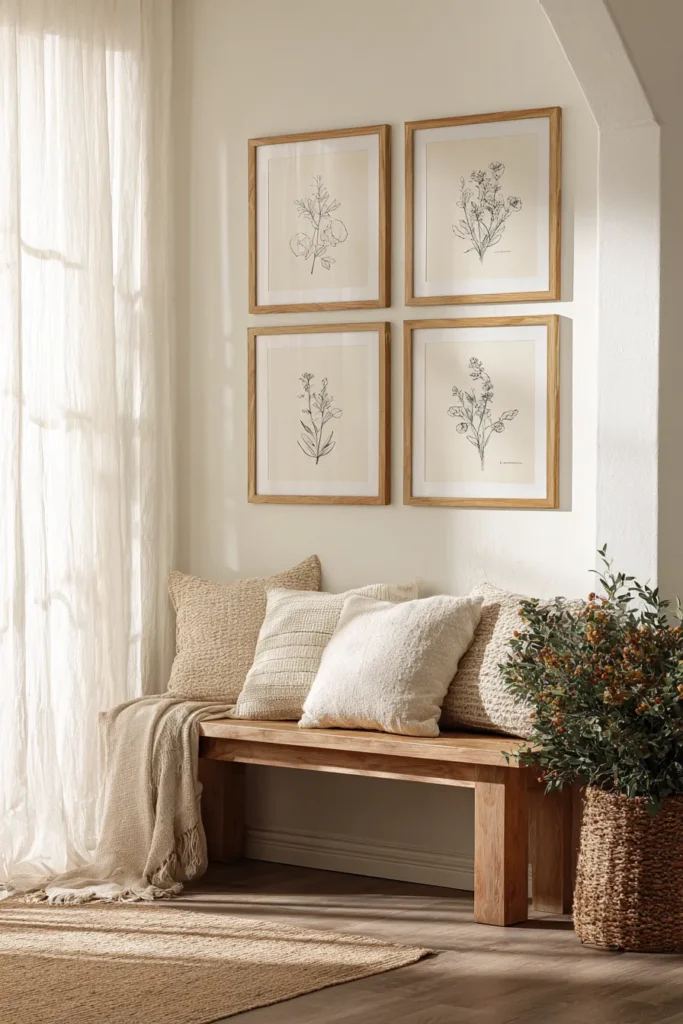
Simplified botanical illustrations—single stems, leaf studies, flower profiles—bring organic softness without literal floral prints. The line-drawn approach feels more sophisticated than traditional botanical art.
Why It Works: These prints add nature-inspired elements that work across multiple design styles—from modern farmhouse to Scandinavian minimalism. The delicate lines create visual interest without competing for attention.
Design Breakdown:
- Configuration: Pair (2 pieces) for symmetry; trio (3 pieces) for asymmetric interest
- Individual size: 16″x20″ or 18″x24″ each
- Subject: Single botanical specimens on white or cream backgrounds
- Frame: Natural wood (light oak or maple) for warmth; white for crispness
- Arrangement: Horizontal line for modern; vertical stack for narrow walls
- Spacing: 3-4 inches between frames
Best For: Bedroom walls, breakfast nooks, bathrooms, farmhouse kitchens, Japandi interiors
Budget Range: $120-$280 per pair
7. Oversized Desert Landscape Photography
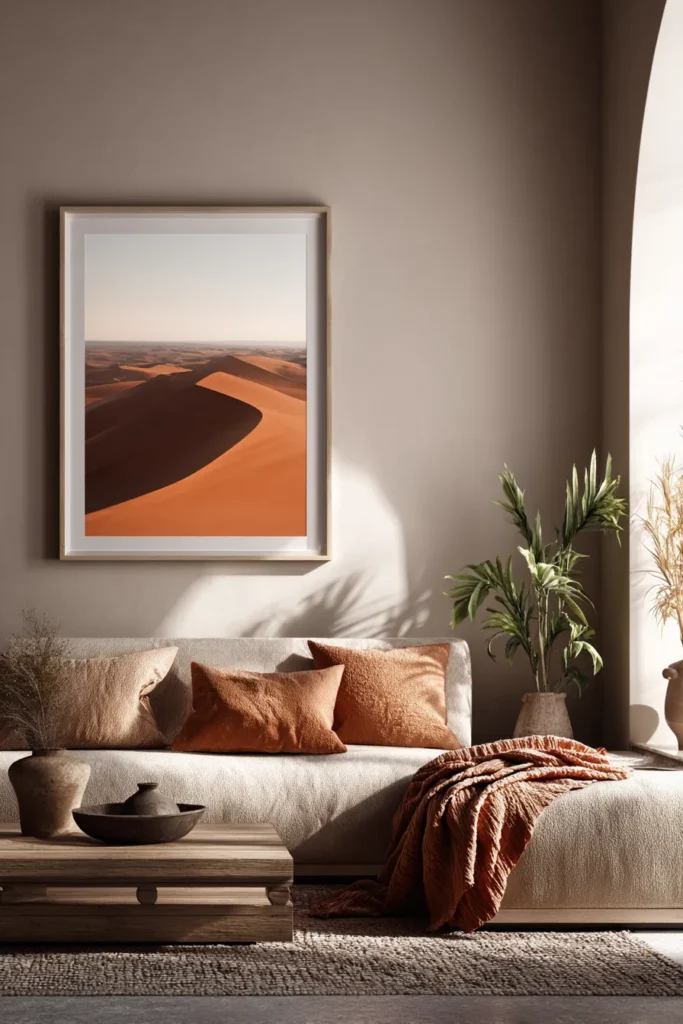
Large-format desert landscapes—sand dunes, southwestern vistas, minimalist horizon lines—capture the 2026 earth-tone trend while providing the scale impact of abstract art at photography prices.
Why It Works: Desert landscapes deliver the same color palette as abstract earth-tone pieces (ochre, terracotta, sand) but with recognizable subject matter that feels less intimidating to traditional buyers. The minimalist compositions work in modern spaces without reading as “rustic.”
Design Breakdown:
- Size: 48″x32″ minimum; oversized art prints 48×36 for statement impact
- Subject: Dunes, desert roads, southwestern rock formations, dried earth patterns
- Color profile: Warm neutrals (avoid vivid sunset colors that date quickly)
- Material: Matte finish paper or canvas to emphasize earthiness
- Frame: Natural wood or skip framing for contemporary look
- Ideal walls: Above low-profile sofas, in bedrooms opposite windows
Best For: Modern southwestern style, earth-tone interiors, living rooms with warm paint colors, master bedrooms
Budget Range: $160-$380
8. Mid-Century Abstract Geometric (Retro Modern)
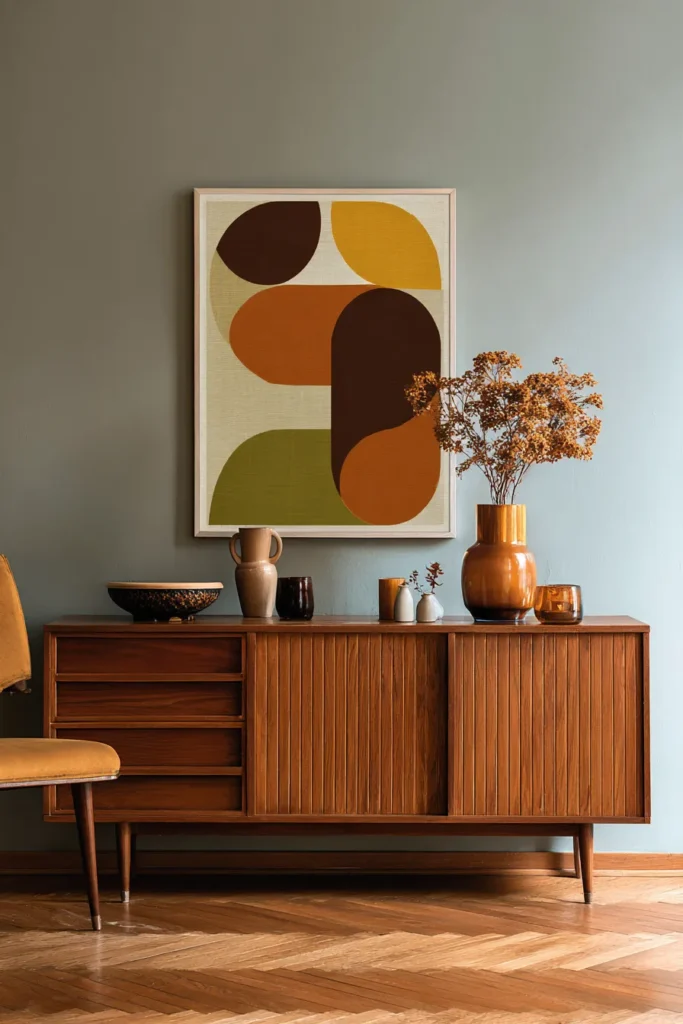
Prints inspired by 1950s-70s abstract art—circles, semi-circles, organic shapes in burnt orange, olive, and mustard—satisfy the ongoing mid-century modern revival while feeling fresh rather than dated.
Why It Works: The retro color palette pairs beautifully with both vintage and new mid-century furniture. Unlike literal vintage posters, these abstract interpretations feel timeless rather than kitschy.
Design Breakdown:
- Size: 30″x40″ to 40″x50″ for primary placement
- Color palette: Burnt orange, olive green, mustard yellow, chocolate brown, cream
- Style markers: Overlapping circles, arch shapes, organic blobs, geometric patterns
- Material: Canvas or heavyweight paper with slight texture
- Frame: Walnut or teak wood frames (1.5-2 inch profile)
- Pair with: Mid-century living room furniture
Best For: Mid-century modern spaces, retro-inspired interiors, eclectic living rooms, 70s modern designs
Budget Range: $140-$320
Designer’s Secret: Place mid-century prints slightly lower than standard (center at 54-56 inches) to echo the low-slung furniture profiles typical of this era—it creates subconscious visual harmony.
9. Monochrome Abstract Brush Strokes (Zen Minimalism)
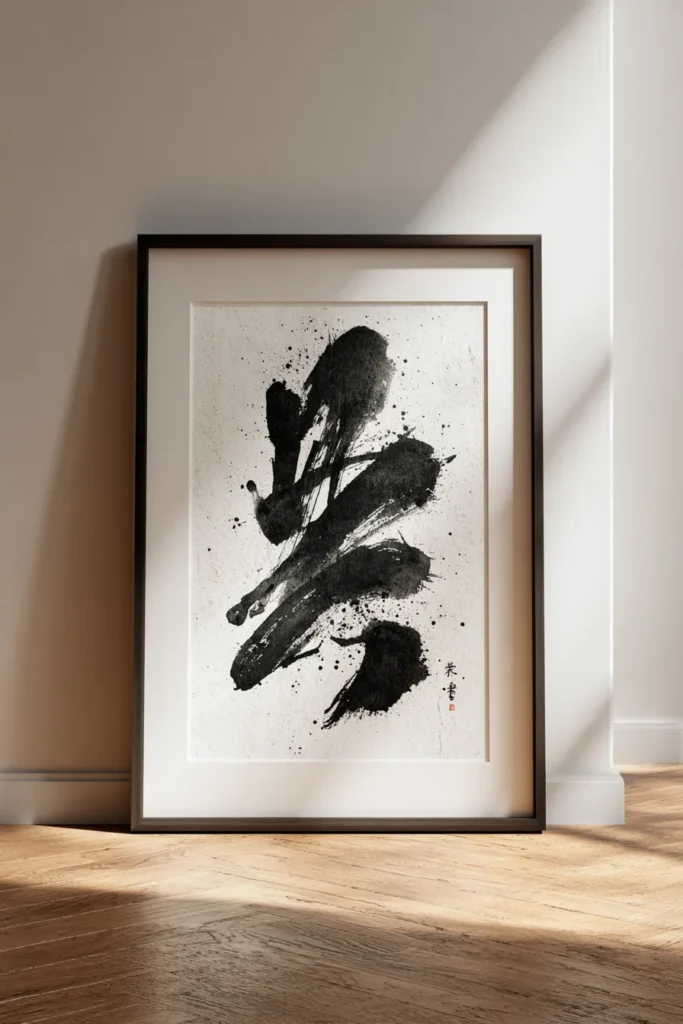
Large brushstroke abstracts in black ink on white backgrounds channel Japanese sumi-e painting traditions. These prints bring movement and energy to minimalist spaces without adding color or pattern.
Why It Works: The high contrast creates drama while maintaining serenity. The gestural brushwork adds human touch to otherwise stark minimalist interiors, preventing them from feeling cold or sterile.
Design Breakdown:
- Size: 40″x30″ minimum; vertical orientation (50″x30″) for narrow walls
- Style: Single bold brushstroke, calligraphic gestures, or minimal ink washes
- Material: Heavyweight white or cream paper (no canvas—the paper texture matters)
- Matting: Wide white mat (5-6 inches) for breathing room
- Frame: Thin black metal or natural light wood
- Placement: Vertical prints for hallways; horizontal for above beds/sofas
Best For: Minimalist interiors, Japandi style, meditation spaces, modern bathrooms, small bedroom layouts
Budget Range: $130-$300
10. Warm Neutral Abstract Triptych (3-Panel Set)
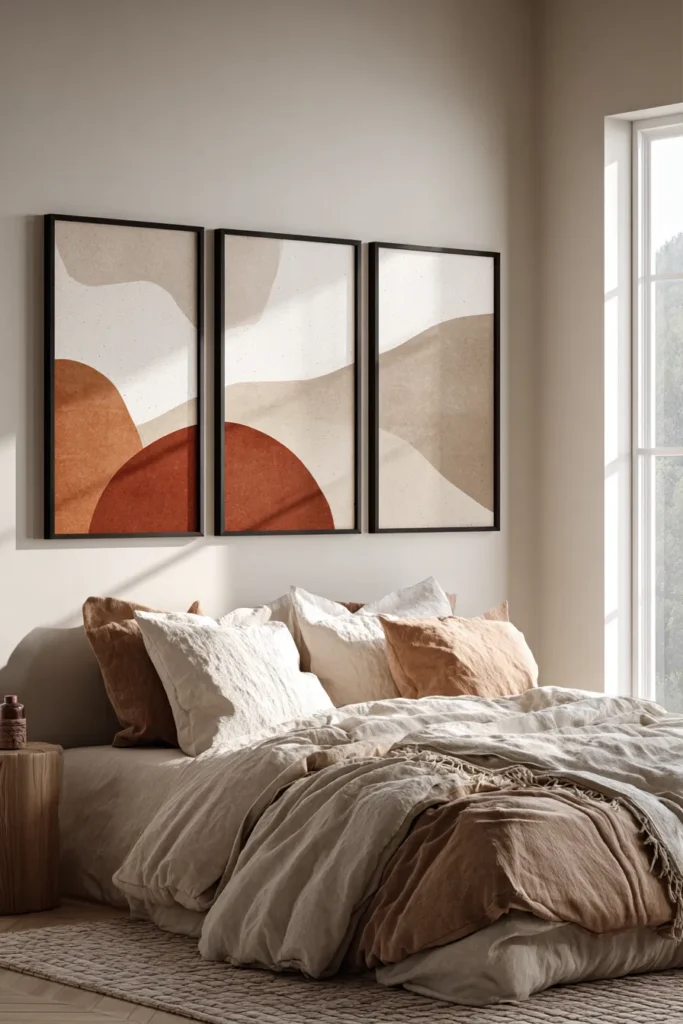
Three-panel abstract sets create the visual impact of gallery walls without the complexity. The connected composition reads as one large piece while offering installation flexibility.
Why It Works: Triptychs solve the “too small” problem for large walls while remaining affordable. The three-panel format allows you to adjust spacing and create custom widths that perfectly fit your furniture proportions.
Design Breakdown:
- Panel sizes: Each 20″x30″ or 24″x36″ (60-72 inches total width when spaced)
- Color: Warm abstracts in beige, taupe, cream, rust, and soft brown
- Material: Gallery wall print sets on canvas or paper
- Arrangement: Equal spacing (2-3 inches) for formal look; varied spacing for organic feel
- Frame: Matching thin black or natural wood on all three panels
- Hanging: Align top edges (not centers) for professional appearance
Best For: Above sectionals, king beds, dining room walls, living rooms with 9+ foot walls
Budget Range: $250-$500 for complete set
11. Coastal Abstract (Blue & Neutral Palette)
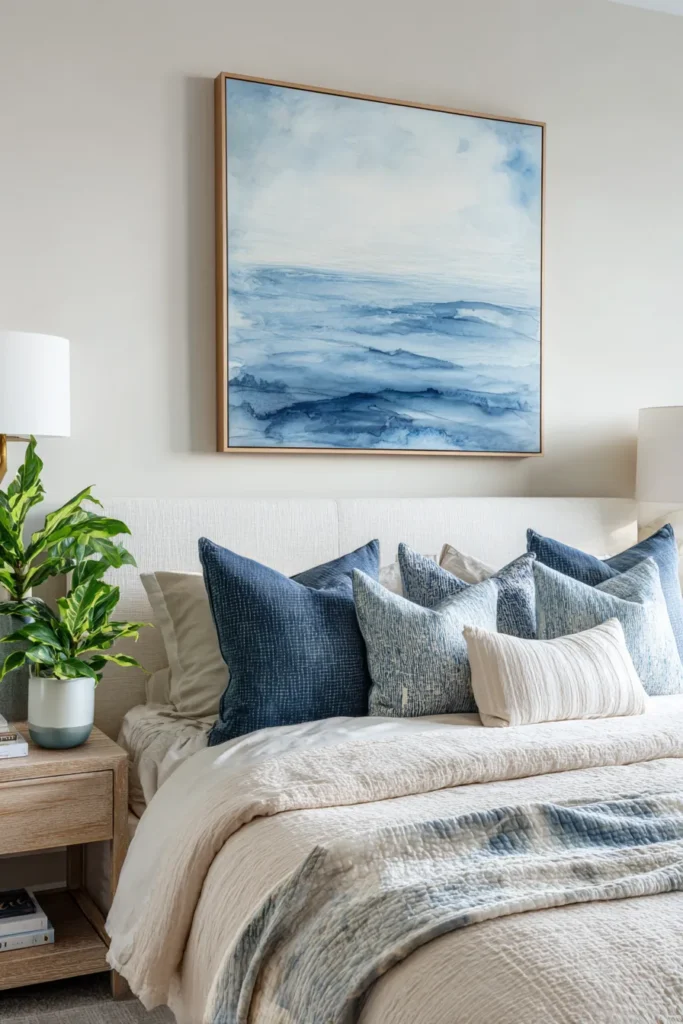
Abstract prints in navy, soft blue, cream, and beige capture coastal aesthetics without literal beach imagery. The palette evokes water and sky while remaining sophisticated.
Why It Works: Coastal colors bring calming energy to bedrooms and bathrooms. Unlike seashell-and-starfish art that feels themed, these abstracts incorporate coastal tones subtly—appropriate for both beach homes and landlocked spaces.
Design Breakdown:
- Size: 36″x24″ to 48″x36″ depending on application
- Color ratios: 60% neutral (cream, beige), 40% blue tones (navy, soft blue, aqua)
- Style: Watercolor-inspired washes, organic shapes, horizon-line suggestions
- Material: Canvas for living spaces; paper with white mat for bathrooms
- Frame: White, light wood, or natural driftwood-style finishes
- Best walls: Bedroom walls in master suites, bathroom feature walls, coastal living rooms
Best For: Coastal interiors, navy blue bedrooms, beach houses, bathrooms, serene master suites
Budget Range: $150-$350
12. Earth & Sky Abstract Landscapes (Horizon Line)
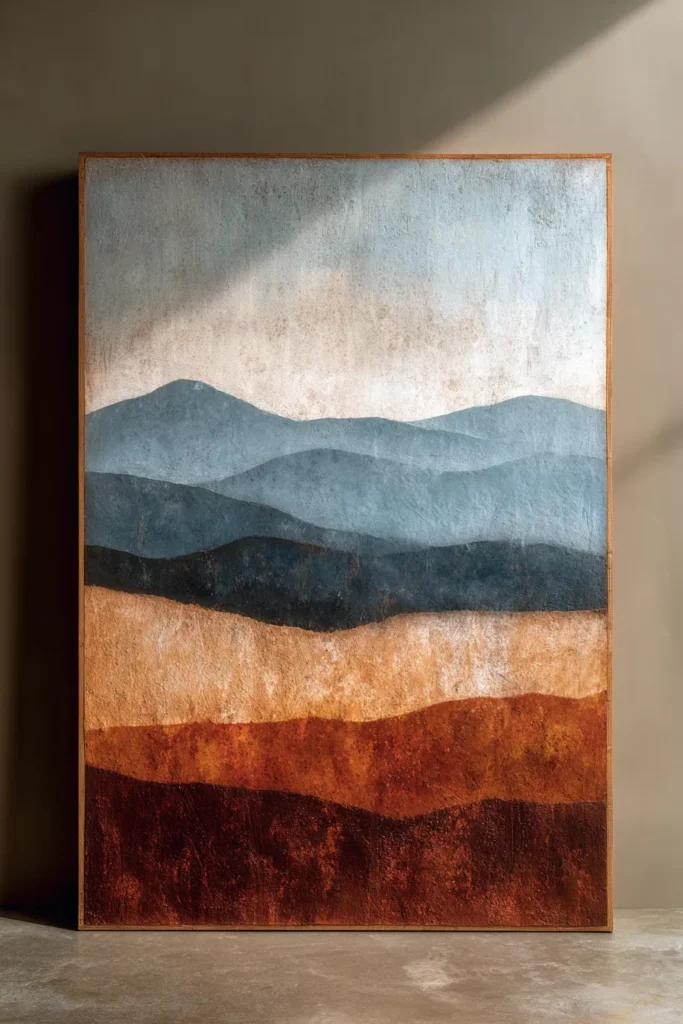
Simplified landscape abstracts with distinct horizon lines—where earth meets sky—provide grounding visual structure. The recognizable composition feels familiar while remaining abstract.
Why It Works: Horizon lines create instant calm by dividing space into clear zones. These prints work exceptionally well in bedrooms where you want soothing energy without sacrificing visual interest.
Design Breakdown:
- Size: 40″x30″ or 48″x24″ (horizontal orientation essential)
- Color blocking: Lower third in earth tones (ochre, rust, brown); upper two-thirds in sky tones (cream, soft blue, gray)
- Style: Minimal detail, abstract color fields, textured layers
- Material: Canvas with visible texture
- Frame: Natural wood to emphasize organic theme, or frameless
- Placement: Eye-level in bedrooms; standard height (57-60″ center) in living spaces
Best For: Master bedrooms, meditation corners, reading nooks, nature-inspired interiors
Budget Range: $170-$380
13. Monochromatic Geometric Patterns (Modern Sophistication)
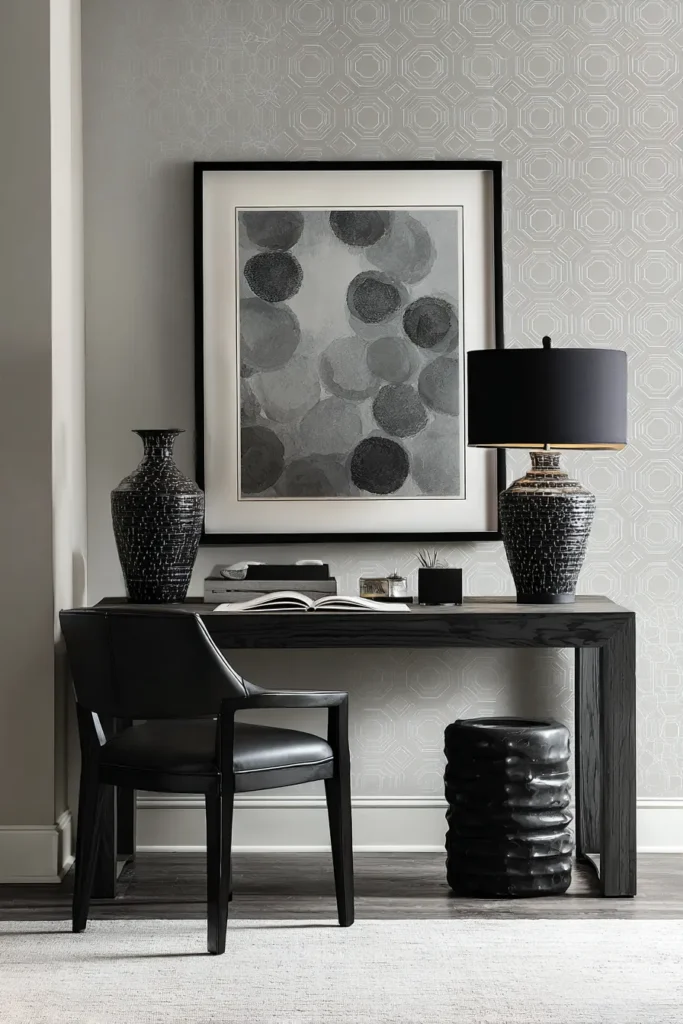
Geometric prints in tonal variations of single colors—all grays, all blues, all creams—create pattern interest without color chaos. The subtle complexity appeals to pattern lovers who want sophistication over exuberance.
Why It Works: Monochromatic patterns add visual texture to minimalist spaces without introducing new colors. The geometric precision provides structure that balances organic furniture shapes and soft textiles.
Design Breakdown:
- Size: 30″x40″ or 36″x36″ (square format works well for geometric designs)
- Pattern types: Repeated circles, tessellations, art deco angles, geometric abstracts
- Color: Single hue in 3-4 tonal variations (light to dark)
- Material: Paper for crispest lines; canvas for softer appearance
- Frame: Match frame color to darkest tone in print
- Placement: Formal spaces, home offices, above console tables
Best For: Contemporary spaces, modern offices, entryway tables, geometric interior styles
Budget Range: $120-$280
14. Warm Abstract Florals (Non-Literal Blooms)
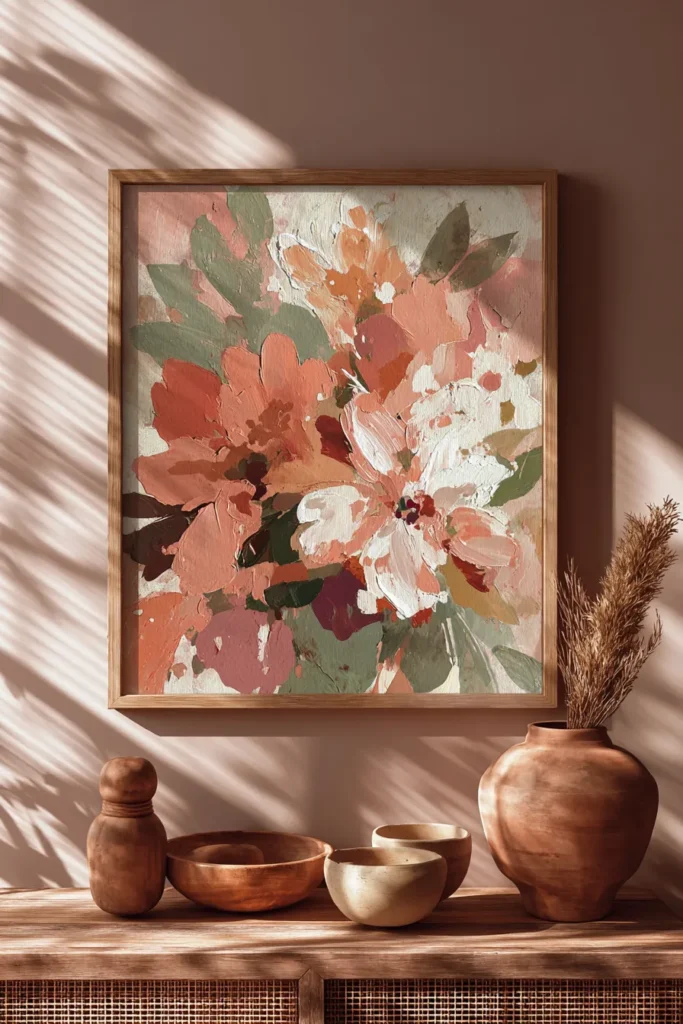
Abstract interpretations of flowers—where blooms become color fields and brushstrokes—bring floral energy without traditional flower art’s dated associations. The abstraction keeps them sophisticated.
Why It Works: These prints satisfy the desire for organic, nature-inspired art while remaining stylistically current. The warm palette (coral, peach, terracotta, pink) adds feminine softness without veering into cliché.
Design Breakdown:
- Size: 30″x40″ to 40″x50″ for bedroom or living room placement
- Color palette: Warm florals (coral, peach, rust, blush pink) with green undertones
- Style: Brushstroke flowers, color-blocked petals, abstract organic shapes suggesting blooms
- Material: Canvas for texture; avoid glossy finishes that look commercial
- Frame: Natural wood or white to keep the organic feeling
- Best rooms: Bedrooms, powder rooms, dressing areas, feminine spaces
Best For: Dreamy bedrooms, nurseries, feminine home offices, romantic interiors
Budget Range: $140-$320
15. Layered Neutral Abstracts (Depth Through Transparency)
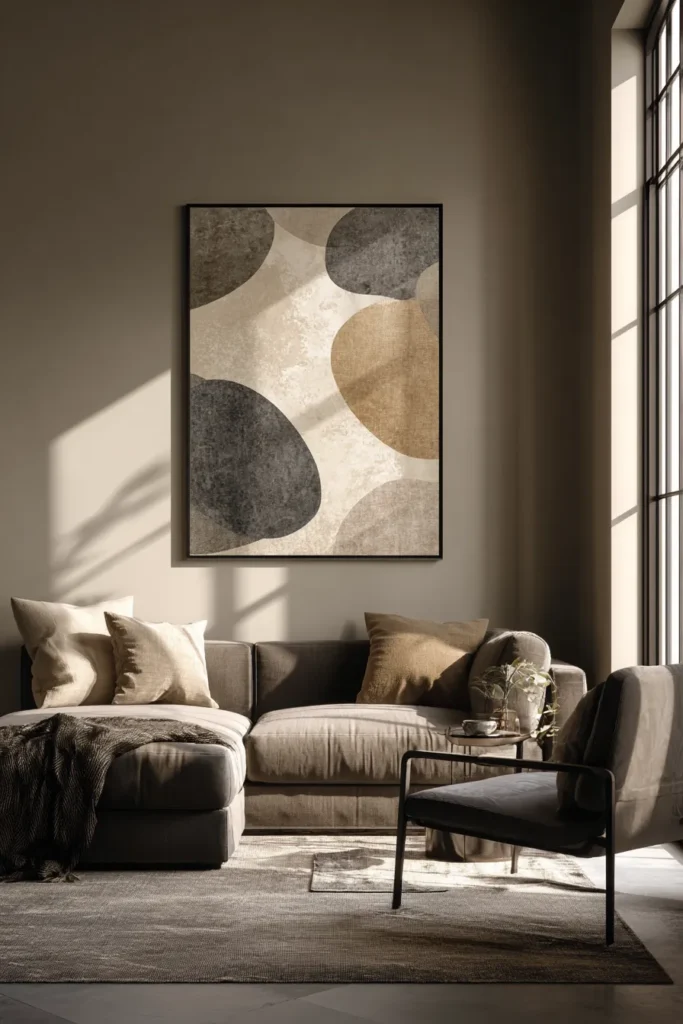
Multi-layered abstract prints where shapes overlap with varying opacity create depth and sophistication. The neutral palette (taupe, cream, gray, soft brown) makes them versatile across styles.
Why It Works: The layering technique creates visual complexity that rewards closer examination—these aren’t “glance and done” pieces. The transparency effects add dimension without the cost of actual textured prints.
Design Breakdown:
- Size: 40″x30″ to 50″x40″ (the layering detail needs space to read)
- Technique: Overlapping organic shapes with transparent/opaque interplay
- Color: 3-4 neutrals maximum (beige, taupe, cream, gray, soft charcoal)
- Material: Large canvas wall art prints or heavyweight paper
- Frame: Floating frame to emphasize the layered effect, or thin black
- Lighting: Side lighting reveals the depth; avoid direct frontal light
Best For: Sophisticated living rooms, luxury spaces, contemporary bedrooms, designers seeking subtle complexity
Budget Range: $200-$450
Designer’s Secret: These layered prints work best on walls painted in one of the print’s lightest tones—the subtle color echo creates subconscious harmony that makes the art feel “meant to be there.”
The Professional Sizing Formula
These 15 styles require proper scaling to achieve their intended impact. Follow this mathematical approach rather than guessing:
The 2/3 Rule Explained
Your wall art should occupy 60-75% of the furniture width it anchors. For an 84-inch sofa, your art should be 50-63 inches wide (single piece or combined width of multiple pieces including spaces).
Application Examples:
- 72″ sofa → 43-54″ total art width
- 96″ king bed → 58-72″ total art width
- 60″ console table → 36-45″ total art width
- 48″ dining buffet → 29-36″ total art width
Height Placement Standards
Standard rule: Center point at 57-60 inches from floor (museum standard for viewing while standing)
Furniture adjustments:
- Above sofas/beds: 6-8 inches between furniture top and frame bottom
- Above console tables: 4-6 inches clearance
- Dining rooms: 60-inch center (accounts for seated viewing)
- Stairway walls: Follow stair angle, maintain 60-inch center from each step
Room-by-Room Size Guide
| Room | Furniture | Wall Width | Recommended Size | Shop |
|---|---|---|---|---|
| Living Room | 7-8 ft sofa | 8-10 ft | 48-60″ wide single or triptych | Gallery Sets |
| Living Room | Sectional | 10-12 ft | 60-72″ wide or oversized | Large Canvas |
| Bedroom | King bed | 6-8 ft | 48-58″ wide | Bedroom Art |
| Bedroom | Queen bed | 5-7 ft | 36-48″ wide | Bedroom Prints |
| Dining Room | Buffet | 6-8 ft | 36-48″ wide | Décor Ideas |
| Entryway | Console | 4-6 ft | 30-42″ wide or pair | Entry Styling |
Designer’s Warning: The #1 sizing mistake is buying too small. When in doubt, size up—oversized art that anchors furniture reads as intentional; undersized art looks like an afterthought.
Budget Allocation Strategy
Rather than spreading funds equally across multiple pieces, allocate strategically:
Hero Piece (60-70% of budget): Your largest, highest-impact print—above the sofa or bed. This is where you invest in oversized quality prints or textured canvas.
Supporting Pieces (20-30% of budget): 1-2 complementary prints for secondary walls. These can be smaller or simpler—line art or affordable abstracts.
Accent Pieces (10% of budget): Small prints for bathrooms, hallways, or reading corners.
Example Budget Scenarios:
$400 Total:
- $250: One 48″x36″ hero piece above sofa
- $100: Two 16″x20″ bedroom prints
- $50: One small bathroom print
$800 Total:
- $500: One large textured abstract or photography piece
- $200: Triptych set for dining room
- $100: Gallery wall of line art for hallway
Common Mistakes to Avoid
1. Buying Too Small (60% of buyers) Online shopping distorts scale perception. A 20″x30″ print looks substantial on your screen but disappears on an 8-foot wall. Always measure before purchasing.
2. Mismatched Color Temperatures Mixing warm prints (oranges, yellows, warm reds) with cool décor (grays, blues, silvers) creates visual discord. Match temperature to your dominant furniture tones.
3. Wrong Height Placement Art hung too high disconnects from furniture and floats awkwardly. The 6-8 inch rule (between furniture and frame) solves 90% of placement errors.
4. Overcrowding Small Spaces In rooms under 10’x10′, one or two well-chosen prints create calm. Six competing pieces create chaos. Reference small space living room layouts for proper scaling.
5. Ignoring UV Protection South and west-facing walls receive 5-8 hours of daily sun exposure. Without UV-protective glass, prints fade within 18-24 months. Invest the extra $40-80.
6. Cheap Frames on Quality Prints A $200 print in a $15 frame looks like a $15 print. Budget 30-40% of print cost toward quality framing.
7. Forgetting Visual Weight Dark, saturated prints feel “heavier” than light, minimal ones. Balance heavy art by positioning lower or pairing with substantial furniture. Light art works above delicate pieces.
Where to Buy These Styles
For Large-Format & Textured Prints: Browse large canvas wall art and textured options that deliver gallery quality without gallery prices.
For Coordinated Sets: Explore abstract art print sets and gallery wall collections that eliminate the guesswork of mixing pieces.
For Budget-Friendly Options: Start with affordable prints under $100 to test styles before committing to larger investments.
For Specific Styles:
- Monochrome: Black and white photography
- Minimalist: Modern line art
- Room-specific: Bedroom wall art and living room décor
Selection Criteria:
- Return policies (essential for online art)
- Quality guarantees or reviews showing actual installations
- Shipping protection (tubes for paper, corner guards for frames)
- Seller ratings above 4.5 stars with photo reviews
Quick Reference: Match Style to Space
For Modern Minimalist Rooms: Ideas #1, #9, #13, #15 (oversized abstracts, brushstrokes, geometric, layered neutrals)
For Warm Bohemian Spaces: Ideas #1, #4, #7, #12, #14 (earth tones, textured neutrals, desert landscapes, florals)
For Contemporary/Urban Interiors: Ideas #2, #5, #8, #13 (architectural photography, color blocks, mid-century, geometric)
For Coastal/Serene Bedrooms: Ideas #6, #9, #11, #12 (botanicals, brushstrokes, coastal abstracts, horizon lines)
For Budget-Conscious Spaces: Ideas #3, #6, #13 (line art gallery, botanical pairs, monochromatic patterns)
For Maximum Impact Statements: Ideas #1, #2, #7, #10, #15 (oversized abstracts, large photography, desert landscapes, triptychs, layered abstracts)
The difference between “decorated” and “designed” often comes down to proper scaling and intentional placement. These 15 wall art print styles work because they’ve been tested in hundreds of real homes—not just styled for Instagram moments.
Start by identifying which design idea matches your space’s style and size requirements. Measure your wall and furniture, calculate the appropriate dimensions using the 2/3 rule, then select within your budget tier. One properly scaled, well-placed print outperforms five random pieces every single time.
The most successful installations happen when you treat wall art as architectural elements rather than afterthoughts. Your prints should anchor furniture, define zones, and set the color palette—not simply fill empty space.
Ready to transform your walls? Measure first, reference this guide second, purchase third. That order prevents the expensive mistakes that lead to closets full of wrong-sized art.