The 2026 shift in bedroom wall art abandons symmetrical gallery walls for asymmetric focal points that prioritize negative space and light reflectance over wall coverage, creating rooms that breathe visually rather than compete for attention. This isn’t about filling every vertical surface—it’s about understanding how a single oversized canvas at 180cm width creates more visual impact than five smaller frames clustered together, and why the space around your art matters more than the art itself.
What separates amateur styling from designer-level execution is precision in scale mathematics, an understanding of light reflectance values, and the confidence to leave walls intentionally bare. The bedrooms that photograph beautifully for editorial features aren’t accident—they’re exercises in restraint, proportion, and material honesty.
1. Oversized Single Statement Canvas (180cm+ Width)
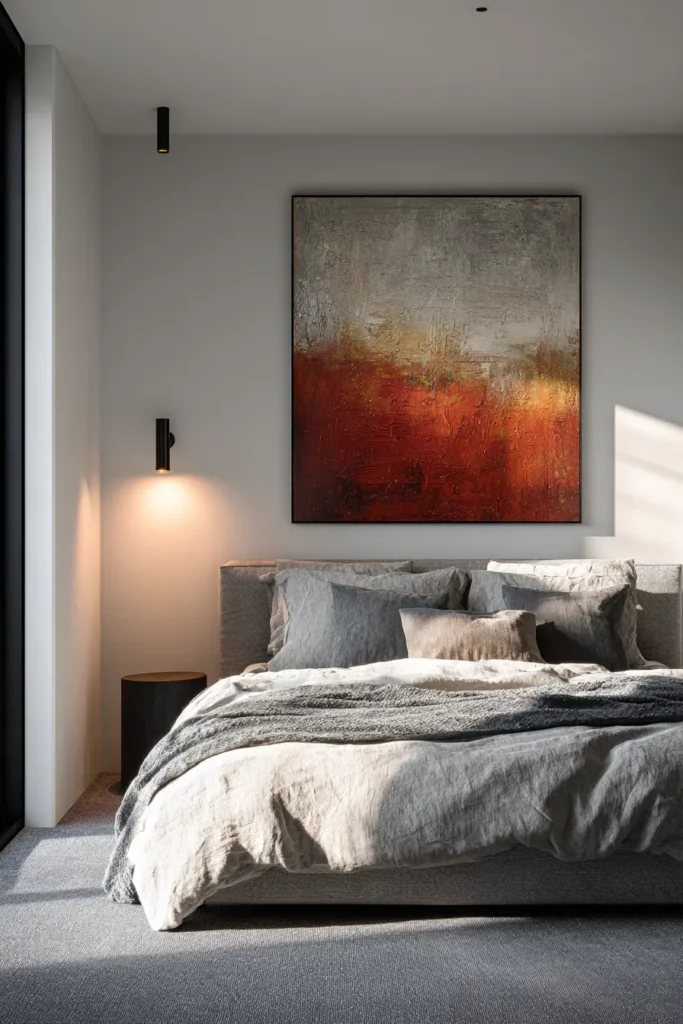
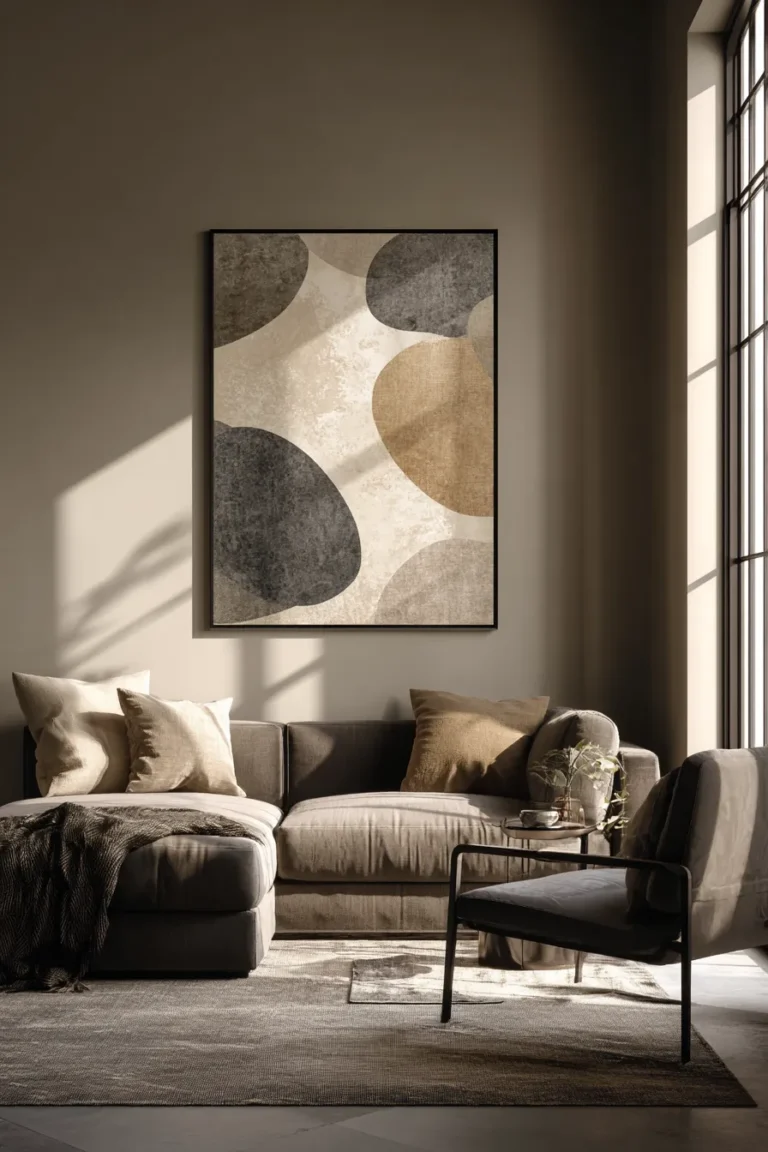
The monolithic canvas trend replaces busy gallery walls with one commanding focal point that anchors the entire room. We’re seeing abstract works in desaturated earth tones—burnt sienna, raw umber, charcoal grey—with visible brushstroke texture that catches light differently throughout the day. The key is scale: your canvas should span 60-75% of your bed’s width to create proper visual weight.
Designer’s Secret: Most people hang oversized art too high. The mathematical sweet spot is 15-20cm above your headboard top, not the standard 57″ center-height rule. This creates a visual “hug” effect where the art feels integrated with the bed architecture rather than floating randomly on the wall.
Design Breakdown:
- Canvas size: Minimum 180cm x 120cm for queen beds, 200cm+ for king
- Frame depth: 4-5cm gallery wrap (frameless edges) or slim 2cm black aluminum
- Paint finish: Look for heavy-body acrylics with visible impasto texture
- Lighting: Two adjustable picture lights at 3000K warm white, 30-degree beam angle
- LRV consideration: If your walls are below 50 LRV (darker tones), choose artwork with 60+ LRV to create contrast
Best For: Minimalists who want maximum impact with minimal effort. High-ceiling bedrooms (2.7m+) where vertical real estate demands bold gestures.
2. Floating Ledge Shelf System with Rotating Art
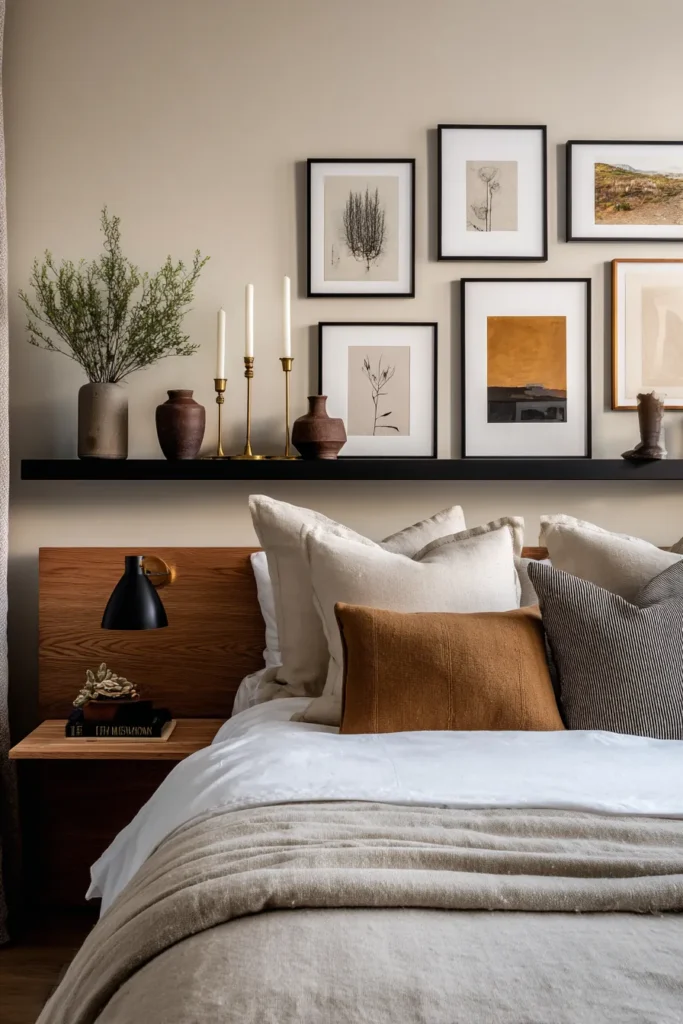
Floating ledges liberate you from commitment. By installing 120cm powder-coated steel ledges or solid walnut ledges with a 4cm lip, you create a curatorial system that allows seasonal rotation without wall damage. This approach mirrors high-end hotel design where art feels deliberately chosen, not permanently married to the space.
The magic is in the layering: overlap frames at slight angles, lean a small sculptural object against a larger print, allow one frame to extend slightly beyond the shelf edge. Imperfect alignment reads as intentional curation.
Designer’s Secret: Install ledges 40-45cm above your headboard, not directly against it. This creates breathing room and allows you to tuck decorative objects (a vintage brass candlestick, a single stem vase) between the ledge front and headboard back—adding depth without clutter.
Design Breakdown:
- Ledge material: Powder-coated steel in matte black or unlacquered brass that develops patina
- Load capacity: Minimum 15kg per meter to support heavy frames
- Depth: 10-12cm to accommodate frame thickness plus layered objects
- Backing detail: Route a shallow groove 2cm from the back edge to prevent frames from sliding
- Styling ratio: 2 large frames + 1 small print + 1 sculptural object per 120cm ledge
Best For: Renters, indecisive curators, and anyone who redecorates with the seasons. Works exceptionally well in bedrooms with low ceilings (2.4m) where vertical hanging feels cramped.
3. Three-Dimensional Fiber Art Installation
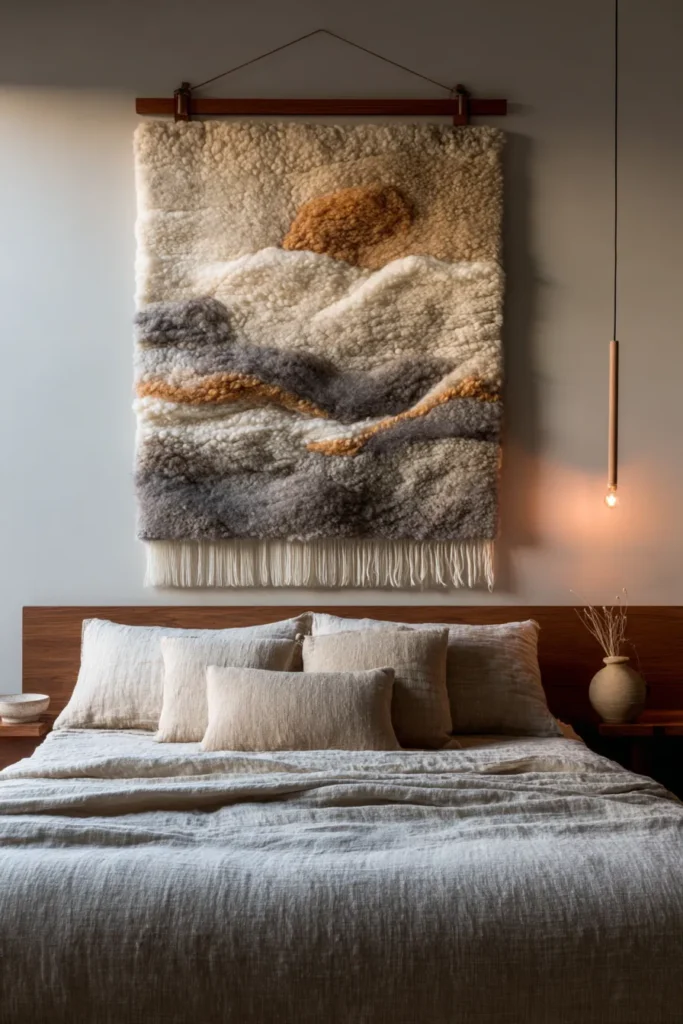
Woven wall hangings have evolved beyond macramé clichés into architectural textile sculptures. We’re talking 160gsm handwoven wool in gradient dye techniques—natural ivory bleeding into iron oxide grey—with dimensional depth created through varying weave densities. The best pieces have 8-12cm of relief, casting shadows that shift with daylight.
Designer’s Secret: Fiber art needs 2700K lighting specifically. Standard 3000K reveals every imperfection in natural fibers, while 2700K warm amber enhances the organic irregularities that make handwoven work valuable. Install a dimmer-controlled picture light 60cm above the piece, angled at 45 degrees.
Design Breakdown:
- Fiber type: Undyed wool, raw cotton, or jute (avoid synthetic blends that look flat under light)
- Weave density: Minimum 12 warp threads per inch for visual substance
- Mounting: Natural wood dowel (4cm diameter, raw or oiled walnut finish)
- Hanging method: Leather strap or waxed cotton cord—never wire
- Scale: Minimum 90cm wide to avoid looking like a decorative afterthought
Best For: Bohemian minimalists, bedrooms with hard surfaces (concrete, terrazzo) that need acoustic softening, and anyone allergic to the sterility of printed canvas.
4. Architectural Millwork Frame as Art
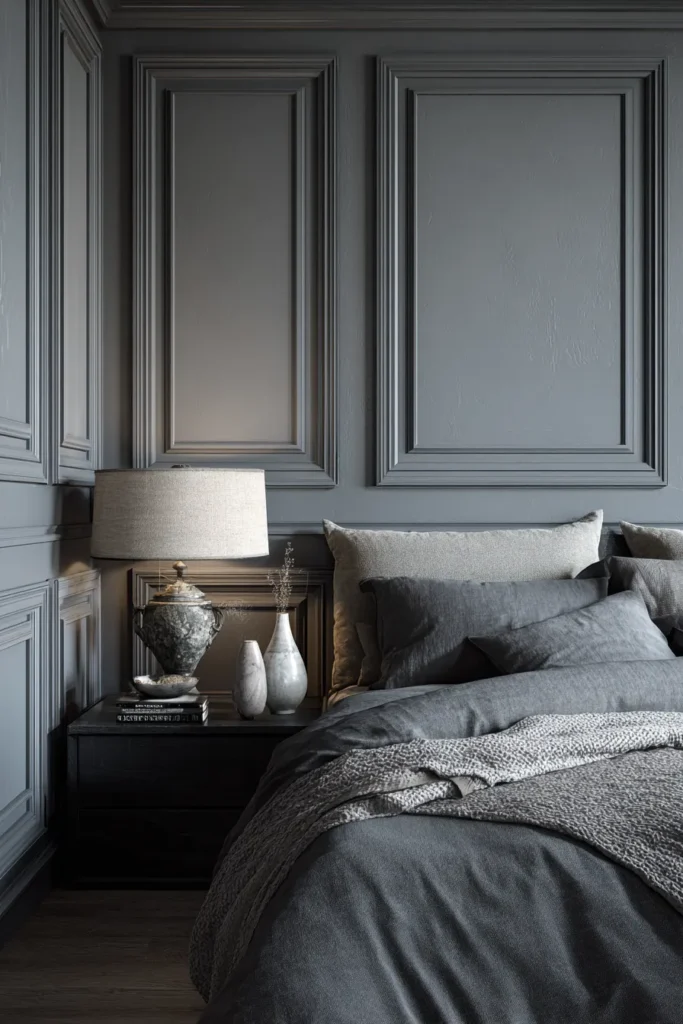
Why buy art when the wall itself becomes the artwork? Decorative paneling in 2026 uses engineered MDF with crisp router profiles—think 12cm wide frames with a subtle stepped reveal. Paint these panels two shades darker than your wall color (same hue family, different saturation) to create shadow-box depth without hanging anything.
The technique works because human eyes perceive dimensional change before color change. A panel set 2cm back from the wall plane creates intrigue even in monochromatic schemes.
Designer’s Secret: Always paint millwork in matte finish (5-10% sheen maximum) while keeping walls in eggshell (20-25% sheen). The reflectance differential makes the panels recede visually, creating a framed “window” effect that adds architecture to builder-grade bedrooms.
Design Breakdown:
- Panel dimensions: 140cm x 180cm vertical rectangle positioned 20cm above headboard
- Frame profile: 10-12cm wide flat stock with 6mm roundover edge
- Paint LRV: If walls are LRV 65 (light grey), paint panels at LRV 45 (medium grey)
- Installation depth: Router a 15mm rabbet to recess panel from wall surface
- Optional insert: Grasscloth wallpaper or Belgian linen fabric for texture
Best For: New construction with blank walls, bedrooms lacking architectural character, and perfectionists who want permanent “art” that never needs dusting.
5. Asymmetric Dual Canvas Pairing
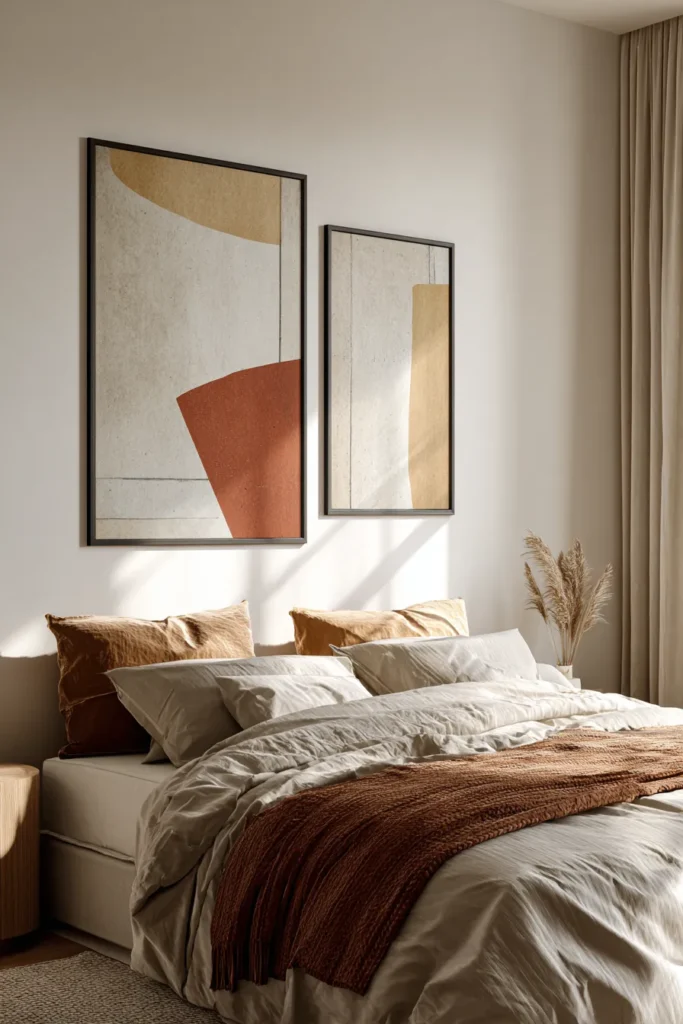
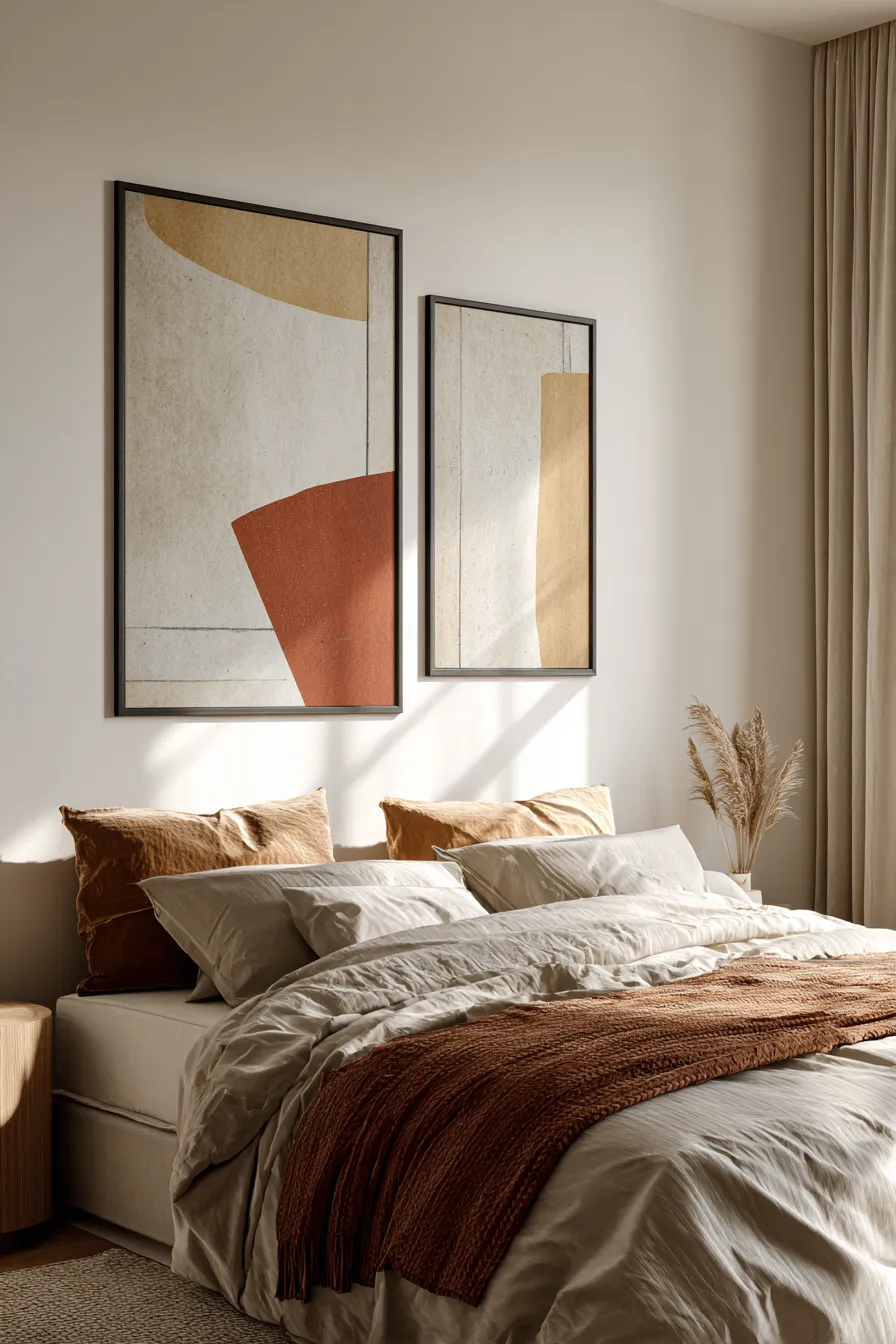
Two canvases of deliberately different sizes—hung at intentionally offset heights—create dynamic visual movement. The math matters: use a 2:3 size ratio (one 60cm x 90cm paired with 90cm x 135cm) and hang them with 15-20cm horizontal gap. Position the smaller canvas 8-10cm higher than the larger to create an ascending diagonal sight line.
Designer’s Secret: The common mistake is matching frame styles. Instead, pair a raw canvas wrap (no frame) with a slim black metal frame—the contrast in finish prevents the “matchy-matchy” look that screams amateur hour. Your eye reads them as intentional curation, not panic-bought set from a home goods store.
Design Breakdown:
- Size formula: Small canvas = 66% of large canvas dimensions
- Color relationship: Either tonal harmony (both warm neutrals) or chromatic opposition (one warm, one cool)
- Hanging height: Align the bottom edge of the higher piece with the top third of the lower piece
- Spacing: 15-20cm horizontal gap (never less than 12cm or more than 25cm)
- Subject matter: Abstract + representational (landscape or botanical) creates intellectual tension
Best For: Bedrooms with off-center headboards, anyone bored by symmetry, and spaces where architectural features (windows, doors) prevent centered placement.
6. Sculptural Metal Wall Relief
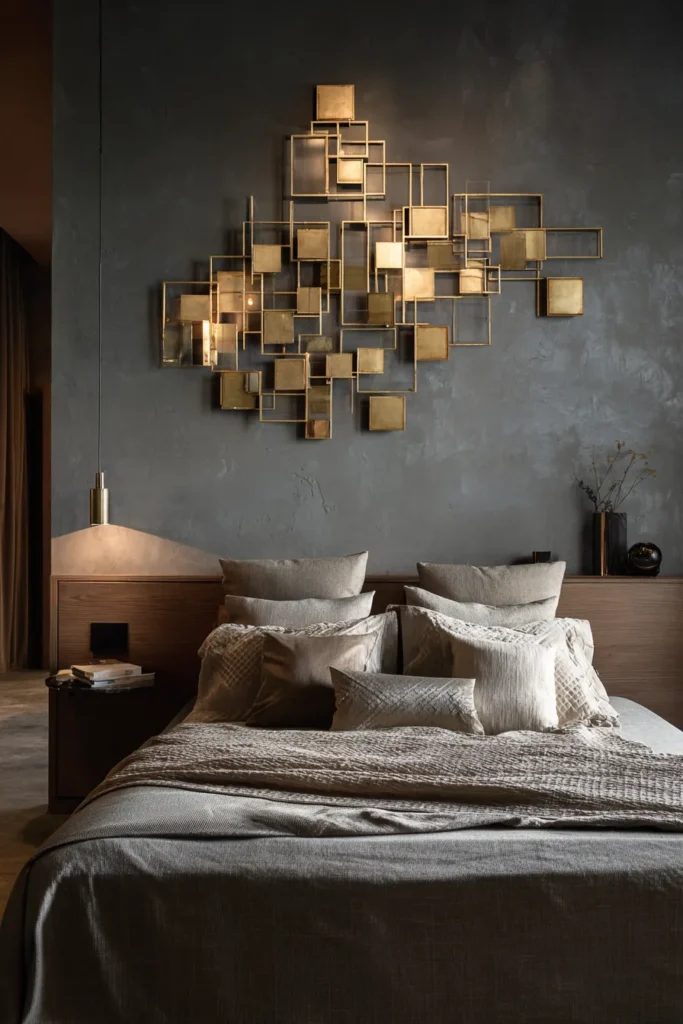
Three-dimensional metal art—whether laser-cut geometric patterns or hand-forged botanical forms—adds tactile luxury that flat prints cannot achieve. Unlacquered brass develops a living patina over months, shifting from bright gold to muted bronze. Blackened steel offers industrial contrast against soft textiles.
The depth is everything. Pieces should project 5-8cm from the wall to cast meaningful shadows. Under-lit from below or side-lit from adjustable track heads, these sculptures become ambient light fixtures themselves.
Designer’s Secret: Metal art needs wall color contrast to work. Against white walls (LRV 85+), choose blackened or dark patinated metals. Against charcoal walls (LRV 15-25), specify polished brass or brushed nickel. The reflectance differential should be minimum 40 LRV points or the sculpture disappears visually.
Design Breakdown:
- Metal finish: Unlacquered brass (develops patina), blackened steel (sealed), or brushed stainless
- Mounting: French cleat system for weights over 5kg (eliminates visible hardware)
- Scale: Minimum 80cm in any dimension to justify the visual weight of metal
- Lighting: LED strip concealed behind sculpture, or adjustable ceiling track at 45-degree angle
- Placement: 25cm minimum from headboard to prevent physical contact
Best For: Industrial-modern bedrooms, spaces with concrete or exposed brick, and collectors willing to invest in statement pieces ($800-2500 range).
7. Organic Woven Wall Hanging (Macramé Revival)
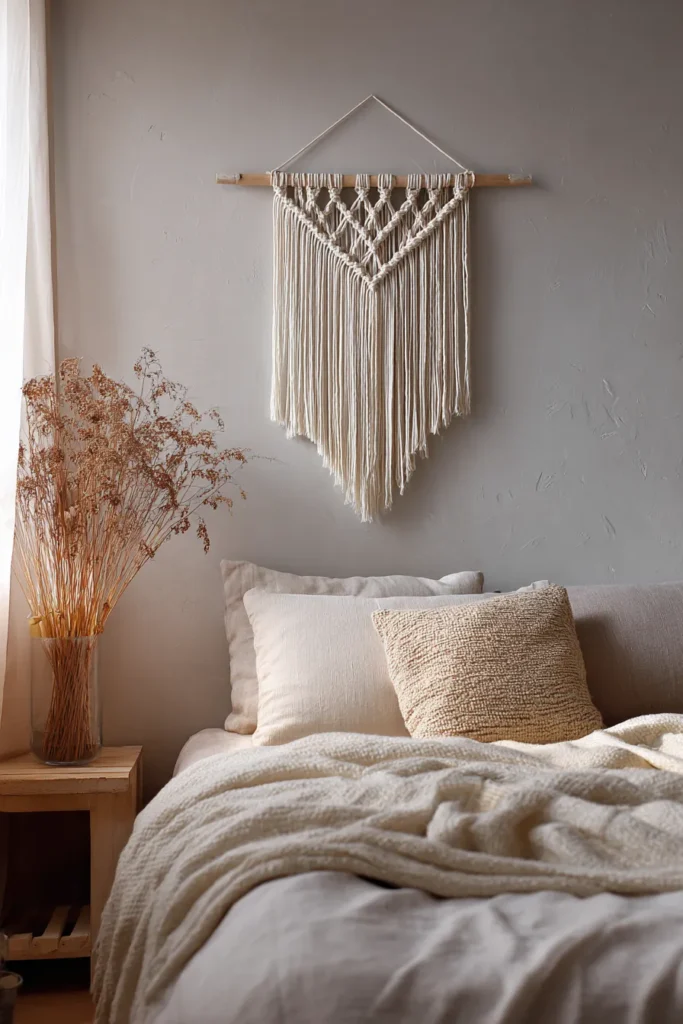
Contemporary macramé abandons the 1970s overly ornate knots for clean geometric patterns—square knotting in chunky 8mm cotton rope, minimal fringe, maximum negative space. The best examples use natural undyed fibers that showcase the rope’s inherent texture rather than fighting it with dye.
Designer’s Secret: Hang macramé minimum 35cm from the headboard, never directly touching. Natural fibers shed microscopic particles, and you don’t want cotton dust in your bedding. The gap also allows the piece to move slightly with air circulation, creating subtle kinetic interest.
Design Breakdown:
- Rope diameter: 6-8mm for sufficient visual weight (3mm reads as craft-store thin)
- Fiber: 100% cotton single twist or braided jute (avoid synthetic blends)
- Dimensions: Width should be 50-60% of bed width maximum (overscaled macramé overwhelms)
- Dowel: Natural wood 3-4cm diameter in raw oak, walnut, or eucalyptus
- Fringe length: Keep to 15-20cm maximum (excessive fringe looks dated)
Best For: Bedrooms with minimal textural variety, spaces dominated by smooth surfaces (painted drywall, glass, metal), and anyone seeking handmade authenticity over mass production.
8. Museum-Quality Photography Triptych
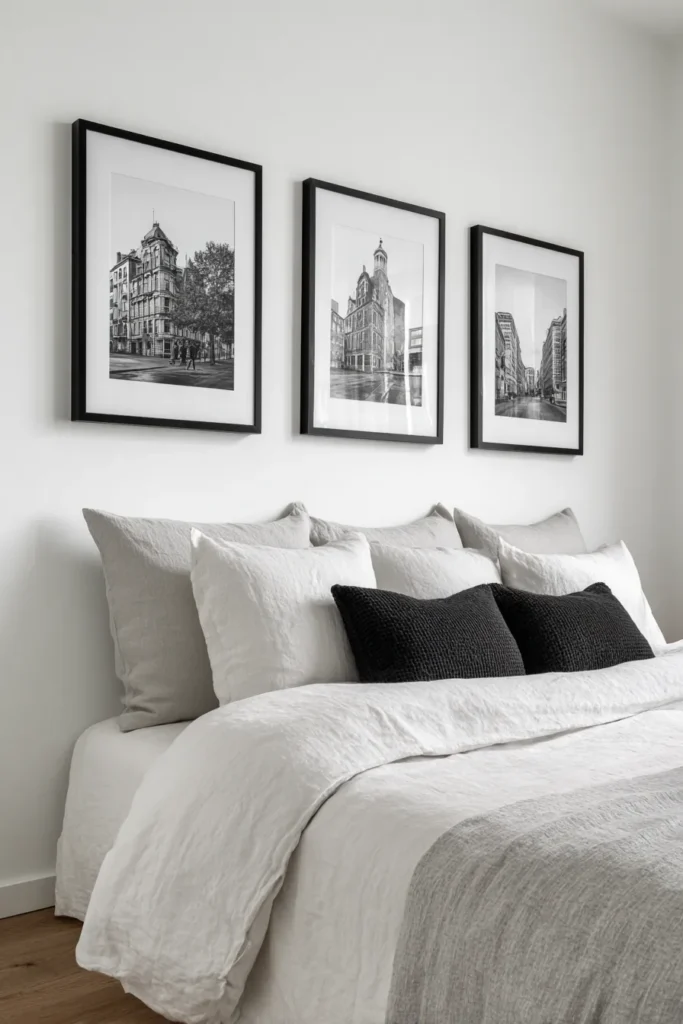
Three black-and-white photographs in identical frames, hung in perfect horizontal alignment, deliver editorial sophistication. The key is archival quality: gelatin silver prints on fiber-based paper, matted with acid-free 8-ply museum board, behind UV-filtering glass. This isn’t décor—it’s collecting.
Designer’s Secret: Mat width determines perceived value. Standard 5cm mats look budget. Museum standard is 10-12cm mats with a subtle reveal cut (the inner bevel) that creates dimensional depth. This single detail elevates a $200 print to look like a $2,000 gallery acquisition.
Design Breakdown:
- Frame: Solid hardwood (not MDF) in matte black or natural ash, 3cm profile width
- Mat board: 8-ply acid-free (2mm thick minimum), bright white or natural cotton rag
- Glass: Museum glass with 99% UV protection and anti-reflective coating
- Print size: 40cm x 50cm actual image with 10cm mat border = 60cm x 70cm framed
- Spacing: 8-12cm between frames (exact spacing, measured with laser level)
Best For: Photography enthusiasts, monochromatic bedroom schemes, and anyone who values archival permanence over trendy aesthetics. Works beautifully in minimalist Scandinavian or mid-century modern settings.
9. Reclaimed Architectural Fragment Display
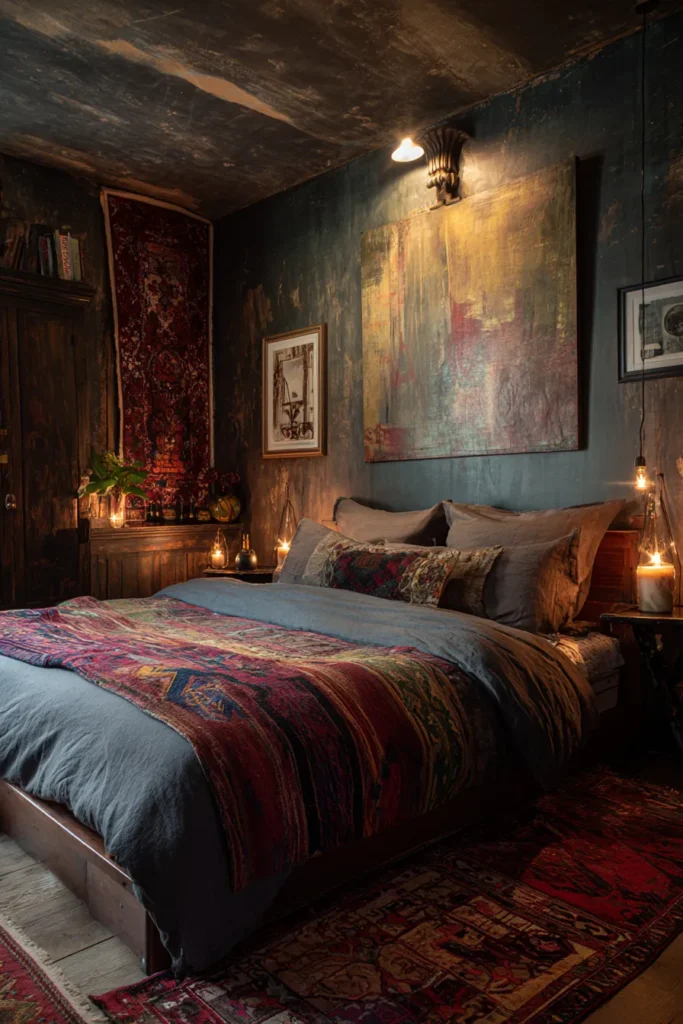
Antique corbels, salvaged window pediments, or sections of Victorian cast iron grillwork become three-dimensional art when mounted directly to the wall. Authenticity shows: look for genuine paint layering, wood grain depth, and proportions that indicate hand-craftsmanship rather than factory molds.
Designer’s Secret: Architectural fragments need “breathing room” around them—minimum 60cm of clear wall space on all sides. Crowding them with other décor ruins the artifact quality. Think museum exhibition, not flea market booth.
Design Breakdown:
- Sourcing: Architectural salvage yards, estate sales (verify authenticity through construction method)
- Mounting: Heavy-duty wall anchors rated for 3x the object weight (decorative corbels can be 8-12kg)
- Finish: Leave original patina intact—wire brushing to clean, but never stripping or repainting
- Scale: Minimum 50cm in largest dimension to read as intentional art, not random bric-a-brac
- Lighting: Single adjustable spotlight from above at 60-degree angle to emphasize dimensional carving
Best For: Restored historic homes, industrial lofts, and maximalist collectors who appreciate the narrative of salvaged materials. Not recommended for minimalist aesthetics.
10. Minimalist Line Drawing Series
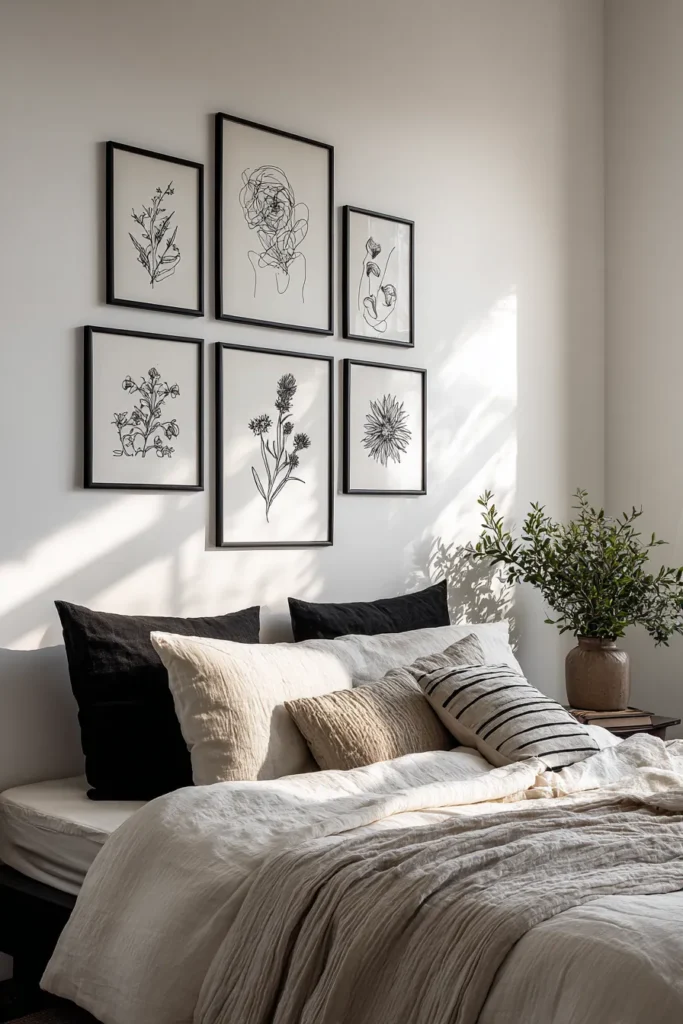
Four to six simple line drawings—faces, botanical stems, architectural sketches—in matching slim frames create a curated gallery without visual chaos. The drawings should be true pen-and-ink on quality paper stock (minimum 200gsm), not digital prints masquerading as hand-drawn work.
Designer’s Secret: Vary the line weight between pieces. Mix a bold 0.8mm ink drawing with delicate 0.3mm sketches—the contrast in mark-making creates visual rhythm even though subject matter is consistent. All-uniform line weights read as flat and digital.
Design Breakdown:
- Paper: Hot-press watercolor paper (200-300gsm) or smooth Bristol board
- Frame: Ultra-slim aluminum (8mm profile) in matte black or brushed brass
- Mat: Optional—these work beautifully edge-to-edge without mats for contemporary look
- Glass: Standard picture glass sufficient (not UV-filtering unless in direct sunlight)
- Grid layout: Two rows of three, with 10cm vertical and horizontal spacing
Best For: Small bedrooms where large art overwhelms, minimalist Japandi aesthetics, and budget-conscious designers (quality line drawings: $80-150 each vs. $800+ for original paintings).
11. Integrated Lighting Art Panel
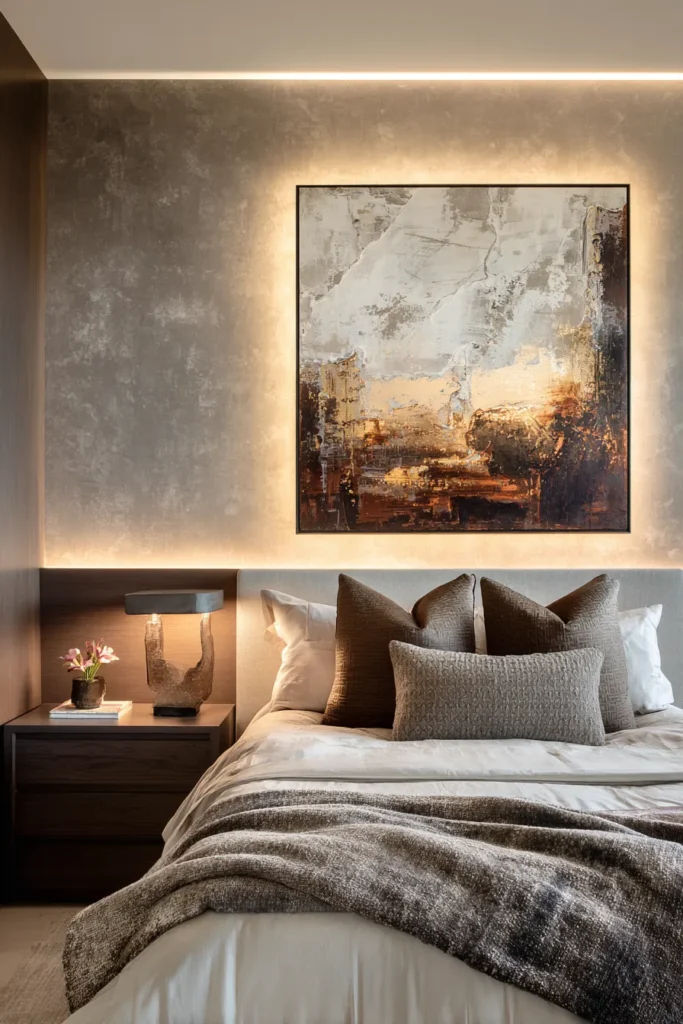
Backlit panels—whether frosted acrylic with etched patterns or translucent resin with embedded botanicals—function as both art and ambient lighting. Install LED strip lighting (2700K, dimmable) behind a 10mm frosted acrylic panel to create a glowing focal point that doubles as bedside reading light.
Designer’s Secret: The panel must be mounted minimum 3cm off the wall surface to allow LED light to wash evenly behind it. Flush-mounting creates hot spots where LEDs show through. Use aluminum spacer standoffs at each corner for precise depth control.
Design Breakdown:
- Panel material: 10mm frosted acrylic or 12mm resin pour (custom tinted)
- Lighting: 24V LED strip, warm white 2700K, minimum 600 lumens per meter
- Dimming: Smart dimmer with app control for color temperature adjustment
- Frame: Aluminum U-channel perimeter in black or brushed nickel to conceal edges
- Power: In-wall wiring during renovation, or surface-mounted cord with remote transformer
Best For: Tech-forward bedrooms, spaces lacking adequate ambient lighting, and anyone seeking multifunctional design solutions. Particularly effective in bedrooms with no overhead lighting.
12. Botanical Pressed Specimen Collection
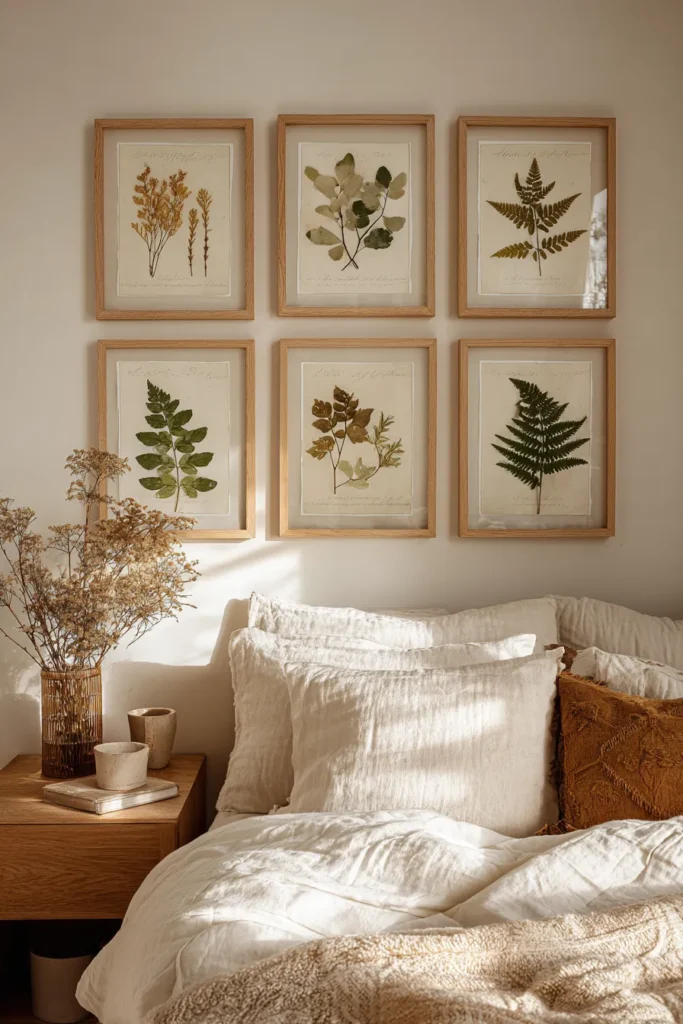
Pressed ferns, dried grasses, or vintage herbarium specimens under glass bring scientific curiosity into the bedroom. Mount these in matching frames—six to nine specimens in a grid—with handwritten Latin nomenclature labels for an apothecary aesthetic.
Designer’s Secret: Real pressed botanicals fade under UV light within 18 months. Always use UV-filtering conservation glass (99% UV protection) and position away from direct sunlight. Alternatively, commission high-resolution scans of antique herbarium sheets—visually identical, permanently stable.
Design Breakdown:
- Specimens: Real dried botanicals (pressed 4-6 weeks) or archival scans
- Backing: Acid-free mat board in natural linen or cream cotton rag
- Frame: Natural wood (light oak or ash) with minimal profile, 2cm width maximum
- Glass: UV-filtering conservation glass (non-negotiable for real specimens)
- Arrangement: Perfect grid with 6cm spacing between frames
Best For: Biophilic design enthusiasts, bedrooms with organic modern or farmhouse aesthetics, and spaces that need subtle color (faded greens, browns) without bold art.
13. Abstract Resin Pour Panel
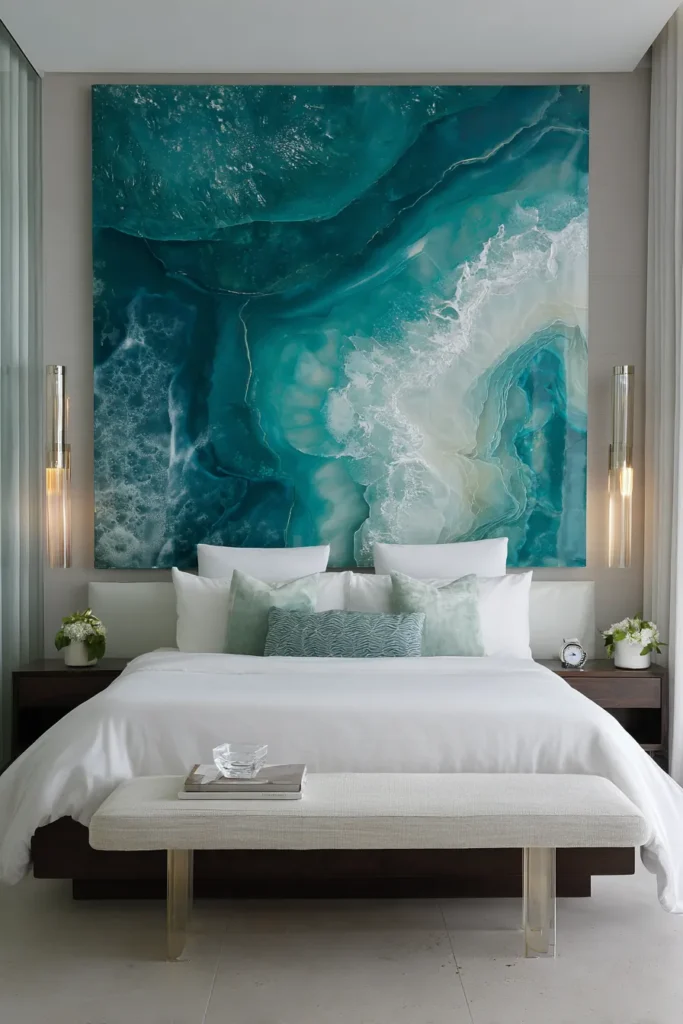
Custom resin art in ocean-inspired colorways—deep teal bleeding into seafoam, or slate grey marbling into champagne—creates depth that shifts with viewing angle. Quality resin work has 10+ translucent layers, creating dimensional depth you could fall into.
Designer’s Secret: Resin art needs specific lighting to work. Top-down lighting creates glare on the high-gloss surface. Instead, install two adjustable wall sconces 90cm to either side of the panel, angled at 30 degrees to graze light across the surface—this reveals the internal layers without reflective hotspots.
Design Breakdown:
- Panel size: 100cm x 150cm minimum (smaller pieces look decorative, not architectural)
- Resin layers: Minimum 8 layers for visual depth, 12-15 for luxury quality
- Finish: High gloss (emphasizes depth) or satin (reduces reflection in bright rooms)
- Mounting: French cleat or Z-bar system for panels over 10kg
- Color palette: Limit to 3 colors maximum—more reads as chaotic
Best For: Coastal bedrooms, modern spaces with minimal color elsewhere, and anyone wanting original art without commissioning a painter (resin artists: $600-1800 for custom work).
14. Vintage Mirror as Reflective Art
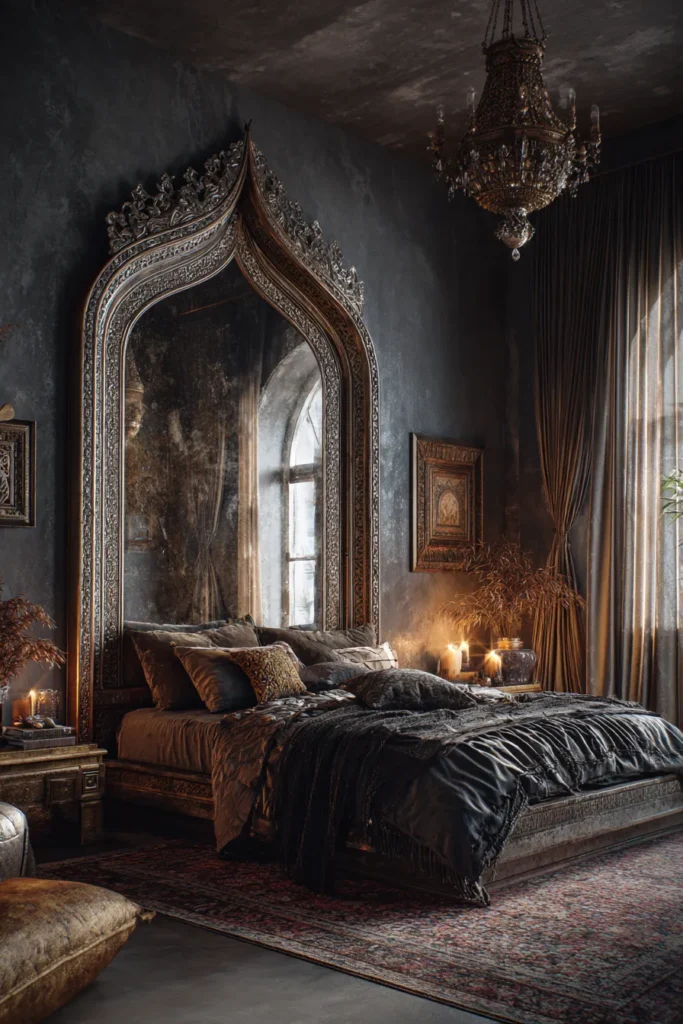
An oversized antiqued mirror—whether arched Moroccan brass, ornate French gilt, or simple industrial metal frame—amplifies light and visually expands the room while functioning as art. The patinated silvering (those dark spots where reflectivity has faded) is the value marker.
Designer’s Secret: Position mirrors to reflect something beautiful—a window, a chandelier, layered textiles—never just blank wall. The reflection becomes part of the composition. Measure sight lines from your bed: what you see in the mirror when lying down matters more than standing views.
Design Breakdown:
- Silvering: Look for authentic foxing (dark spots) in antique mirrors, not artificial distressing
- Frame material: Unlacquered brass develops verdigris, gilt shows wear authentically
- Size: Minimum 90cm in any dimension to function as focal point
- Hanging height: Bottom edge 20-25cm above headboard, not standard eye-level placement
- Lighting: Position table lamps or wall sconces where they reflect in the mirror for doubled light
Best For: Small bedrooms needing spatial expansion, dark rooms requiring light amplification, and vintage maximalists who layer eras confidently.
15. Commissioned Custom Mural Section
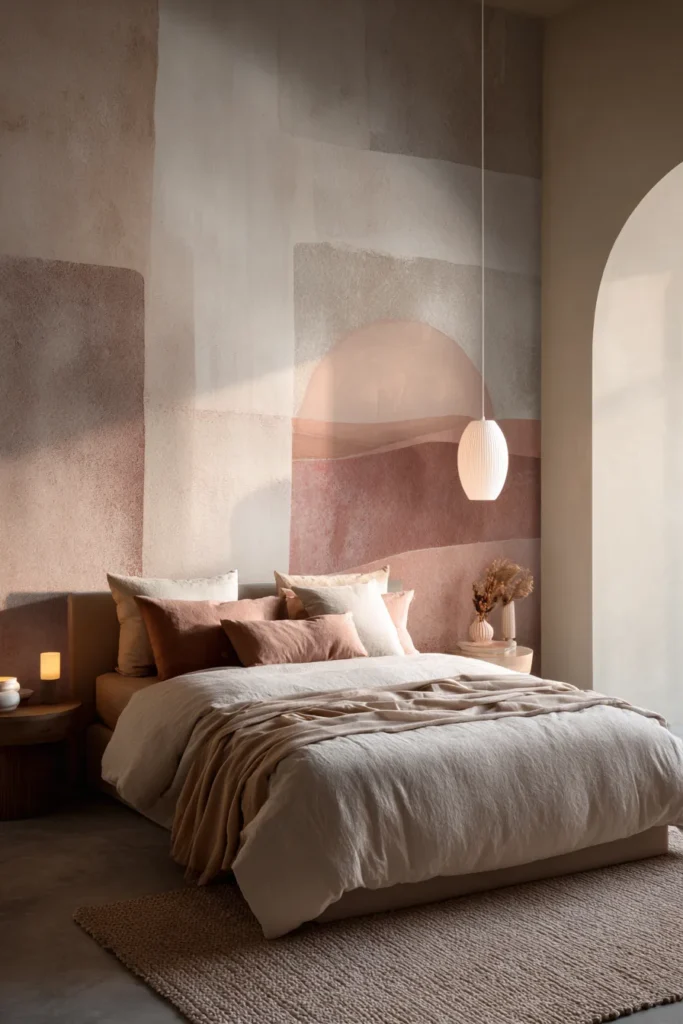
A single wall (or 2-3 meter section) painted with a custom mural—whether abstract color field, trompe-l’oeil architectural detail, or stylized landscape—becomes permanent art. Work with a muralist who uses low-VOC acrylic house paint, not craft paints, for durability.
Designer’s Secret: Protect murals with a matte clear coat sealer (Polycrylic or equivalent) in 2-3 thin coats. This allows gentle cleaning without damaging the painted surface—critical in bedrooms where dust accumulates. Most muralists skip this step; insist on it contractually.
Design Breakdown:
- Paint: Low-VOC acrylic in eggshell or satin finish (matte shows every wall imperfection)
- Wall prep: Prime with stain-blocking primer, then base coat in your lightest mural color
- Artist process: Provide digital mockup approval before paint touches wall
- Sealer: Water-based polycrylic in matte finish, 2 coats minimum
- Longevity: Expect 8-12 years before repainting needed (longer than most design cycles)
Best For: Homeowners committed to long-term residence, children’s bedrooms with thematic design, and anyone wanting truly one-of-a-kind spaces. Budget: $1200-4000 depending on complexity and artist rates.
Designer’s Warning: The Hanging Height Miscalculation
Common Mistake: Applying the universal “57 inches to center” rule in bedrooms destroys proper proportional relationships. This museum standard assumes viewers are standing and moving—you’re lying down 8 hours daily.
Correct Approach: Measure from your headboard top, not the floor. Add 15-20cm above your headboard for breathing room, then position your art so its visual center (not geometric center) sits at your eye level when propped up in bed reading. This typically means 40-50cm lower than standing gallery height.
For oversized art above king beds, ignore center-height entirely. The bottom edge should sit 15cm above the headboard—this creates architectural unity between furniture and art, preventing the “floating in space” effect that happens when you measure from the floor.
The 2026 Bedroom Wall Art Shift
What drives these changes isn’t aesthetic whimsy—it’s cultural recalibration. Post-pandemic living revealed that bedrooms function as remote offices, meditation zones, and creative studios, not just sleep chambers. Art must work harder: calming circadian-appropriate color temperatures, biophilic natural materials that reduce stress, and negative space that allows visual rest.
The sustainability imperative pushes natural fibers over synthetic prints, vintage finds over mass production, and commissioned local artisans over dropshipped canvases. Light sensitivity awareness—how 3000K cool white disrupts melatonin production—means designers now specify art and lighting as integrated systems, not separate purchases.
Most significantly, 2026 buyers reject the “fully decorated” aesthetic. Bare wall sections aren’t unfinished—they’re intentional breathing room, recognizing that visual overwhelm contributes to anxiety. The new luxury is restraint: one perfect piece over a wall of mediocre attempts.
Choose art that serves your nervous system, not your Instagram feed. The bedroom that photographs well but agitates you nightly is beautiful failure. The one that makes you exhale when you enter—even if bare by design magazine standards—is success.