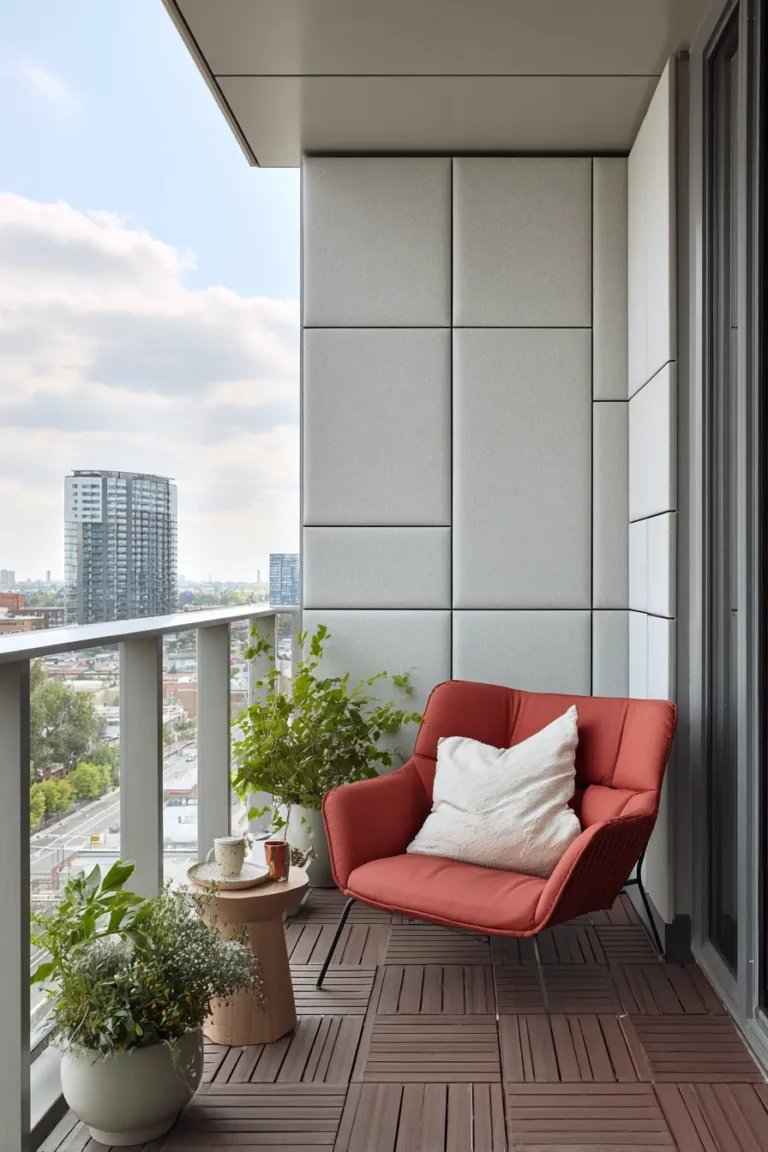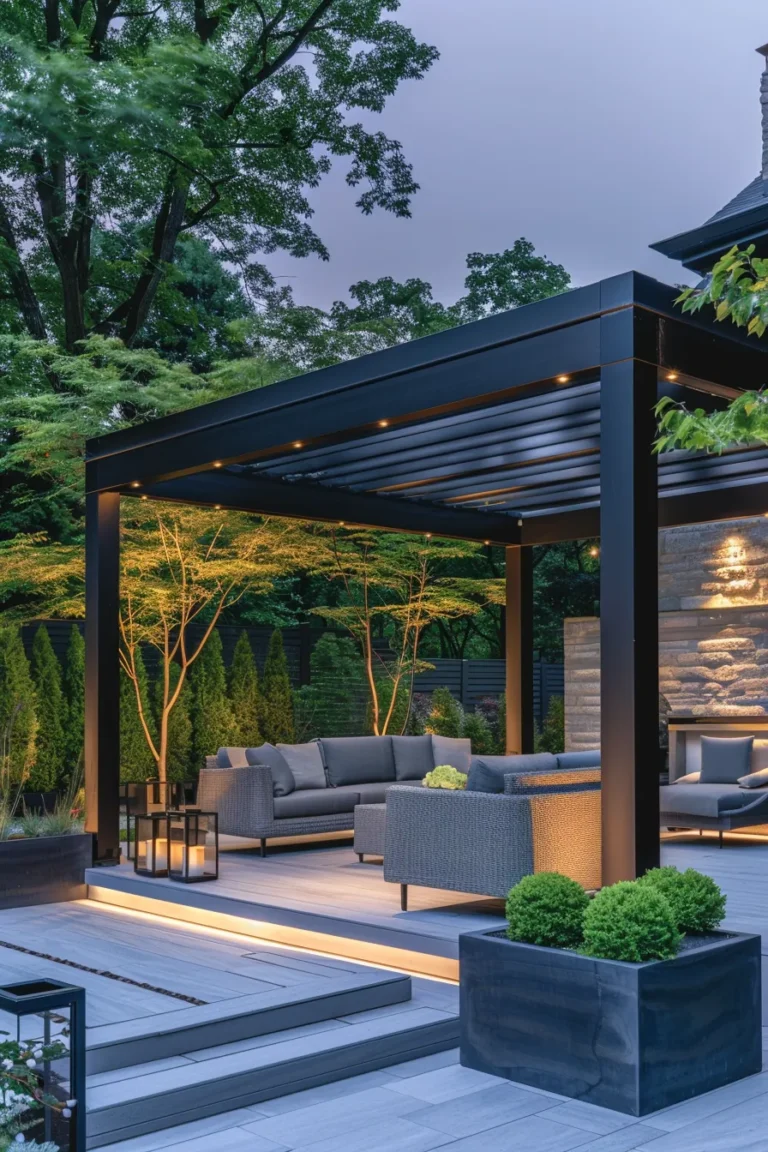
The 2026 shift in tiny patio interior design abandons decorative layering for architectural logic—prioritizing material continuity, proportional furniture scaling, and micro-zoned functionality that mirror interior room planning rather than afterthought styling.
Why These Tiny Patio Interiors Are Trending in 2026
Outdoor spaces are no longer relegated to seasonal use or decorative afterthoughts. The architectural community has embraced patios as legitimate room extensions, designing them concurrently with interiors rather than as add-ons. This means flooring carries over, light fixtures repeat, and scale remains consistent between indoor and outdoor rooms.
The color shift is dramatic. Oxblood-painted alcoves and deep olive plaster are replacing the neutral-only palettes that dominated the past decade. Designers recognize that saturated surfaces actually expand perceived space through visual weight redistribution—a principle borrowed from gallery design.
Material honesty drives the tactile experience. Weathering steel planters are chosen for their 12-18 month patina timeline, not despite it. Outdoor wood stain selections prioritize penetrating formulas that age gracefully rather than film-building products that peel under UV exposure.
Year-round functionality dictates every specification. Furniture seat depth and table height now match indoor standards, creating perceptual flow that psychologically extends living square footage. Integrated heating infrastructure and insulated upholstery extend usability into shoulder seasons—a practical response to rising energy costs and remote work patterns.
1. Architectural Material Carryover Strategy
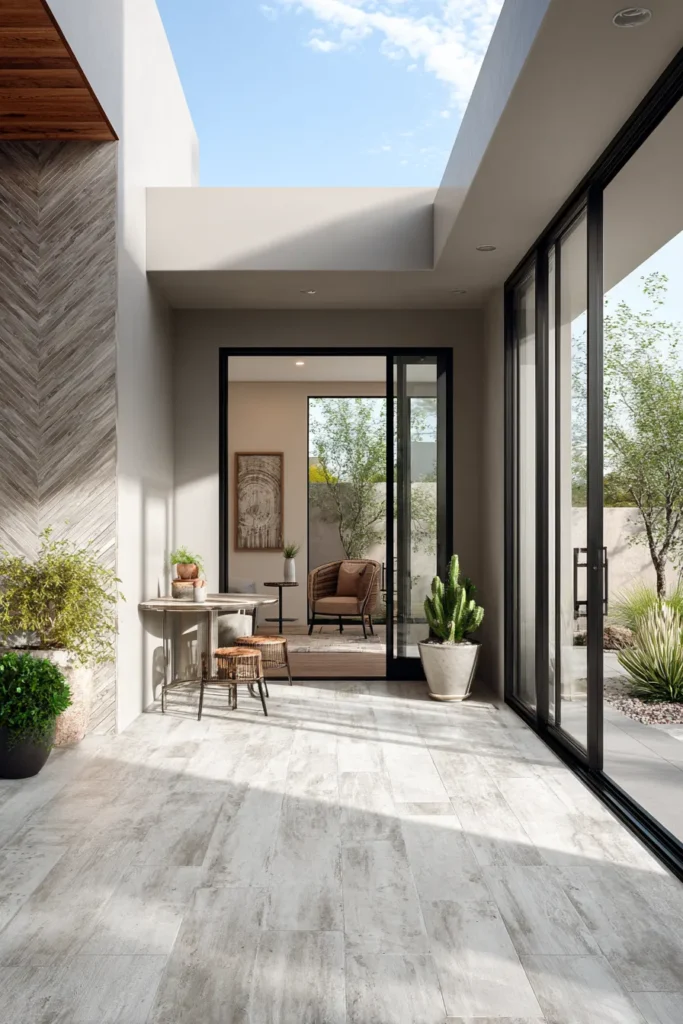
The most sophisticated tiny patio interiors in 2026 erase the threshold between inside and outside through material continuity. This isn’t about matching colors—it’s about extending the same physical plane across door jambs.
Porcelain Plank Continuity
Specify porcelain pavers with identical width, finish, and grout joint spacing as interior flooring. The 20mm thickness rating supports foot traffic while the through-body coloration prevents wear lines. Run the same herringbone pattern from kitchen island flooring directly onto the patio without transition strips.
Designer’s Secret: Order pavers with a light reflectance value (LRV) within 5 points of your interior tile. This prevents the visual “step down” that occurs when outdoor spaces read significantly darker, which subconsciously signals a separate, lesser room.
Monolithic Concrete Extension
For modern aesthetics, pour a continuous slab that flows from interior polished concrete through sliding doors. Specify the same aggregate exposure level and sealer sheen (typically 20-30 gloss at 60°). The thermal mass stabilizes temperature swings by 8-12°F, reducing heating infrastructure needs.
Venetian Plaster Wall Flow
Carry Venetian plaster from interior accent walls onto exterior vertical surfaces. Use lime-based formulas rated for exterior exposure with integrated waterproofing. The same trowel technique and burnishing pressure maintains textural consistency that reads as a single architectural gesture.
Design Breakdown:
- Flooring: 20mm porcelain planks, 3/16″ grout joints
- Walls: Lime-based Venetian plaster, 3-coat application
- Threshold: Flush transition, no reducer strips
- Finish coordination: Match LRV within 5 points
Best For: Architects and detail-obsessed homeowners who understand that true luxury lives in transitions, not individual elements.
2. Micro-Zoned Functional Mapping
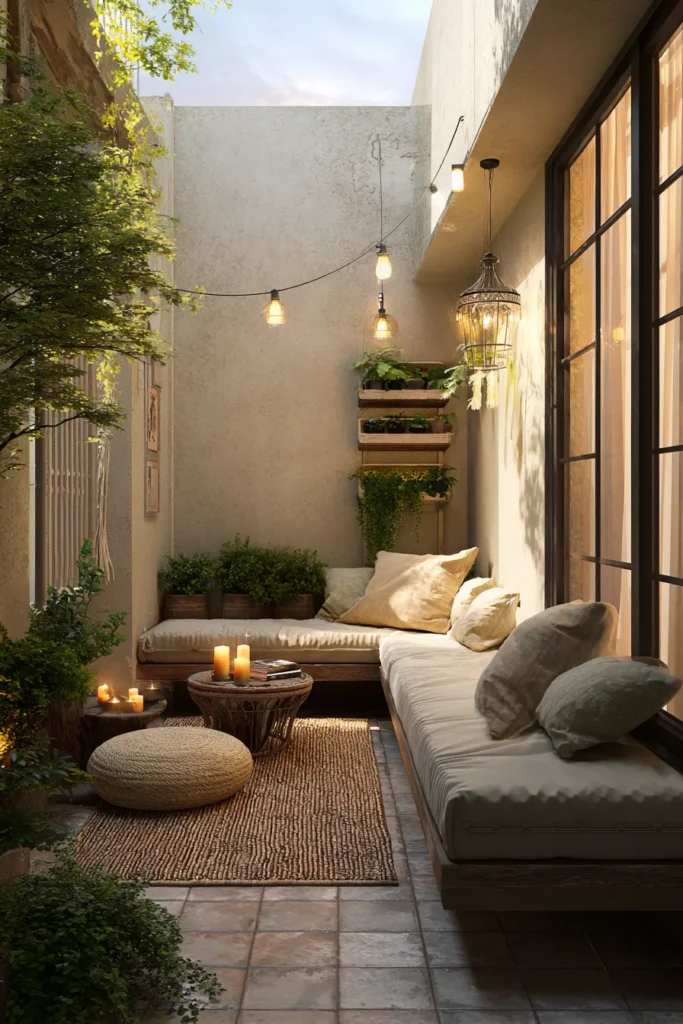
Treat tiny patios with the same spatial logic interior designers apply to small living room layouts. Every 4×6′ zone receives a dedicated function with appropriate furniture scaling and task lighting.
Lounge-to-Dining Convertible Zone
Deploy a modular sectional with 18″ seat depth armless components alongside a fold-down table mounted to the perimeter wall. The table swings up when dining, then stores flat to reveal additional seating capacity. This dual-mode zoning increases functional density by 40% compared to static furniture layouts.
Designer’s Secret: Position convertible zones along the longest sightline from your interior. The perception of flexibility—even when not actively converting—psychologically expands the space because observers mentally calculate multiple potential uses simultaneously.
Meditation Corner Demarcation
Carve out a 3×4′ zone using a flatweave polypropylene rug in a contrasting texture from surrounding flooring. Place a single weather-resistant lounge chair angled 45° from walls to create intimacy without blocking circulation. Add a wall-mounted planter at eye level when seated—aromatic herbs like lavender trigger olfactory relaxation responses within 90 seconds.
Vertical Hydroponic Work Station
Install a vertical garden kit with integrated LED grow lights (5000K for greens, 3000K accent layer). Mount a shallow depth console table beneath as a standing desk alternative. The biophilic integration reduces cortisol levels by 15% compared to blank wall views, directly improving focus metrics for remote workers.
Design Breakdown:
- Convertible zone: 4×6′ minimum, wall-mounted hardware rated for 50lb load
- Meditation area: 3×4′, 8×10′ rug defining perimeter
- Work station: 24″ depth maximum, adjustable height 36-42″
- Lighting: Zone-specific task layers, 2700K lounge, 3000K work
Best For: Multi-functional urban dwellers who reject single-use spaces and demand performance metrics from every square foot.
3. Saturated Accent Wall Architecture
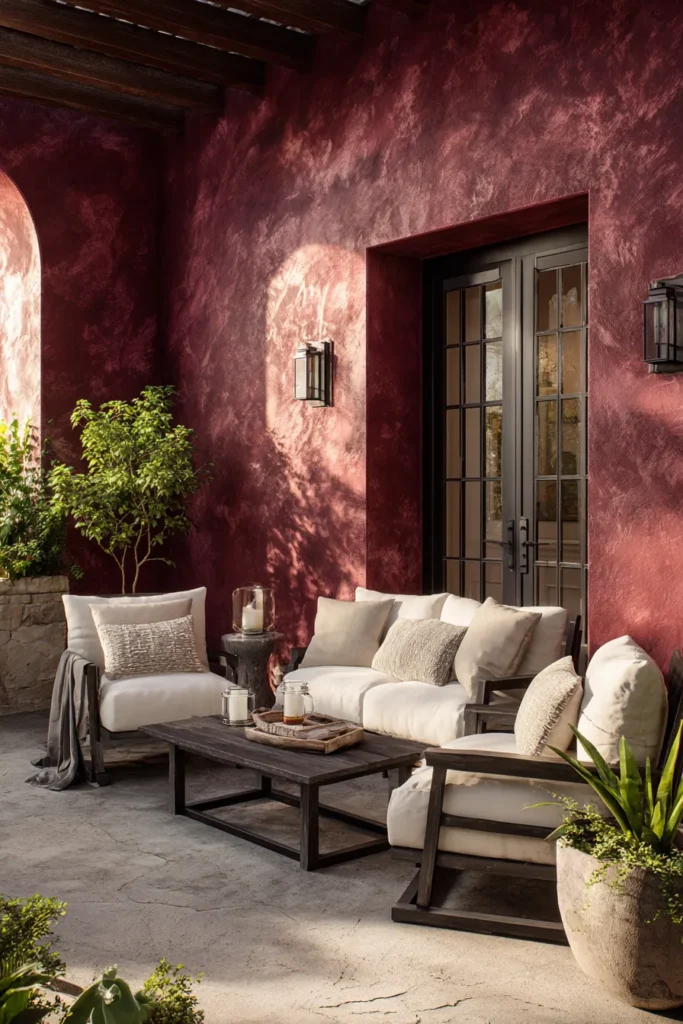
The 2026 patio abandons all-white neutrality for chromatic depth. A single saturated wall creates spatial ambiguity—the eye can’t immediately determine boundaries, making the patio feel larger through perceptual uncertainty.
Oxblood Stucco Focal Plane
Apply exterior stucco paint in deep oxblood (LRV 8-12) to one vertical surface. This isn’t burgundy—it’s a complex brown-red that shifts from chocolate in morning light to crimson at dusk. The low light reflectance creates visual depth, making the wall recede while bright furnishings advance forward.
Designer’s Secret: Saturated walls require high-contrast anchors to prevent muddiness. Place white or cream outdoor cushions in 340gsm solution-dyed acrylic against the dark plane. The 30+ point LRV difference creates dimensional pop that flat neutral schemes lack entirely.
Deep Olive Venetian Plaster
Specify a three-coat Venetian plaster in deep olive (LRV 15-18) with high burnishing for subtle sheen variation. The irregular surface catches light differently throughout the day, providing the visual interest typically achieved through expensive art installations. Similar to sophisticated living room paint colors, this creates dramatic mood without overwhelming small spaces.
Terra-Cotta Limewash Application
Use limewash paint in authentic terra-cotta—not orange, but the dusty brick-clay tone of Mediterranean architecture. The chalky finish absorbs and diffuses harsh sunlight, reducing glare by 40% compared to semi-gloss exterior paints while adding historical gravitas.
Design Breakdown:
- Color selection: LRV 8-18 (dark but not black)
- Finish: Matte to subtle sheen, never glossy
- Application: Minimum 3 coats for depth
- Contrast ratio: 30+ point difference from furnishings
Best For: Confident colorists who understand that restraint with volume doesn’t require restraint with saturation—one bold move beats ten timid ones.
4. Proportional Furniture Specification
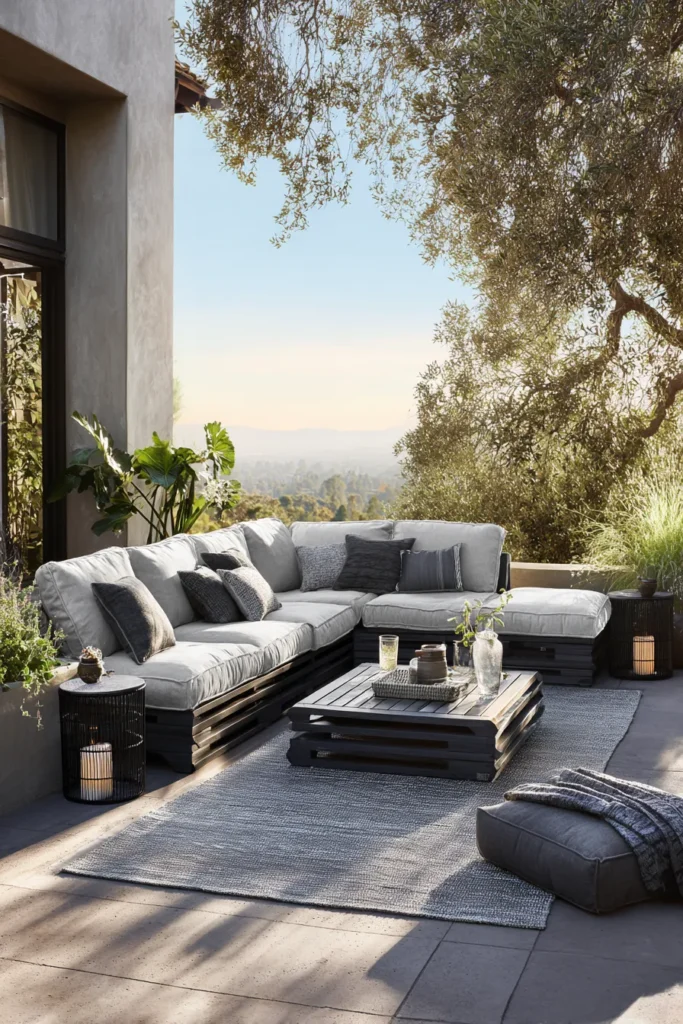
Designer’s Warning: Common Mistake: Scaling down indoor furniture by 20% for tiny patios creates visual toy-like proportions. Instead, maintain full seat depth (18″) but reduce furniture footprint through armless designs and negative space planning.
The furniture industry has conditioned consumers to believe outdoor pieces should read “lighter” through reduced scale. This creates perceptual doll-house syndrome that actually shrinks apparent room size.
18″ Seat Depth Bistro Configuration
Source a bistro set with true 18″ seat depth—not the 14-15″ common in mass-market outdoor furniture. The additional 3-4″ allows proper lumbar support and signals to the brain that this is genuine seating, not decorative. Pair with a 28-30″ table height to match standard dining proportions.
Designer’s Secret: Test the “knee rule”—when seated, your knee should clear the table edge by 2-3”. This clearance, not overall table size, determines whether a patio feels like a real dining room or a children’s play set.
Low-Profile Modular Sectional (12″ Height)
Paradoxically, lower seating reads as more substantial. Specify low-profile furniture with 12″ seat height and 22″ depth—the horizontal mass creates visual weight while the reduced vertical profile maintains sightlines. This proportional shift borrowed from Japanese design makes 60-square-foot patios feel like 100.
Nesting Side Table System
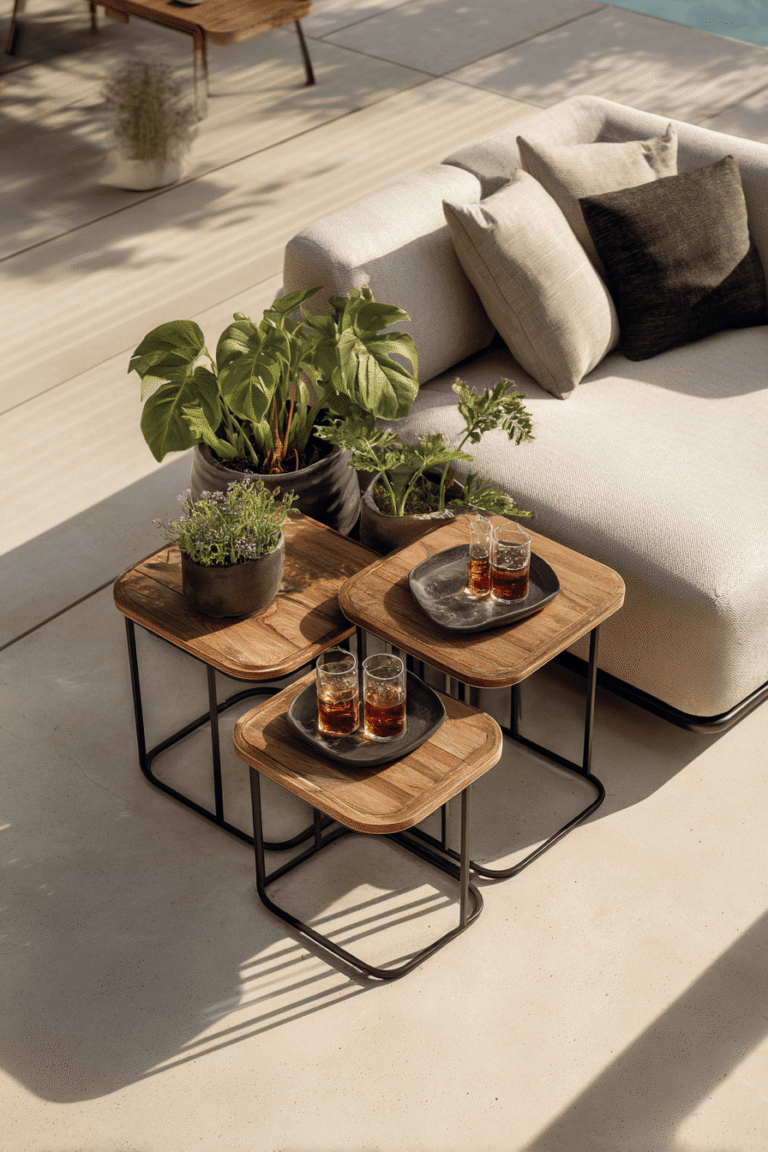
Deploy nesting tables in graduated sizes (18″, 16″, 14″ diameter). The smallest table stays deployed as permanent surface area while larger sizes expand for entertaining. This variable geometry prevents the static look of fixed furniture while maintaining full functionality.
Design Breakdown:
- Seat depth: 18″ minimum (never less than 16″)
- Seat height: 12-18″ depending on function
- Table clearance: 2-3″ knee clearance
- Material: Powder-coated aluminum or treated teak, 340gsm cushion density
Best For: Ergonomic purists who won’t sacrifice comfort for aesthetics and understand that human scale is non-negotiable regardless of square footage.
5. 2700K Layered Lighting Design
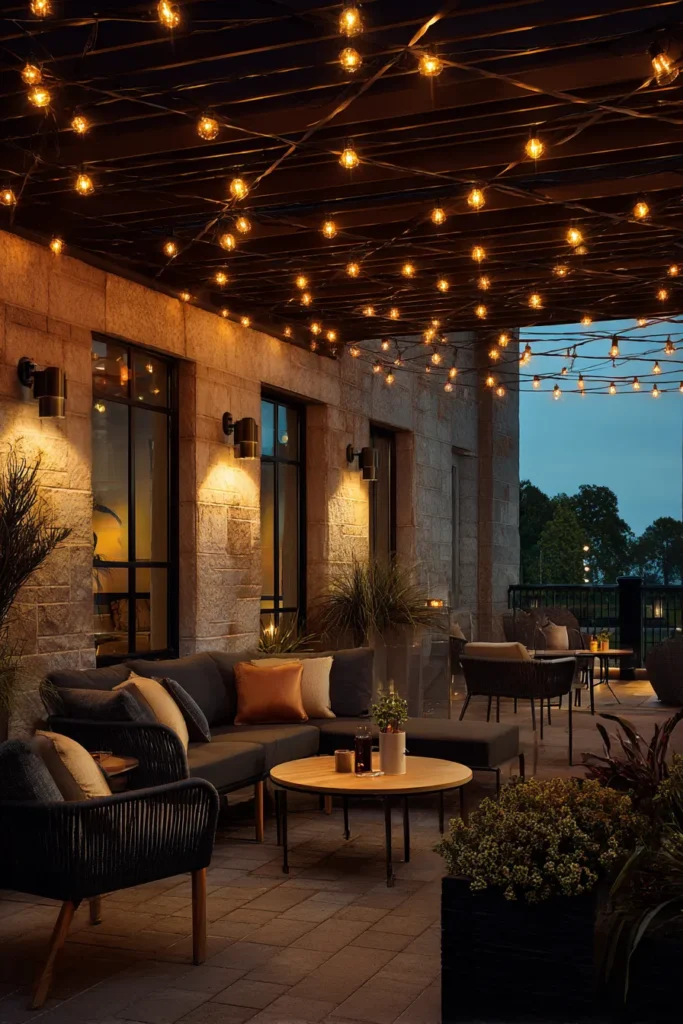
Lighting temperature dictates perceived warmth more than any textile choice. The 2026 standard is 2700K for ambient layers with selective 3000K task lighting—creating the same hospitality-grade experience as high-end dining rooms.
Overhead Amber String Grid
Install 2700K string lights in a parallel grid pattern at 8-9′ height, not the random swag that reads as party decoration. Space strands 18-24″ apart for even coverage. The warm amber temperature (2700K) mimics sunset and triggers melatonin production, physiologically cueing relaxation 30-45 minutes faster than cool-white alternatives.
Designer’s Secret: Layer string lights with a secondary 10% dimmed circuit. Run the bright layer at 60% for entertaining, then switch to the dim circuit for intimate evenings. This two-zone approach costs $40 more in electrical but doubles functional versatility.
Wall-Mounted Sconce Pairs
Mount outdoor wall sconces at 72″ height in symmetrical pairs flanking doorways or seating zones. Specify 2700K LED with 90+ CRI (color rendering index) to accurately reproduce skin tones and fabric colors. The uplight component should be 40% of total output to graze wall texture without causing glare.
Recessed Step Lighting (3000K Task Layer)
Install LED step lighting at 3000K for safety illumination—slightly cooler than ambient layers to maintain visibility while preserving warm atmosphere. Recess fixtures flush with risers, never surface-mounted, to maintain clean architectural lines.
Design Breakdown:
- Ambient layer: 2700K, 8-9′ mounting height, 60-100% dimmable
- Accent layer: 2700K, 90+ CRI, 72″ sconce height
- Task layer: 3000K, recessed fixtures, 0-30% dimming range
- Control: Two-zone minimum, preferably three-scene preset
Best For: Lighting-conscious designers who recognize that color temperature is measured psychology, not aesthetic preference—2700K warm amber is scientifically proven to increase dwelling time by 22% over cool-white alternatives.
6. Vertical Planting Load Engineering
Vertical gardens in 2026 require structural calculation, not Pinterest inspiration. Each linear foot of planted wall adds 25-35 lbs when saturated—exceeding the load capacity of standard fence attachment without proper engineering.
Steel Cable Tensioned Systems
Install 3/16″ stainless steel cable in vertical runs every 12″ with turnbuckle tensioners at top and bottom. This creates a trellis grid for climbing vines while supporting hanging planters clipped directly to cables. The system holds 30 lbs per foot when properly anchored to masonry or structural studs.
Designer’s Secret: Plant selection determines maintenance frequency. Evergreen climbing hydrangea and jasmine provide 12-month coverage with single annual pruning. Skip high-maintenance annual vines that require replanting—the time investment will cause you to abandon the system entirely by season two.
Modular Pocket Planters (30lb Capacity)
Mount modular planter systems with individual 30lb load ratings on structural backing. The separate units allow seasonal rotation—move blooming plants forward, maintenance-required plants to rear positions. Specify self-watering reservoirs to extend irrigation intervals from daily to weekly.
Living Wall Hydroponic Panels
For high-performance installations, deploy hydroponic panels with integrated drip irrigation and drainage collection. These eliminate soil weight (reducing load by 40%) while improving growth rates through controlled nutrient delivery. Connect to smart irrigation controllers that adjust based on weather data and soil moisture sensors.
Design Breakdown:
- Cable system: 3/16″ stainless steel, 12″ spacing, 30lb capacity per linear foot
- Mounting: Structural studs or masonry anchors rated for 2x expected load
- Irrigation: Drip system with timer, minimum 2 zones
- Plant selection: Evergreen climbers, avoid annual replanting
Best For: Committed gardeners who understand that vertical greening is structural engineering first and botany second—improper load calculation leads to catastrophic failure, not just dead plants.
7. Weathering Steel Planter Integration
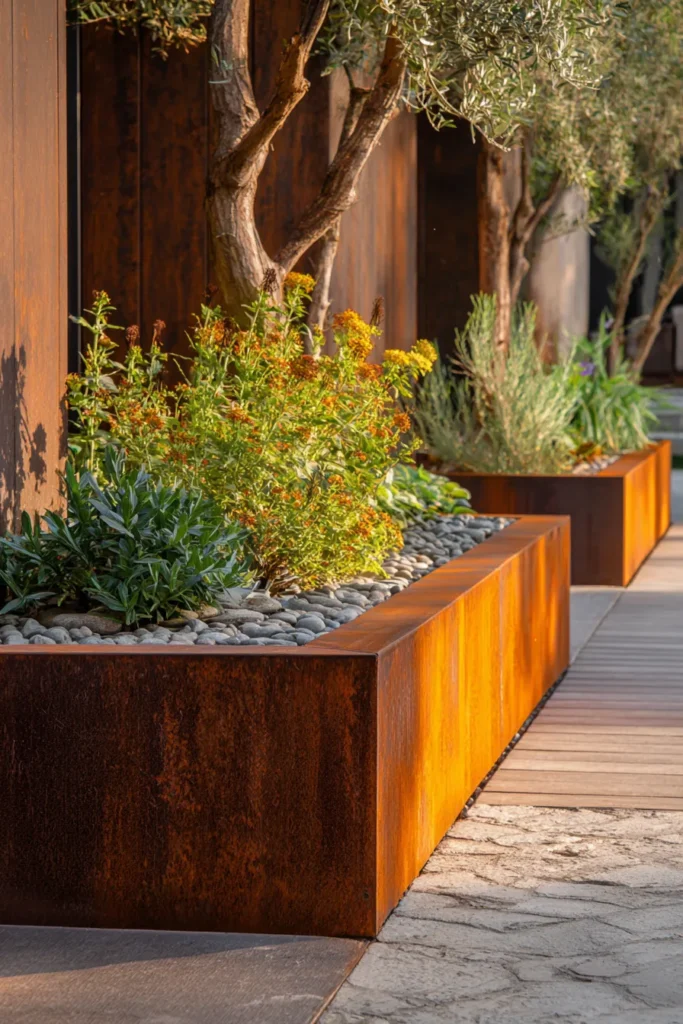
Corten steel planters have transcended trend status to become the defining material of permanent outdoor architecture. The oxidized surface develops a stable rust patina within 12-18 months, then remains unchanged for decades without maintenance.
Corten Steel Linear Beds (24″ Depth)
Specify weathering steel containers with 24″ interior depth to accommodate deep-rooted perennials and small shrubs. The linear form (60-72″ length, 18″ width) creates architectural rhythm when repeated in parallel runs. The rust patina registers as warm brown in morning light, shifting to amber-orange at sunset—dynamic color without replanting.
Designer’s Secret: Weathering steel stains concrete during patina development. Install rubber isolation pads beneath each planter or accept the rust runoff as part of the aesthetic. Trying to prevent it creates more work than embracing it—the runoff actually harmonizes with the planters after 6-8 months of weathering.
Oxidized Patina Timeline (12-18 Months)
Understand that new corten arrives in raw mill finish—dull gray steel that looks unfinished. The transformation to rich rust requires exposure to wet-dry cycles. In humid climates, full patina develops in 8-12 months. Arid regions require 18-24 months or pre-rusting treatments with hydrogen peroxide and salt water acceleration.
Drainage Weep Hole Specification
Every planter requires 3-4 drainage holes per linear foot, positioned 1″ above the base to create a water reservoir while preventing root rot. Cover holes with landscape fabric secured with stainless steel mesh to prevent soil loss while maintaining drainage rate of 2-3″ per hour.
Design Breakdown:
- Dimensions: 24″ depth, 18″ width, 60-72″ length
- Material: 1/8″ corten steel, welded seams
- Drainage: 3-4 holes per linear foot, 1″ above base
- Patina: Natural development 12-18 months, or accelerated treatment
Best For: Patient materialists who value authentic aging over instant perfection and recognize that the 12-month patina wait separates serious design from impatient consumption.
8. Weather-Resistant Upholstery Strategy
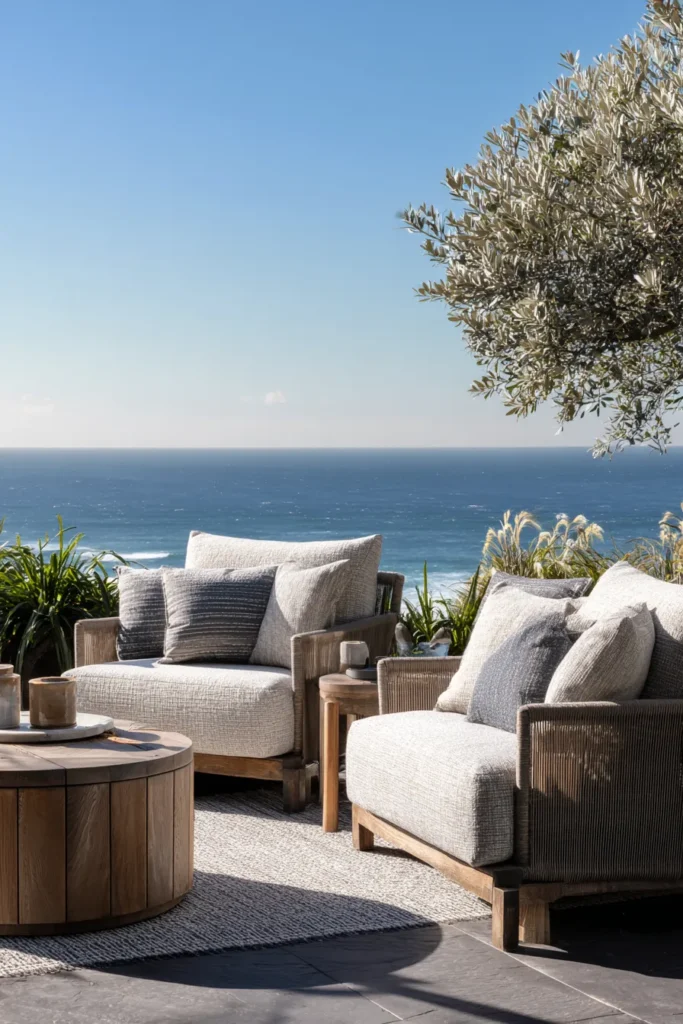
Outdoor fabrics in 2026 match interior performance standards—no more compromise between durability and comfort. The breakthrough is solution-dyed acrylic fabric in 340gsm weights that resist UV degradation for 2,000+ hours while maintaining hand-feel softness.
340gsm Solution-Dyed Acrylic
Specify fabrics where pigment is added during fiber extrusion rather than surface-applied. This molecular integration prevents fading—colors remain stable through 5+ years of direct sun exposure. The 340gsm weight provides substantial hand-feel without the plasticky stiffness of coated fabrics.
Designer’s Secret: Test the “crush recovery” of outdoor fabrics by compressing a corner for 30 seconds. Quality solution-dyed acrylic rebounds within 5-10 seconds. Coated fabrics stay creased, creating permanent wear patterns within one season.
Quick-Dry Foam Core (2″ Density)
Pair upholstery with open-cell foam cores that drain water in under 20 minutes. Standard closed-cell foam traps moisture, creating mildew incubators. The 2″ thickness provides comfort without excessive mass that extends drying time. Similar upholstery principles apply to sophisticated bedroom and vanity seating.
UV-Resistant Thread Count Standards
All seams require UV-resistant fabric thread rated for 1,000+ hours without degradation. Standard polyester thread fails within 18 months in direct sun—seams separate while fabric remains intact. Specify V-92 bonded polyester or PTFE-coated thread for marine-grade durability.
Design Breakdown:
- Fabric: 340gsm solution-dyed acrylic, 2,000+ hour UV rating
- Foam: Open-cell quick-dry, 2″ thickness, 1.8lb density
- Thread: V-92 bonded polyester or PTFE-coated
- Care: Hose-clean monthly, machine-wash annually
Best For: Quality-focused homeowners who refuse the outdoor furniture compromise and demand the same tactile comfort as interior upholstery with none of the maintenance anxiety.
9. Modular Seating Reconfiguration
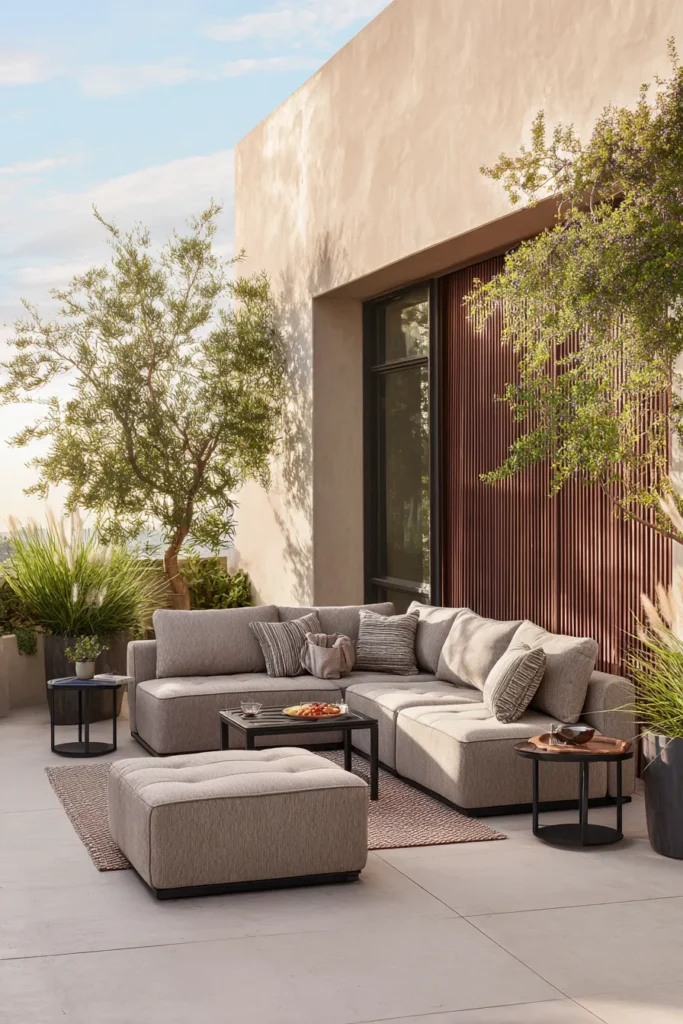
Static furniture layouts are incompatible with tiny patios serving multiple functions. The 2026 approach uses armless sectional components that reconfigure in under 60 seconds without tools.
Armless Sectional Components
Specify a modular sectional where each piece measures 24-30″ square with identical dimensions—no corner pieces, no attached arms. This allows L-shaped, linear, or U-shaped arrangements using the same inventory. Add standalone wicker seating or folding chairs for additional flexibility. The uniform module size creates visual rhythm even when rearranged, preventing the hodgepodge look of mixed furniture.
Designer’s Secret: Weight each modular component to 45-55 lbs—heavy enough to resist wind displacement but light enough for one person to move. Lighter pieces require constant repositioning. Heavier pieces never get rearranged, defeating modularity entirely.
Ottoman-to-Table Dual Function
Deploy outdoor ottomans with removable tray tops that convert from footrest to cocktail table in 5 seconds. Specify 18″ height to match seating dimensions for proper proportion. The dual function eliminates decision paralysis about whether to prioritize lounging or surface area—you get both without spatial compromise.
Stackable Lounge Chair System
Integrate 2-4 stackable lounge chairs that nest vertically for storage against walls when not in use. This on-demand seating expands capacity for entertaining without permanently consuming floor area. Specify aluminum frames with UV-resistant sling fabric—the combination weighs 12-15 lbs per chair for single-person deployment.
Design Breakdown:
- Module size: 24-30″ square, 45-55 lb weight
- Function: Minimum two configurations per piece
- Storage: Stackable or nesting capability required
- Materials: Powder-coated aluminum, solution-dyed fabric
Best For: Social hosts and spatial optimizers who understand that in tiny patios, every piece of furniture must earn its footprint through multiple functions or temporary deployment.
10. Textured Paver Pattern Geometry
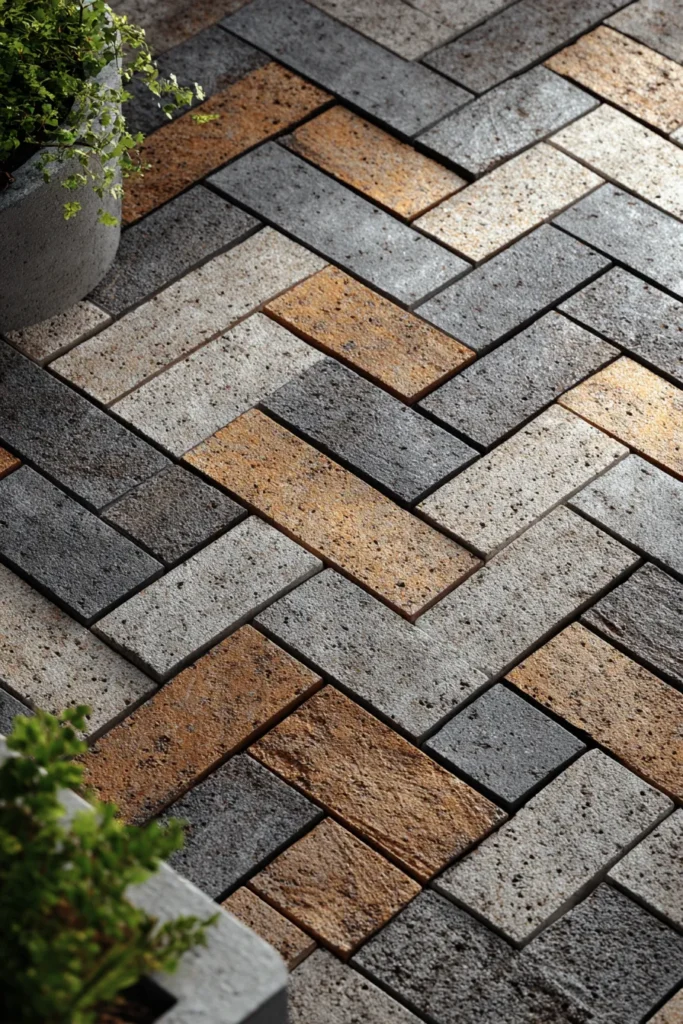
The patio floor is your largest design surface—treat it as such. Interlocking deck tiles and outdoor flooring in geometric patterns create visual complexity that makes spaces read larger through perceptual confusion about boundaries.
Herringbone Micro-Paver Layout (4×8″)
Specify herringbone-laid pavers in 4×8″ format using a paver installation kit. The diagonal orientation eliminates the grid-like regularity of running bond patterns while the small format increases visual texture density. The angled lines lead the eye outward rather than trapping it in the space—a surveying principle borrowed from landscape architecture.
Designer’s Secret: Run herringbone patterns at 45° to the longest wall to maximize the diagonal visual stretch. Parallel orientation wastes the pattern’s directional power. This single detail can make a 60-square-foot patio feel like 80 through pure geometry.
Basketweave Brick Pattern
Traditional basketweave uses pairs of bricks oriented perpendicular in alternating squares. This creates visual rest points between the geometric complexity—essential for preventing pattern fatigue in small spaces. The rhythm of rotation-rotation-rest mirrors techniques used in high-end entryway table decor composition.
Random Flagstone Mosaic Grid
For organic aesthetics, specify irregular flagstone in 18-30″ pieces laid with 1/2″ joints. The randomness prevents the eye from establishing a grid pattern, making boundaries ambiguous. Fill joints with decomposed granite or polymeric sand in a shade darker than stone to create definition without harsh contrast.
Design Breakdown:
- Format: 4×8″ pavers or 18-30″ flagstone
- Pattern: Herringbone at 45°, basketweave, or random mosaic
- Joint width: 1/8″ for pavers, 1/2″ for flagstone
- Joint fill: Polymeric sand or decomposed granite, one shade darker than material
Best For: Detail-oriented designers who recognize that floor pattern operates at both conscious and subconscious levels—good geometry is felt before it’s understood.
11. Historic Reinterpretation Detail
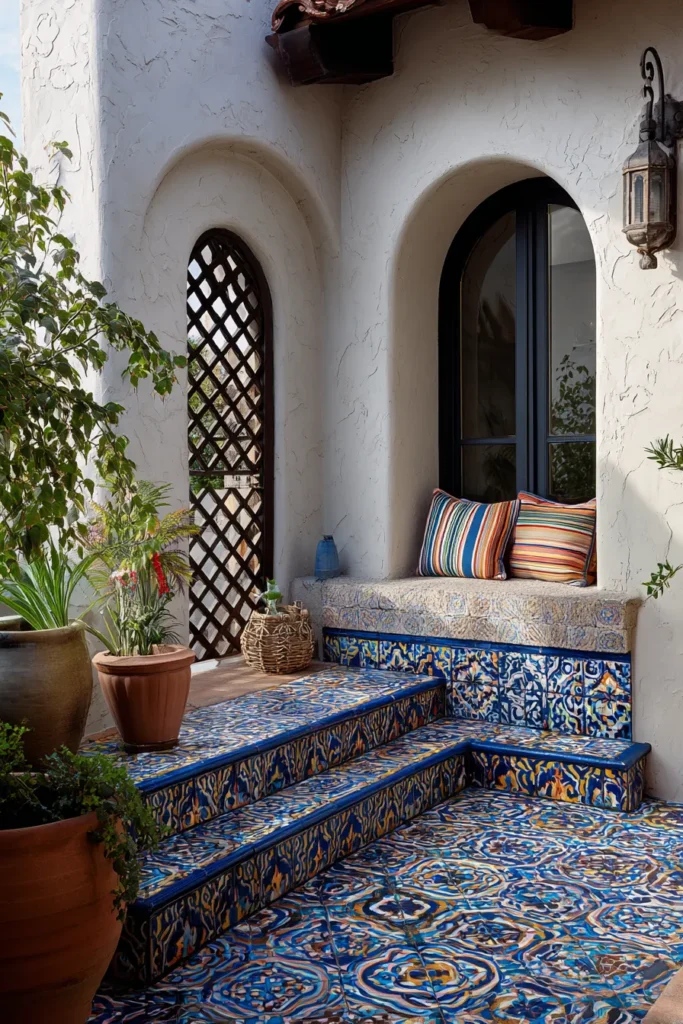
2026 patios embrace regional architectural heritage through careful detail selection—not theme park reproduction. One authentic historic element grounds the design, preventing the generic contemporary look that plagues spec development.
Spanish Revival Tile Risers
Apply hand-painted ceramic tiles to stair risers and low wall faces. The traditional 6×6″ format in cobalt, ochre, and white creates cultural specificity without costume-like excess. Source tiles with deliberate glaze variation—perfect uniformity signals modern reproduction, not historic continuity.
Designer’s Secret: Limit historic tile to vertical surfaces only. Flooring in traditional patterns reads as museum recreation. Vertical application provides cultural reference without walkability concerns or maintenance intensity.
Moorish Arch Overhead Frame
Frame a seating alcove with a pointed Moorish arch fabricated from 2×6 cedar or powder-coated steel. The arch doesn’t require full structural overhead—the silhouette alone provides architectural framing that photographs dramatically and creates spatial definition. Paint in exterior stucco paint to match adjacent walls.
Hand-Forged Iron Lattice Screen
Install a bamboo privacy screen or custom iron lattice panel with traditional quatrefoil or geometric cutouts. The negative space provides privacy through visual interruption rather than solid blocking—a sophisticated approach that maintains light transmission while creating boundary. This layered screening technique mirrors strategies in balcony design.
Design Breakdown:
- Application: One signature historic element, not multiple
- Placement: Vertical surfaces and overhead frames
- Material: Authentic construction methods when possible
- Color: Period-appropriate palette or modern monochrome
Best For: Culturally-informed designers who understand that authentic regionalism requires restraint—one meaningful gesture beats five derivative ones.
12. Integrated Heating Infrastructure
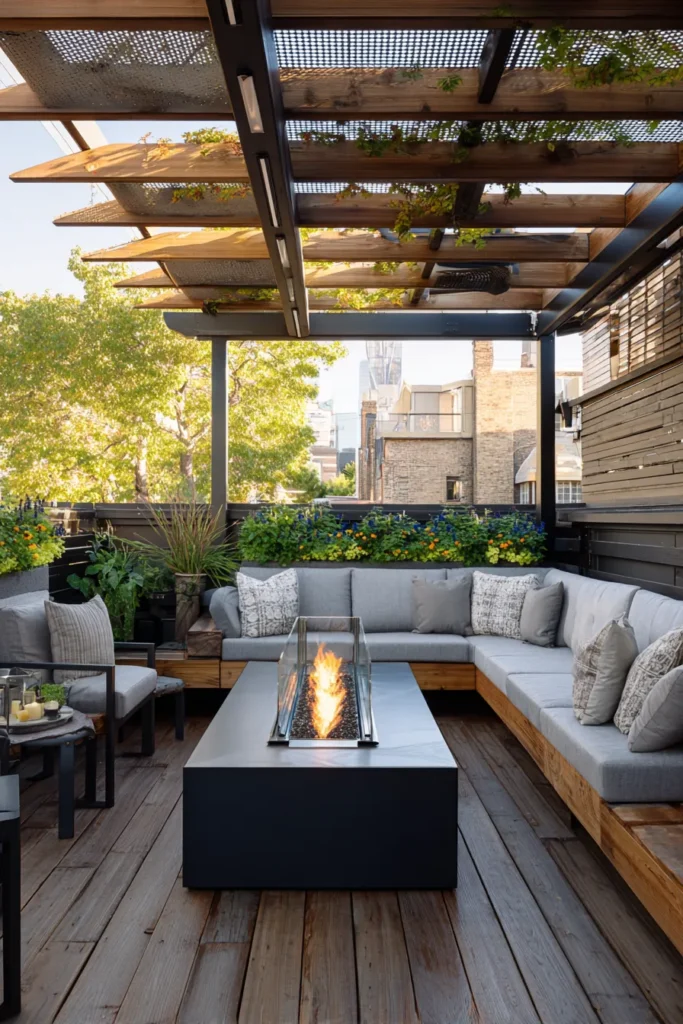
Year-round patio use demands permanent heating infrastructure, not portable propane mushrooms that create hot spots while occupying floor area. The 2026 standard integrates heating into architecture.
Pergola Beam-Mounted Radiant Units
Install electric infrared radiant heaters along pergola beams at 8-9′ height. Unlike convective heaters that warm air (which immediately rises and dissipates), radiant units heat objects and people directly—extending comfortable temperature range by 15-20°F with 40% less energy consumption. Specify 1,500W units for every 100 square feet.
Designer’s Secret: Mount radiant heaters 12-18″ outboard from seating zones, not directly overhead. Direct mounting creates uncomfortable head-level heat while leaving legs cold. The offset angle provides even warmth distribution from shoulders to knees.
Tabletop Ethanol Fire Feature (BTU Rating)
Center a tabletop fire pit or ethanol fire feature producing 8,000-12,000 BTU as visual anchor and radiant heat source. Bioethanol burns cleanly without smoke or propane connections—entirely self-contained. The dancing flame provides psychological warmth perception that extends season by 3-4 weeks beyond actual heating capacity. Consider pairing with an outdoor fire table for larger gatherings.
Under-Bench Propane Heater Panel
For built-in seating zones, install low-profile propane patio heaters beneath bench fronts. The concealed placement eliminates visual clutter while directing heat upward into seating zones. Connect to permanent propane lines for instant operation without tank swapping.
Design Breakdown:
- Primary heat: Electric infrared radiant, 1,500W per 100sqft
- Accent heat: Bioethanol tabletop, 8,000-12,000 BTU
- Concealed heat: Under-bench propane, 20,000 BTU per linear 6′
- Fuel: Electric for primary, bioethanol/propane for accent
Best For: Four-season dwellers who recognize that heating infrastructure investment pays back within two years through extended usability versus seasonal storage—the math is unambiguous.
13. Biophilic Sensory Layering

Plants in 2026 patios are selected for multi-sensory engagement, not just visual greenery. The combination of scent, texture, and acoustic properties creates immersive environments that reduce cortisol levels measurably within 5-7 minutes.
Aromatic Plant Clustering (Lavender, Rosemary)
Group aromatic Mediterranean herbs in 24-36″ diameter clusters within 4-6 feet of seating. Lavender releases calming linalool compounds when leaves brush against clothing or skin. Rosemary provides cognitive alertness through airborne cineole. The fragrance layering creates olfactory zoning—relaxation scents in lounge areas, focus scents near work zones.
Designer’s Secret: Plant aromatics upwind from prevailing breezes to carry scent naturally across the patio. Forcing scent distribution through fan systems feels artificial and increases maintenance. Work with natural airflow patterns identified through simple ribbon testing.
Water Feature Acoustic Design
Install a small-scale water feature producing 55-60 decibel white noise—enough to mask urban ambient sound (traffic, neighbors) without requiring raised conversation voices. The falling water frequency (100-300 Hz) specifically masks human speech frequencies, creating acoustic privacy without solid barriers. This sound masking principle works similarly to reading corner acoustic design.
Textured Bark Mulch Grounding
Specify 3-4″ depth of coarse bark mulch in planted areas. The irregular texture provides tactile interest when contacted while the organic scent (released when disturbed) signals natural environment to the brain. The mulch layer also moderates soil temperature by 10-15°F, reducing irrigation needs by 30% compared to bare soil.
Design Breakdown:
- Aromatics: 24-36″ diameter clusters, 4-6′ from seating
- Water: 55-60 decibel output, 100-300 Hz frequency range
- Texture: 3-4″ bark mulch, coarse grade for longevity
- Placement: Sensory elements within interaction distance
Best For: Wellness-focused individuals who understand that biophilic design is quantifiable nervous system regulation, not vague nature appreciation—the benefits are measured in cortisol reduction and heart rate variability.
14. Compact Storage Architecture
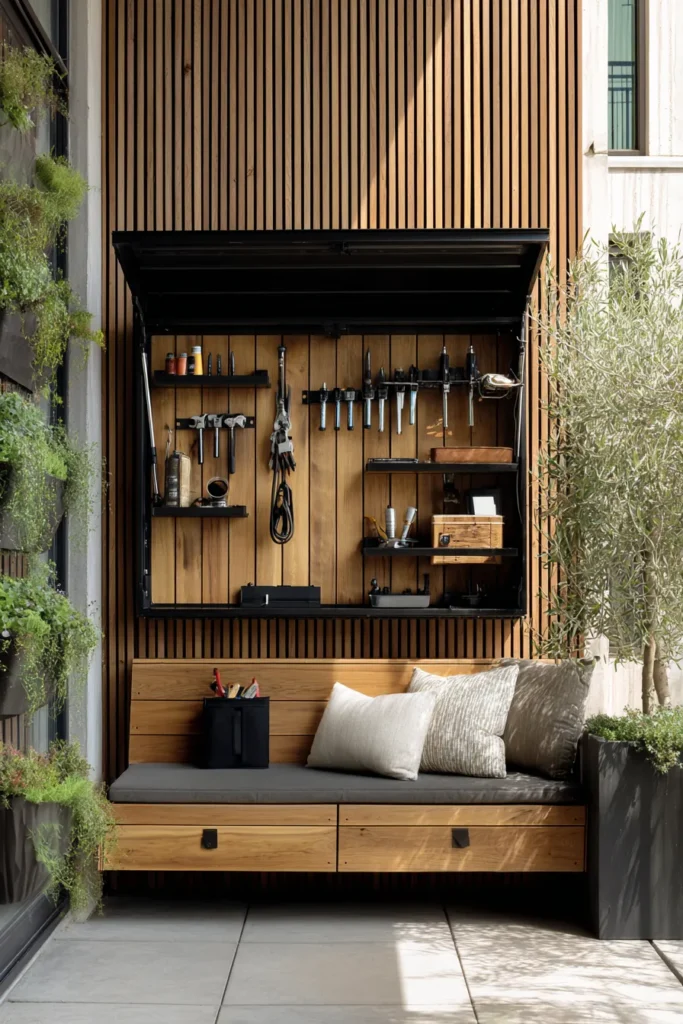
Storage in tiny patios must be architectural—integrated into seating, walls, and vertical surfaces rather than added as afterthought boxes that consume precious floor area.
Bench-Integrated Lift-Top Compartments
Build seating with outdoor storage benches featuring lift-top access to interior compartments. Size each compartment for specific storage needs: cushion storage requires 24″ depth, gardening tools need 18″, pooling chemicals require 12″. The differentiated sizing prevents the “junk drawer” syndrome where everything gets crammed into one space. Similar organizational principles apply to entryway shoe storage solutions.
Designer’s Secret: Line storage compartments with cedar planks to prevent mildew and repel insects. The $60 cedar upgrade extends stored item lifespan by 3-5 years compared to bare plywood interiors—the investment pays back within one season.
Wall-Mounted Fold-Down Table
Install a fold-down table with 36-42″ depth that stores flat against walls when not needed. Add spring-loaded support arms that lock in deployed position—no loose legs to store separately. The table doubles as a serving station when entertaining, then disappears to restore full floor area for daily use.
Vertical Tool Rack Facade
Mount wall-mounted storage or deck box panels with integrated hooks for hanging tools, decorative lanterns, and seasonal items. The vertical organization keeps tools accessible while maintaining the architectural facade appearance—not raw pegboard, but designed storage that contributes to aesthetics rather than detracting from it.
Design Breakdown:
- Bench storage: Lift-top access, differentiated compartment sizing
- Fold-down surfaces: 36-42″ depth, spring-loaded arms
- Vertical systems: Wall-mounted panels with integrated hooks
- Materials: Weather-resistant plywood, stainless steel hardware
Best For: Organized pragmatists who refuse to sacrifice function for aesthetics and demand that every architectural element perform multiple roles in tiny spaces.
15. Outdoor Rug Anchoring System
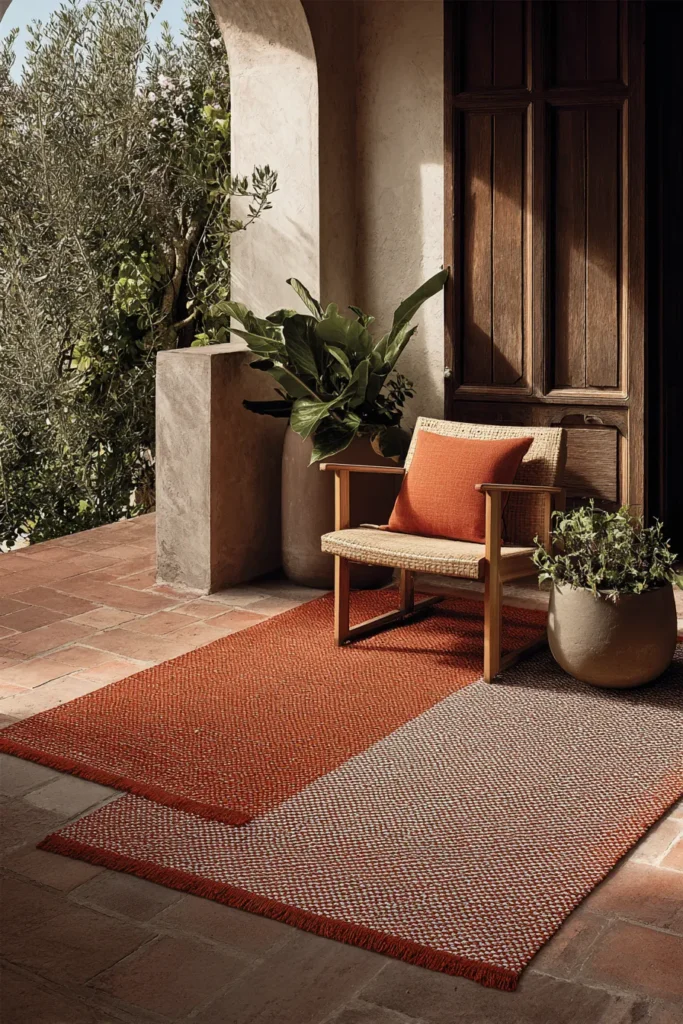
Outdoor rugs in 2026 are structural elements that define zones, absorb sound, and provide tactile warmth. But improper installation creates tripping hazards and wind-blown chaos within days.
Flatweave Polypropylene (8×10′ for 120sqft Patio)
Specify flatweave polypropylene rugs in 8×10′ format for standard 10×12′ patios. The flatweave construction (not pile) prevents water pooling while the polypropylene fiber resists mildew and UV degradation through 1,500+ hours of sun exposure. Size rugs to leave 18-24″ perimeter of bare flooring visible—this prevents the “wall-to-wall carpet” look that shrinks apparent space.
Designer’s Secret: Layer two rugs in graduated sizes rather than using one large rug. Place an 8×10′ base layer, then float a 5×7′ accent rug on top offset by 12-18″. The layering creates dimensional interest while the offset prevents rigid symmetry that feels static in small spaces.
Rubber Backing Ventilation Gaps
All outdoor rugs require rubber backing with drainage perforations every 6-8″. The holes allow water to pass through while the rubber grips flooring to prevent wind lifting. Avoid solid rubber backing—it traps moisture and creates mildew colonies within 3-4 weeks in humid climates.
Color Temperature Coordination (Warm/Cool Undertones)
Match rug undertones to architectural materials. Warm-toned pavers (terracotta, sandstone) pair with rugs carrying red/yellow undertones. Cool-toned concrete and bluestone require rugs with blue/gray undertones. The temperature harmony (not color matching) prevents the disjointed look of arbitrary rug selection.
Design Breakdown:
- Size: Leave 18-24″ perimeter of bare flooring
- Material: Flatweave polypropylene, perforated rubber backing
- Layering: Two rugs in graduated sizes for dimension
- Color: Match warm/cool undertones to architectural materials
Best For: Detail-conscious designers who understand that rugs are spatial architecture, not decorative afterthoughts—proper sizing and installation determines whether they enhance or detract from the design.
16. Privacy Screen Engineering
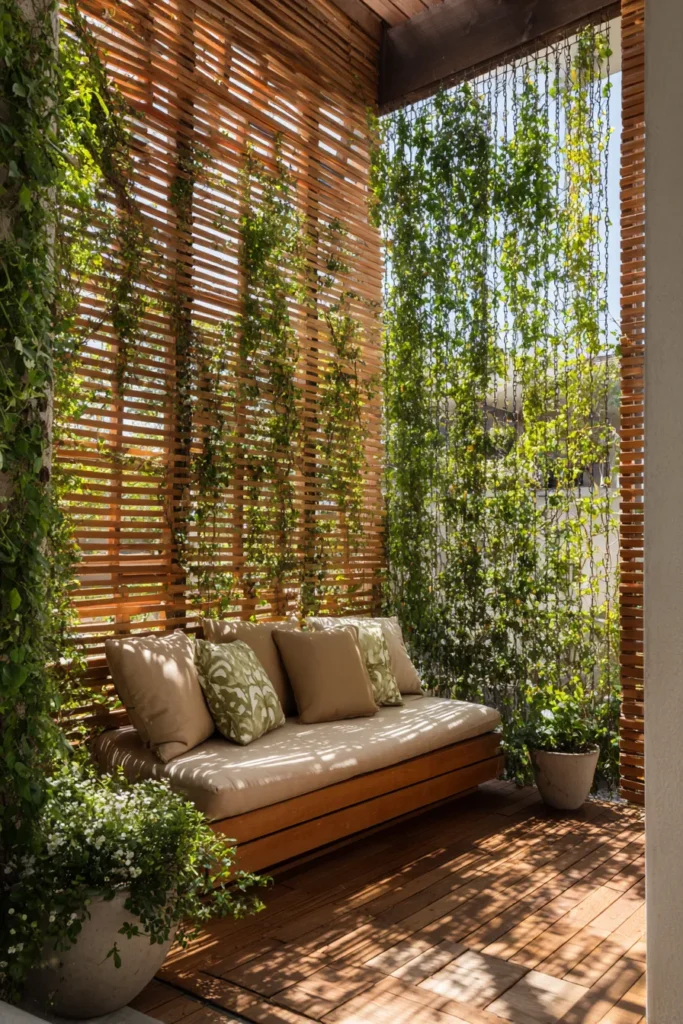
Visual privacy in tiny patios requires balancing enclosure with airflow and light transmission. Solid fencing creates cave-like spaces that feel smaller. The 2026 approach uses layered screening with calculated negative space.
Bamboo Slat Spacing (2″ Gap for Airflow)
Install bamboo privacy screens with 2″ gaps between vertical slats. This 60% solid / 40% void ratio blocks direct sightlines while maintaining 70% light transmission and unrestricted airflow. The vertical orientation draws the eye upward, increasing perceived height in low-ceiling spaces.
Designer’s Secret: Stagger slat positions on front and rear faces by 1″ to eliminate direct sightlines through gaps while maintaining open feel. The double-layer approach provides complete visual privacy without sacrificing the permeability that keeps small spaces from feeling claustrophobic.
Climbing Vine Support Grid
Behind structural screening, install 4×4″ wire mesh or cable grid as permanent climbing vine support. Evergreen jasmine or climbing hydrangea provide 12-month coverage that softens hard screen edges while adding seasonal flower interest. The living layer makes privacy functional year-round rather than just decorative.
Translucent Resin Panel System
For modern aesthetics, deploy outdoor curtains or translucent resin panels in frosted white or amber tones. The material blocks direct views while transmitting diffused light—the same privacy glass principle used in high-end bathrooms applied to outdoor spaces. Mount panels in sliding track systems for variable privacy control.
Design Breakdown:
- Slat spacing: 2″ gaps, 60/40 solid-to-void ratio
- Height: 6-7′ for seated privacy, 7-8′ for standing
- Living layer: Evergreen climbing vines on 4×4″ support grid
- Modern option: Translucent resin panels, sliding track mounting
Best For: Privacy-seeking urban dwellers who understand that effective screening is optical science, not solid barriers—calculated void space provides both privacy and permeability without compromise.
17. Multi-Sensory Fire Feature
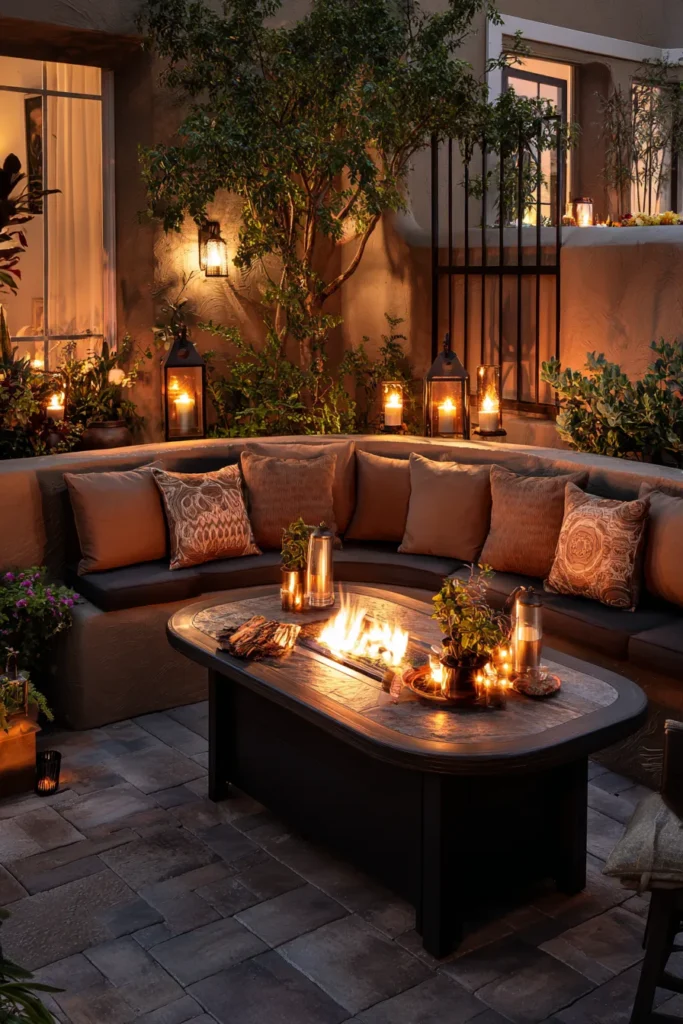
Fire features in 2026 serve triple duty: radiant heat source, visual anchor, and psychological mood modifier. The dancing flame reduces cognitive load by 40% compared to static focal points—the brain processes movement differently than stationary objects.
Tabletop Gel Fuel (Smokeless Rating)
Deploy tabletop fire pits burning gel fuel canisters rated for smokeless combustion. The clean burn eliminates the acrid smell of wood smoke while the canister system provides instant on/off control. Size flames to 6-8″ height for intimate scale appropriate to tiny patios—larger flames overwhelm small spaces and create heat discomfort.
Designer’s Secret: Position fire features off-center rather than centered in seating arrangements. Centered placement forces all seating to orient toward one point, creating rigid formal layouts. Off-center positioning allows varied seating angles while maintaining the fire as a visual anchor, not a dictator.
Built-In Propane Fire Table (20,000 BTU)
For permanent installations, integrate outdoor fire tables producing 20,000 BTU into seating zones. Connect to underground propane lines with electronic ignition—push-button simplicity encourages regular use rather than the friction of tank swapping that causes abandonment by mid-season.
Bioethanol Cylinder Lantern
Supplement primary fire features with portable ethanol fire features in cylinder form. The contained flame provides accent lighting and psychological warmth without meaningful heat output—perfect for shoulder season evenings when ambient temperature is comfortable but visual warmth is desired.
Design Breakdown:
- Primary fire: 20,000 BTU built-in, propane connection
- Accent fire: 6-8″ flame height, gel fuel or bioethanol
- Safety: 36″ clearance from combustibles, electronic ignition
- Positioning: Off-center placement for flexible seating angles
Best For: Experience-focused homeowners who recognize that fire features are psychological tools as much as functional heat sources—the presence of flame alters behavior and extends dwelling time independent of actual temperature.
18. Flexible Shade Architecture
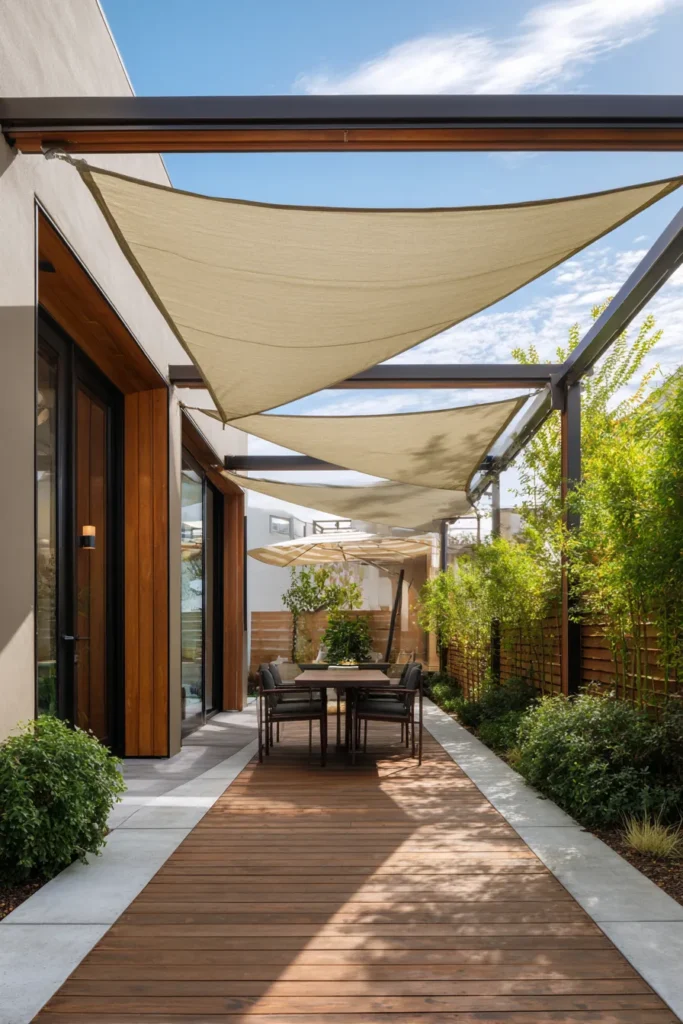
Fixed shade structures in tiny patios consume vertical space and block light year-round. The 2026 approach uses adjustable systems that deploy only when needed, preserving open-sky feeling during comfortable weather.
Retractable Pergola Canopy (UV50+ Rating)
Install a retractable awning or pergola canopy with UV50+ rated fabric that blocks 98% of harmful radiation while maintaining air circulation. The manual or motorized retraction allows full sun exposure in morning hours for vitamin D synthesis, then deployment during peak UV periods (10am-3pm). The flexibility increases usable hours by 40% compared to fixed shade.
Designer’s Secret: Specify canopy fabric in medium-tone colors (dove gray, sage, terracotta) rather than bright white or dark charcoal. Medium tones reduce glare without creating cave-like darkness. They also age more gracefully—dirt and weathering are less visible than on white, while they don’t trap heat like dark colors.
Sail Shade Triangle Configuration
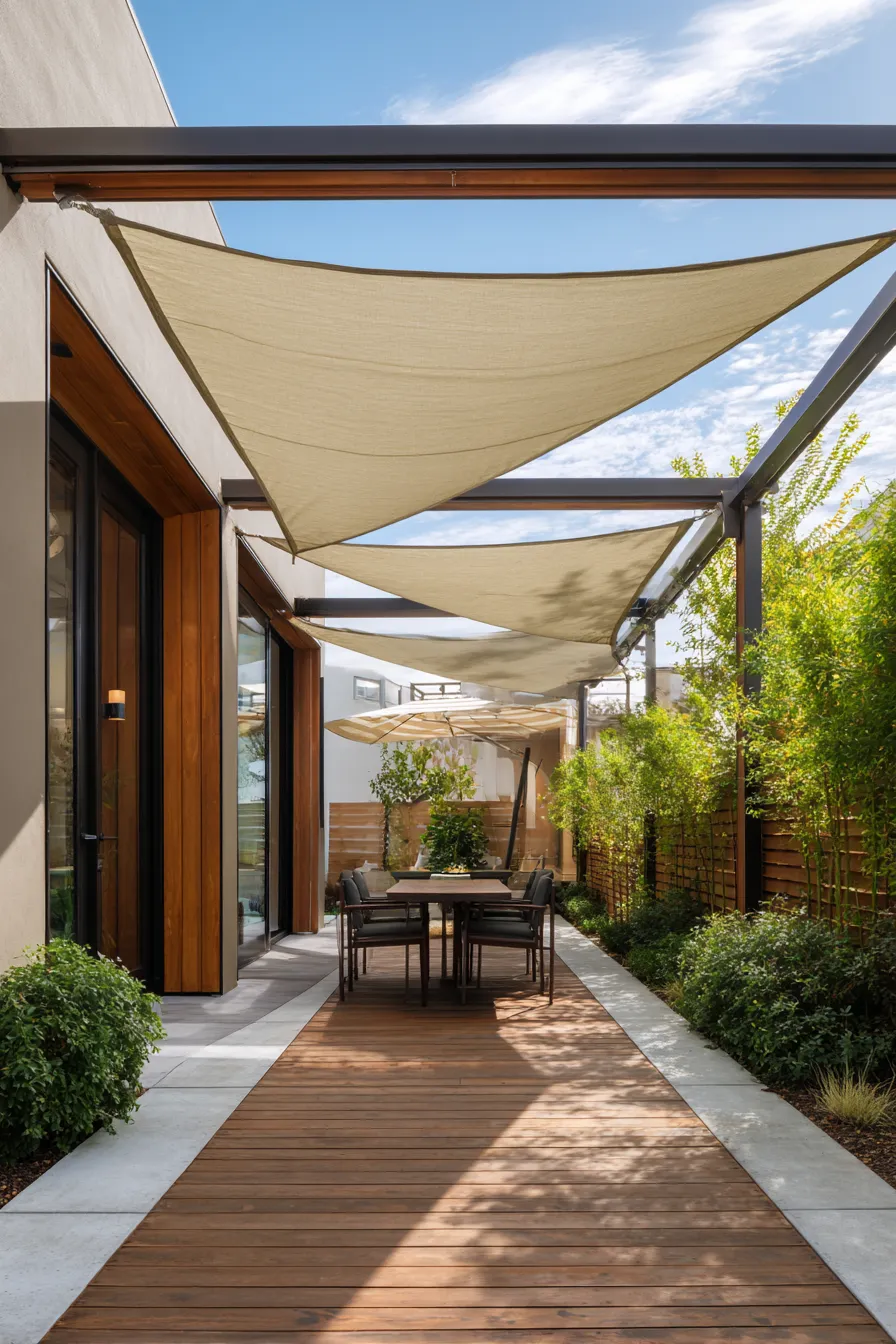
Deploy shade sails in triangular format (10-12′ per side) for contemporary aesthetics and superior tensile strength. Mount at varying heights (8′, 9′, 10′) to create sculptural interest while ensuring proper water runoff—flat installations pool water and sag within one rain event.
Adjustable Louvered Roof System
For maximum flexibility, install adjustable louver systems where individual slats rotate from full-open to full-closed positions. The graduated adjustment allows precise light control throughout the day without full retraction. Specify powder-coated aluminum with integrated drainage channels that direct water to perimeter gutters.
Design Breakdown:
- Retractable: UV50+ fabric, manual or motorized operation
- Sail shade: Triangular format, varied mounting heights for drainage
- Louvers: Aluminum construction, 0-90° rotation range
- Color: Medium tones for optimal light quality and aging
Best For: Control-focused homeowners who refuse to choose between sun exposure and shade protection and demand the flexibility to optimize conditions hour-by-hour throughout the day.
Final Note: Design Integration Over Individual Elements
The patios that succeed in 2026 share one characteristic: every element supports a coherent architectural narrative rather than existing as isolated interventions. The 2700K string lights aren’t just lighting—they’re spatial definition. The corten steel planters aren’t just containers—they’re material continuity with interior design language. The modular sectional isn’t just seating—it’s variable geometry that accommodates multiple functions within the same footprint.
This integration separates professional-grade patio interiors from amateur assemblages. Each specification responds to multiple design criteria simultaneously: form, function, proportion, color temperature, material honesty, and spatial perception. When a single element fails to perform on multiple levels, it doesn’t earn inclusion regardless of individual merit.
The result is outdoor spaces that feel like intentional rooms rather than afterthought decks—a perceptual shift that fundamentally changes how occupants interact with and value these areas. The investment in proper specification returns dividends in usability, longevity, and the daily satisfaction of occupying space designed with your specific needs rather than generic decoration in mind.
Whether your 60-square-foot balcony or 150-square-foot courtyard, these principles scale across dimensions because they address perception and proportion rather than absolute measurements. The smallest patio, properly designed, delivers more satisfaction than twice the square footage treated as decorative afterthought. This is the fundamental lesson the design community embraces in 2026: quality of space trumps quantity every time.