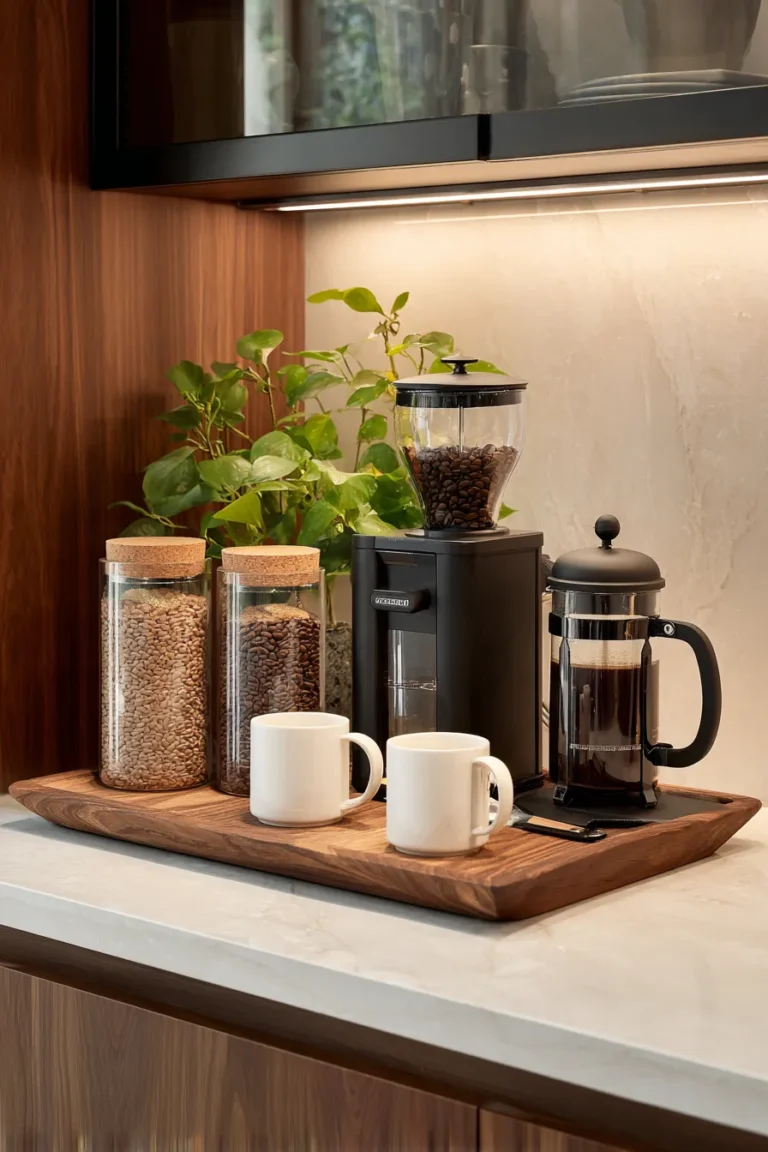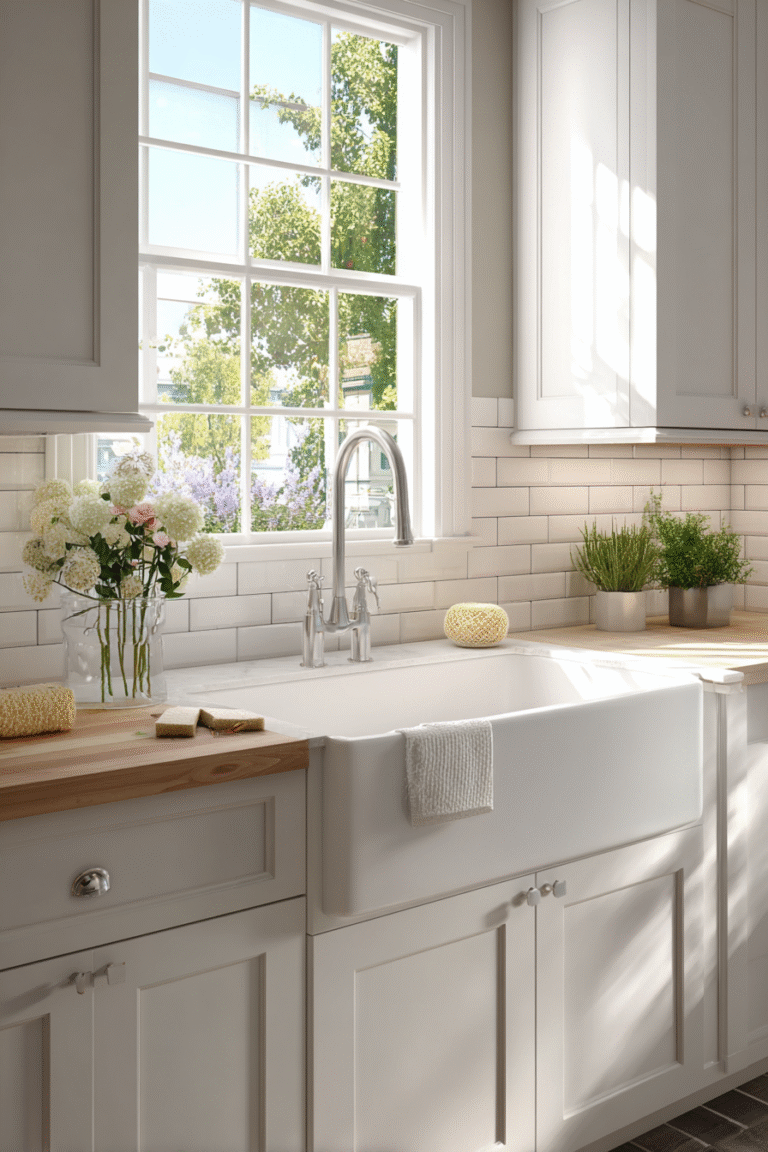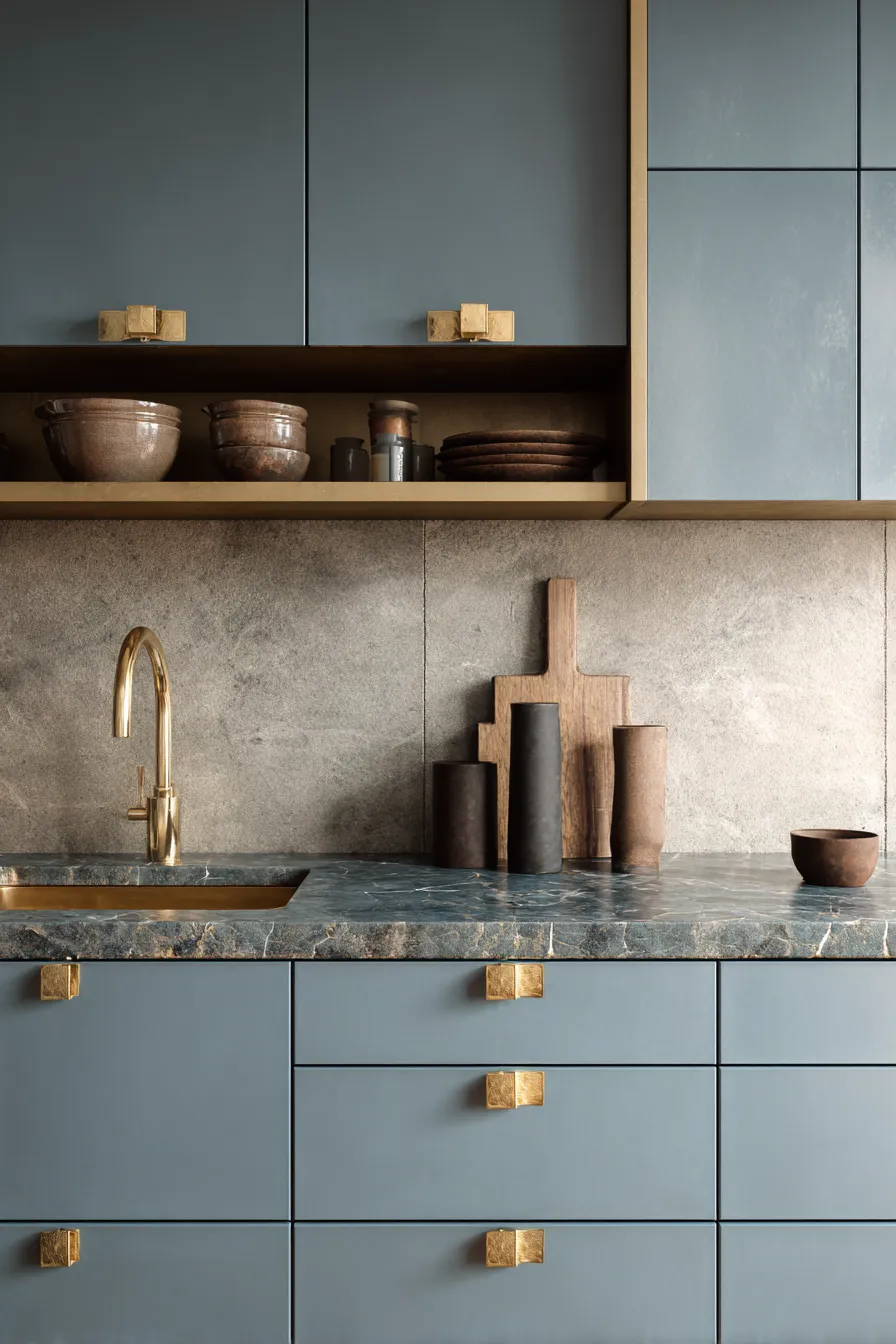
The 2026 cabinet color shift abandons monochromatic perfection for light reflectance value (LRV) layering—pairing high-LRV whites (85+) with mid-tone accent cabinetry (LRV 40-60) to create dimensional depth that responds to natural light cycles throughout the day.
If you’ve been conditioned to believe that “safe” kitchen cabinets mean Benjamin Moore Simply White on every surface, 2026’s design evolution will recalibrate your entire approach. The most sophisticated kitchens now employ color temperature mapping—a technique borrowed from hospitality design where cabinet hues are selected based on their Kelvin response under both morning 5000K daylight and evening 2700K ambient lighting. This isn’t about trends; it’s about understanding how pigment molecules interact with your home’s directional light.
Why 2026 Cabinet Color Strategy Has Evolved
Three converging forces have transformed how architects specify cabinet finishes. First, the material honesty movement rejects perfect factory finishes in favor of patinated metals and visible grain structures that improve with age. Second, biophilic design mandates now prioritize earth-derived pigments—terracotta iron oxides, olive chlorophyll tones, limestone calcium carbonates—that reduce visual stress in multi-functional kitchen spaces. Third, LED standardization at 2700K-3000K means designers must pre-visualize how matte versus satin sheens will either absorb or reflect these warmer light spectrums.
The result? Cabinets that function as ambient light modulators rather than static color blocks.
Limewashed Bone White with Unlacquered Brass
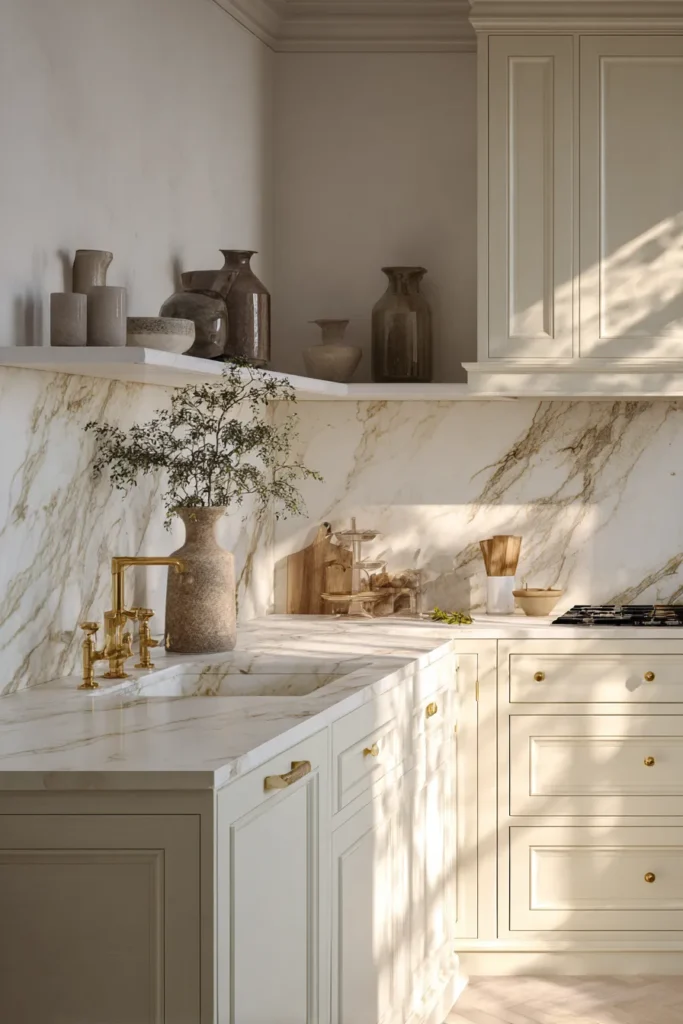
This isn’t your builder-grade white. Limewash creates a chalky, slightly textured surface (LRV 88-92) that diffuses light rather than bouncing it harshly. The calcium hydroxide base allows the wood substrate to breathe, preventing the sterile “appliance white” effect that plagued 2010s kitchens.
Designer’s Secret: Specify limewash only on inset shaker doors—the recessed panels create micro-shadows that prevent the flat, one-dimensional look of painted surfaces. Under 2700K lighting, this reads as warm ivory; under 5000K northern exposure, it maintains cool clarity.
Design Breakdown:
- Finish: Limewash or mineral paint in Farrow & Ball “Pointing” equivalent (LRV 92)
- Hardware: Unlacquered brass pulls that patina to rose-gold within 6-12 months
- Counter Pairing: Honed Calacatta with warm gray veining (avoid stark white marble)
- Light Strategy: 2700K under-cabinet LED strips to enhance warmth
Best For: Minimalists who want textural depth without color commitment. Ideal for south-facing kitchens where natural light prevents coolness.
Charcoal Graphite with Warm Walnut Islands
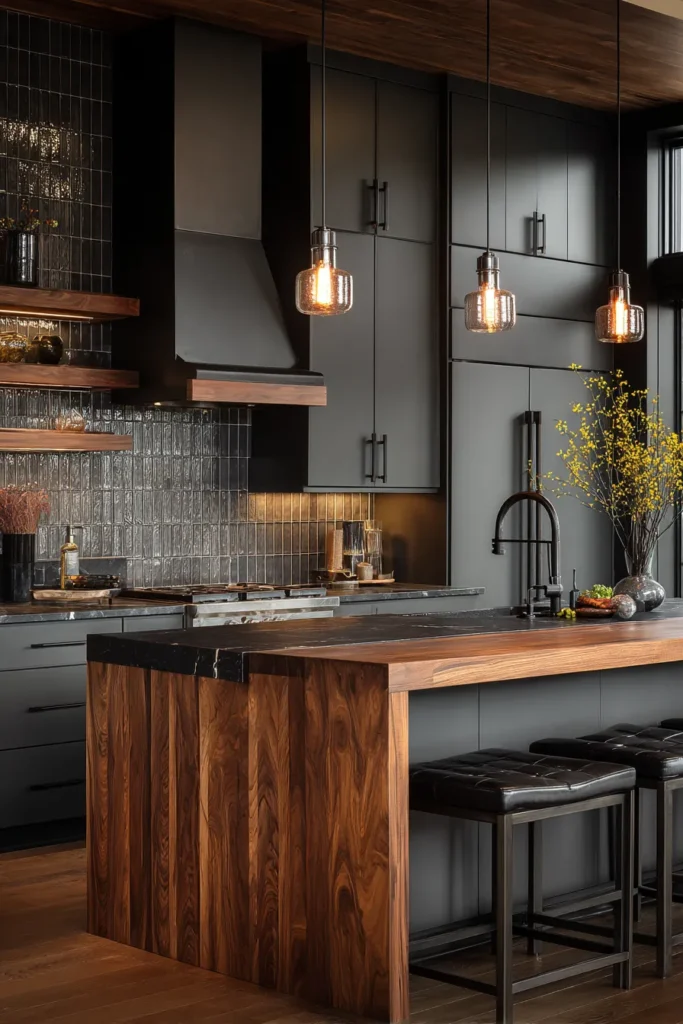
Charcoal (LRV 15-20) grounds a kitchen spatially, but only when you introduce thermal contrast through wood islands in 2400K-range walnut. The key is specifying a dead-flat matte finish—any sheen above 5% will read as industrial rather than residential.
Designer’s Secret: Use charcoal only on perimeter cabinets, never on the island. The human eye needs a “visual escape route” in enclosed kitchens, and a mid-tone wood island (LRV 25-30) provides that psychological relief. If you’re working with dark granite countertops—a combination I discuss extensively in my kitchen counter decor guide—the walnut island prevents the space from feeling cavernous.
Design Breakdown:
- Finish: Benjamin Moore “Kendall Charcoal” in matte (sheen 0-5%)
- Island Material: Quarter-sawn walnut with clear coat only (no stain)
- Hardware: Aged bronze or blackened steel—never chrome
- Backsplash: Vertical-stacked subway in warm gray grout
Best For: Open-plan kitchens requiring spatial definition. Not recommended for spaces under 150 square feet.
Sage Green in Dead-Flat Matte Finish
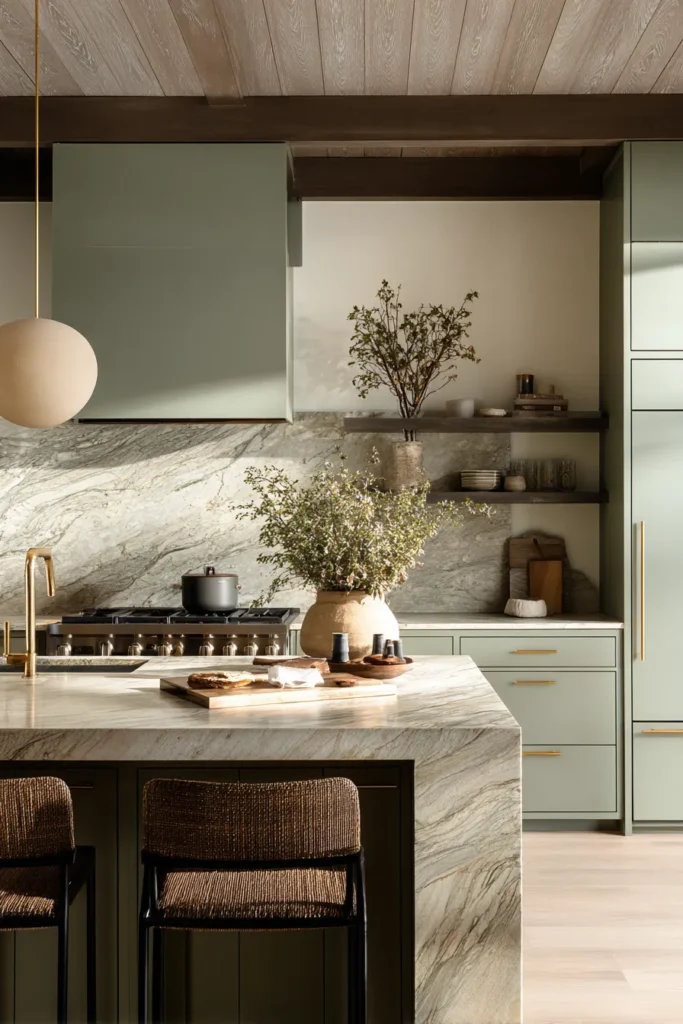
Sage (LRV 45-50) has been bastardized by amateur renovators, but when executed in a zero-sheen matte, it becomes a sophisticated neutral. The chlorophyll undertones create a biophilic calm that reduces cortisol—a studied effect in hospitality design.
Designer’s Secret: Sage fails in kitchens with cool-white quartz or stainless appliances. You need material adjacency: honed marble, unlacquered brass, and 2700K lighting. I always pair this with natural textures similar to what I recommend in reading corner ideas for creating sensory-rich environments.
Design Breakdown:
- Finish: Farrow & Ball “Vert de Terre” or Sherwin-Williams “Clary Sage”
- Counter: Honed marble or leathered quartzite (never polished granite)
- Hardware: Brushed brass or unlacquered bronze
- Ceiling Treatment: Limewashed to LRV 85+ to prevent oppression
Best For: North-facing kitchens needing warmth injection. Feng shui practitioners seeking wood element representation.
Navy Blue with 15-Degree Satin Sheen
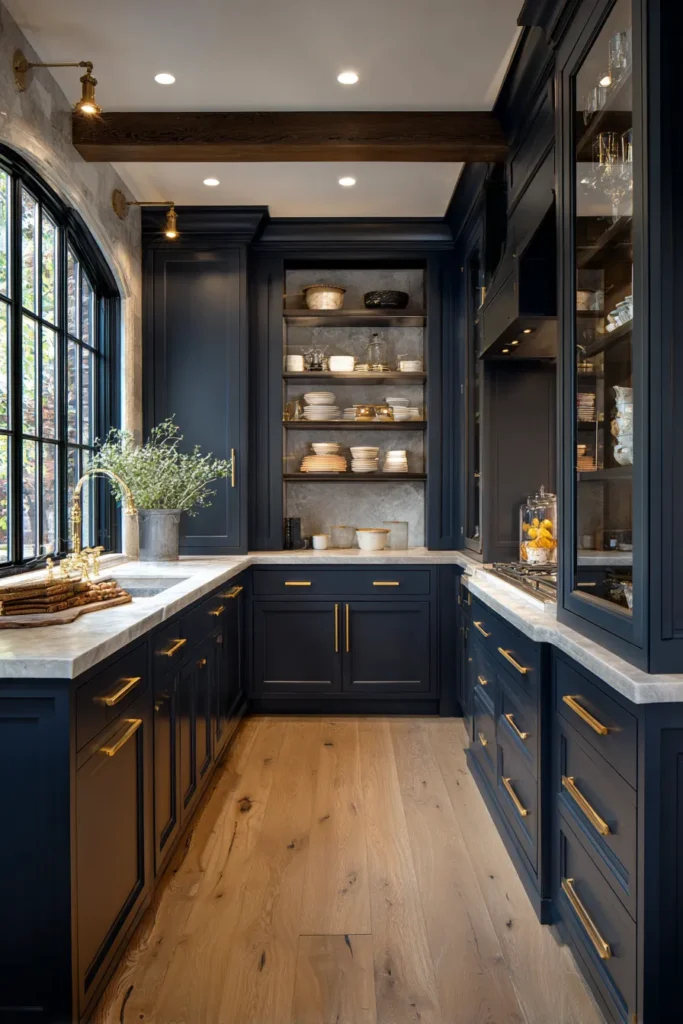
Navy (LRV 8-12) requires precise sheen calibration. Below 10-degree sheen, it reads as black under evening lighting. Above 20-degree, it becomes reflective and cheap. The 15-degree sweet spot allows the indigo undertones to emerge without glare.
Designer’s Secret: Navy demands architectural lighting—a single overhead fixture will create dead zones. Install 3000K recessed cans on a 4-foot grid, supplemented by 2700K under-cabinet strips. This dual-temperature approach prevents the “cave effect” while maintaining sophistication.
Design Breakdown:
- Finish: Benjamin Moore “Hale Navy” in 15-degree satin
- Counter: Taj Mahal quartzite or White Macaubas—both have warm veining
- Hardware: Aged brass or polished nickel (never oil-rubbed bronze)
- Floor: Wide-plank white oak in natural finish (not gray-washed)
Best For: Historically-inspired kitchens in pre-war homes. Avoid in modern minimalist contexts.
Raw Cement Gray with Steel Accents
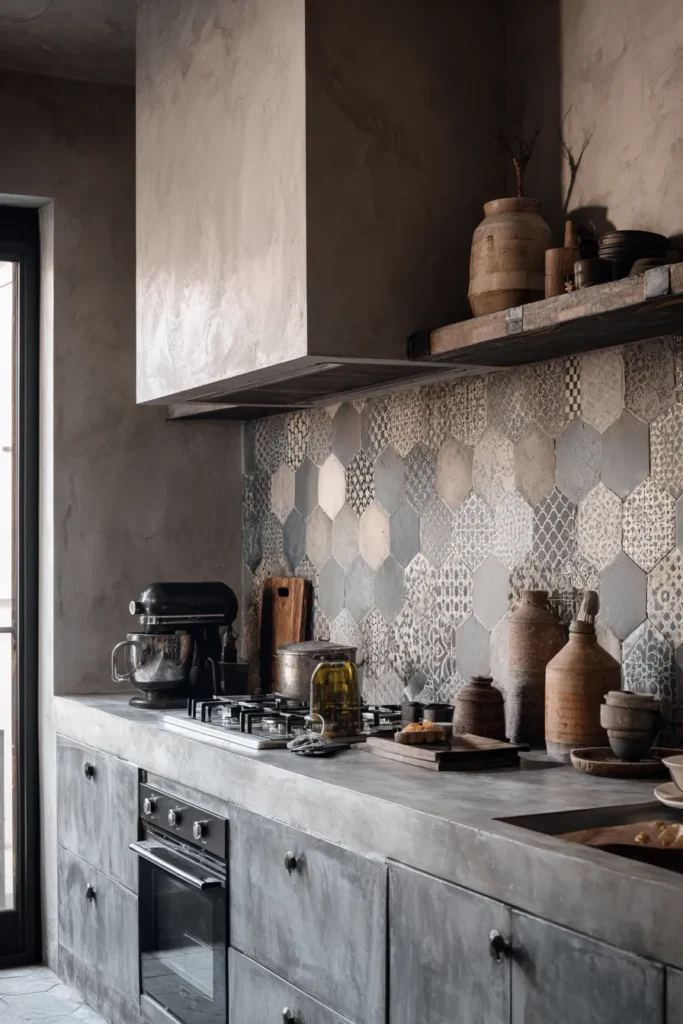
True cement gray (LRV 35-40) mimics tadelakt plaster—a Moroccan technique where lime plaster is burnished to a stone-like finish. This isn’t Home Depot gray; it’s a complex neutral with green and violet undertones visible only under changing daylight.
Designer’s Secret: Cement gray requires textural counterweight. If your cabinets are smooth, your backsplash must have dimensional relief—hand-formed zellige tile or 3D-carved stone. The same principle applies to living room designs for small spaces where texture prevents flatness.
Design Breakdown:
- Finish: Portola Paints “Roman Clay” in custom gray
- Hardware: Brushed stainless steel or pewter (warm-toned metals clash)
- Backsplash: Handmade zellige in mixed grays
- Appliances: Integrated panels—exposed stainless ruins the aesthetic
Best For: Industrial lofts and Scandinavian minimalists. Requires abundant natural light.
Terracotta Clay with Honed Marble
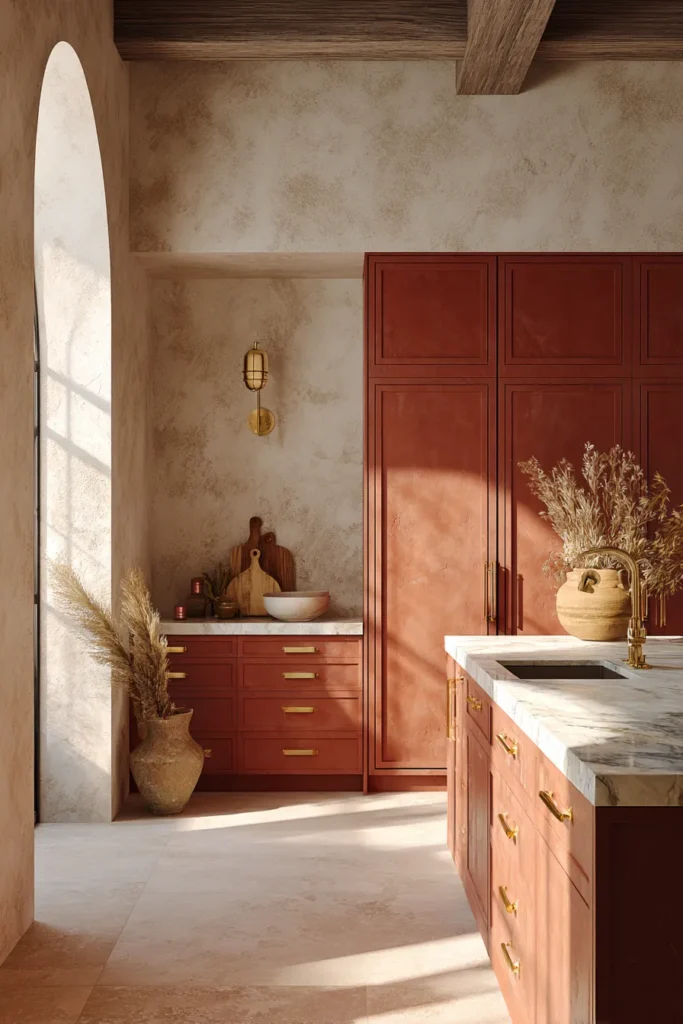
Terracotta (LRV 30-35) introduces iron oxide warmth without the aggression of orange. When paired with honed Carrara or Danby marble, the warm-cool contrast creates a Mediterranean sensibility that feels collected rather than designed.
Designer’s Secret: Terracotta cabinets must have recessed panel detailing—flat-front modern cabinets make this color read as juvenile. The shadow lines within shaker or beaded inset doors add the gravitas this pigment needs. Consider similar warmth strategies from my cozy kitchen design ideas.
Design Breakdown:
- Finish: Benjamin Moore “Audubon Russet” or Sherwin-Williams “Cavern Clay”
- Counter: Honed Carrara marble (3cm thickness for presence)
- Hardware: Unlacquered brass or antique bronze
- Wall Treatment: Venetian plaster in off-white (LRV 85)
Best For: Spanish Colonial and Mediterranean revivals. Excellent in homes with arched doorways.
Greige Gradient: Upper Light, Lower Dark
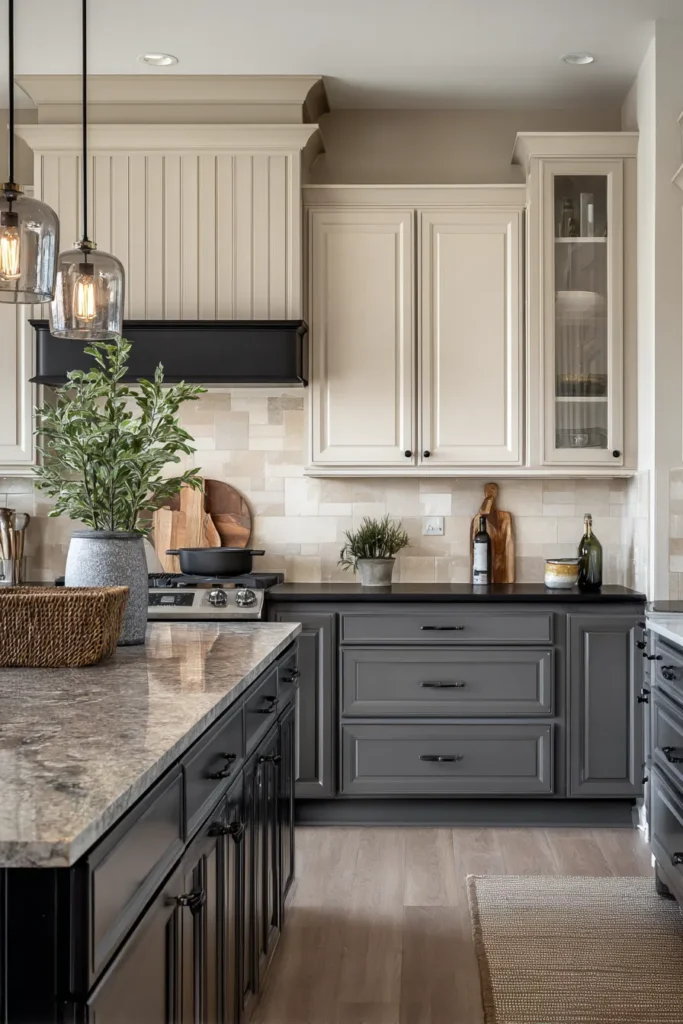
This two-tone strategy uses tonal progression—upper cabinets in LRV 70 greige, lowers in LRV 40. The gradient mimics natural shadow falloff, making 8-foot ceilings feel taller through visual trickery borrowed from scenic design.
Designer’s Secret: The transition line must occur at countertop height—never mid-wall. And your grout color becomes critical: it should match the darker lower cabinet to create a continuous vertical line. This optical anchoring works equally well in small bedroom ideas where vertical emphasis expands perception.
Design Breakdown:
- Upper Finish: Benjamin Moore “Balboa Mist” (LRV 67)
- Lower Finish: Benjamin Moore “Chelsea Gray” (LRV 38)
- Hardware: Matte black throughout for continuity
- Counter: Leathered granite in warm gray family
Best For: Kitchens with low ceilings (under 9 feet). Creates architectural interest in builder-grade spaces.
Blackened Bronze Metallic Lacquer
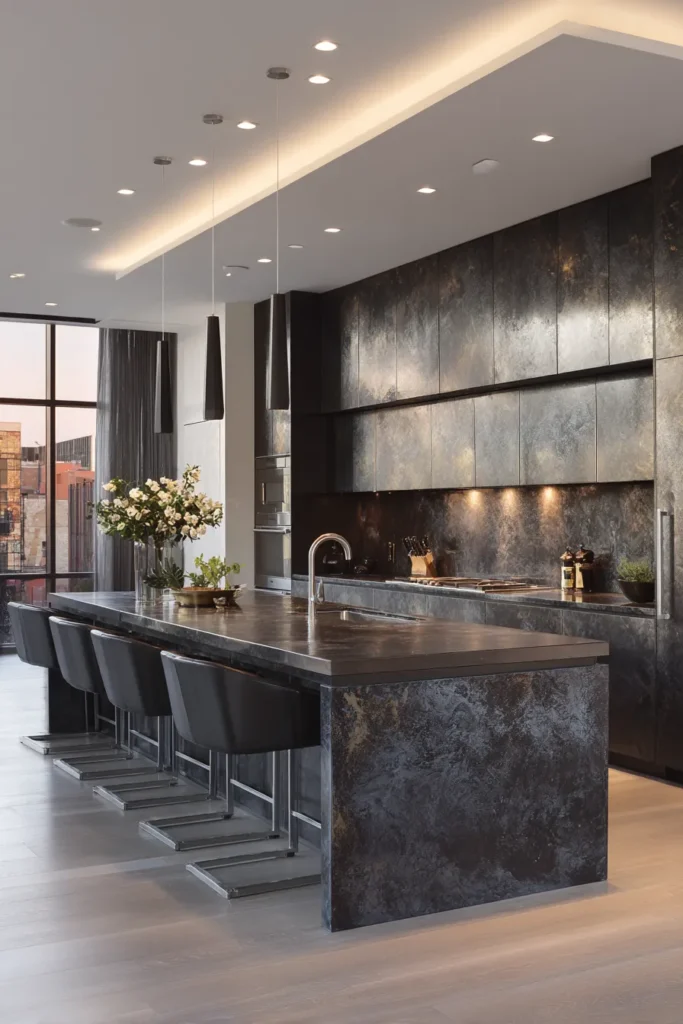
This isn’t paint—it’s automotive-grade lacquer with metallic bronze particles (0.5mm flake size) suspended in a black base. Under direct light, you see bronze shimmer; in shadow, it reads as deep charcoal. The chromatic shift creates a living surface that changes hourly.
Designer’s Secret: Metallic lacquer shows every imperfection. Your cabinet boxes must be five-piece construction with furniture-grade sanding (220-grit minimum). Any MDF substrate or poor joinery will telegraph through the finish. Budget 40% more than standard paint.
Design Breakdown:
- Finish: Custom automotive lacquer or Sherwin-Williams Emerald in “Black Magic” with bronze additive
- Hardware: Recessed pulls or push-latch (hardware competes with the finish)
- Lighting: 3000K recessed cans on dimmer to control shimmer intensity
- Counter: Soapstone or honed black granite
Best For: Art collectors and design-forward clients. Requires professional spray application.
Warm Taupe with Unlacquered Copper
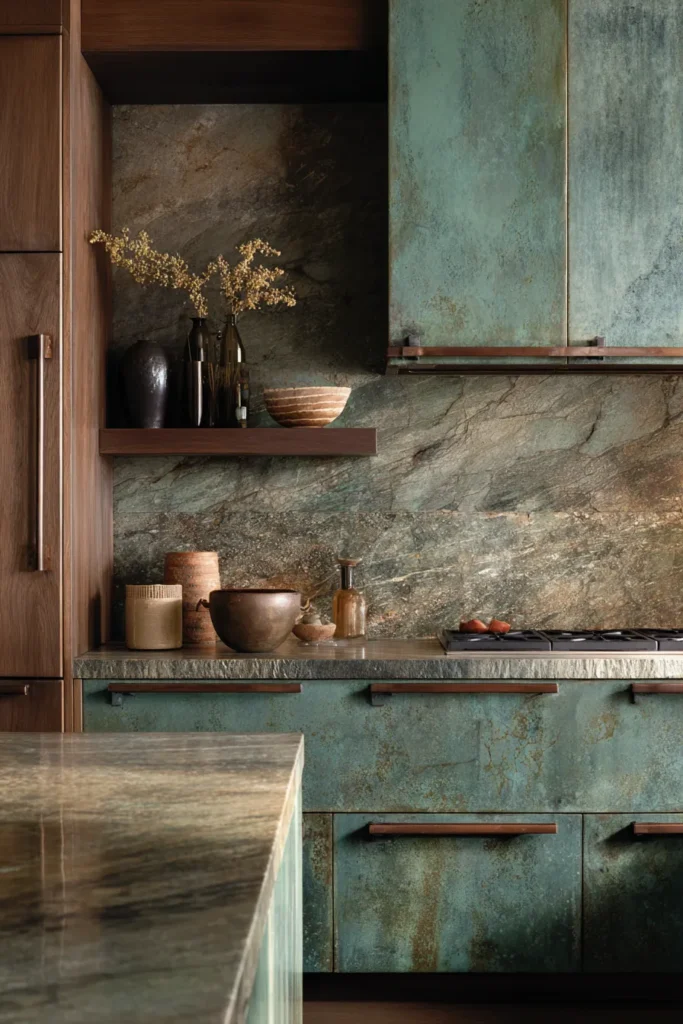
Taupe (LRV 45-50) with pink undertones—not gray-brown—paired with copper that oxidizes to verdigris patina creates an aging narrative. Within 18 months, the copper develops aqua-green spots that contrast beautifully with the blush-taupe base.
Designer’s Secret: You must seal the cabinet finish with low-VOC topcoat, but leave the copper unsealed. The contrasting aging rates—static cabinets versus evolving hardware—create visual interest that improves over time. This living patina philosophy extends to bathroom decor where fixtures develop character.
Design Breakdown:
- Finish: Farrow & Ball “Elephant’s Breath” (LRV 48)
- Hardware: Unlacquered copper pulls (1.5-inch diameter minimum for patina visibility)
- Counter: Taj Mahal or Calacatta Laza with warm veining
- Backsplash: Limestone or travertine in honed finish
Best For: Clients who appreciate wabi-sabi aesthetics. Not suitable for perfectionists.
Powder Blue with Brushed Nickel
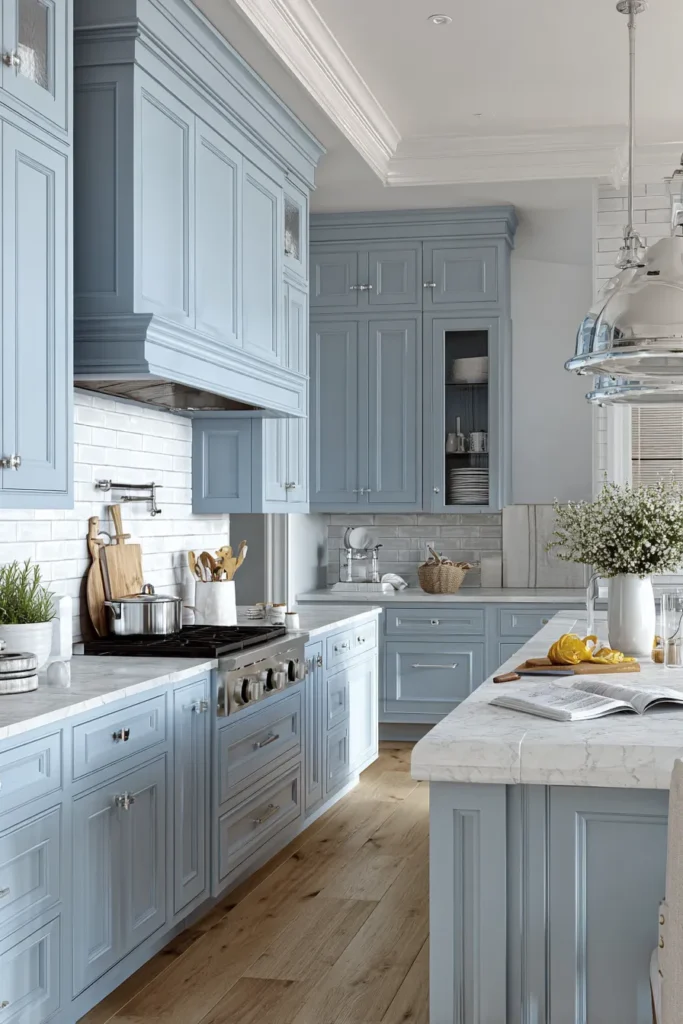
Powder blue (LRV 60-65) with gray undertones avoids the “nursery blue” trap when paired with cool-toned metals. The key is chromatic discipline: every material in the space must have blue or gray undertones—no warm brass, no honey oak.
Designer’s Secret: Powder blue fails in warm-toned homes. Check your floor—if it’s red oak or cherry, abandon this color immediately. It requires white oak, maple, or concrete floors. The same color temperature awareness applies to wall treatments I discuss in living room paint colors.
Design Breakdown:
- Finish: Benjamin Moore “Palladian Blue” (LRV 64)
- Hardware: Brushed nickel or polished chrome
- Counter: White quartz with gray veining (Cambria “Torquay”)
- Backsplash: White subway with gray grout (not cream)
Best For: Coastal homes and Hamptons-style interiors. Requires abundant natural light.
Olive Drab with Limestone Counters
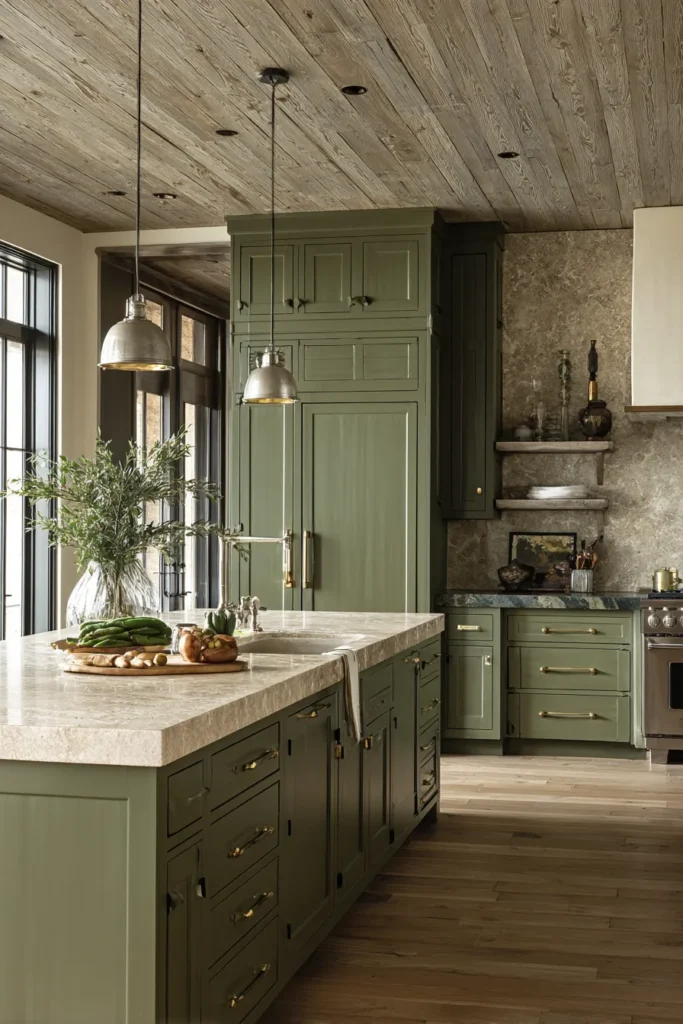
Military-inspired olive (LRV 25-30) brings unexpected sophistication when paired with French limestone’s fossil-filled texture. The biological undertones—chlorophyll in the paint, ancient marine life in the stone—create a primordial connection that feels grounding.
Designer’s Secret: Olive reads as brown in poorly-lit kitchens. You need either abundant south-facing windows or a 4000K task lighting layer that reveals the green undertones. Without proper lighting strategy, this becomes muddy. Consider the spatial lighting techniques from kitchen island ideas for proper illumination.
Design Breakdown:
- Finish: Farrow & Ball “Olive” or Benjamin Moore “Caldwell Green”
- Counter: Pierre de Bourgogne limestone (honed, 3cm)
- Hardware: Aged brass or blackened bronze
- Ceiling: White oak planks or limewashed to prevent oppression
Best For: English country and modern farmhouse aesthetics. Excellent in homes with exposed beams.
Ivory with Visible Wood Grain (Cerused Oak)
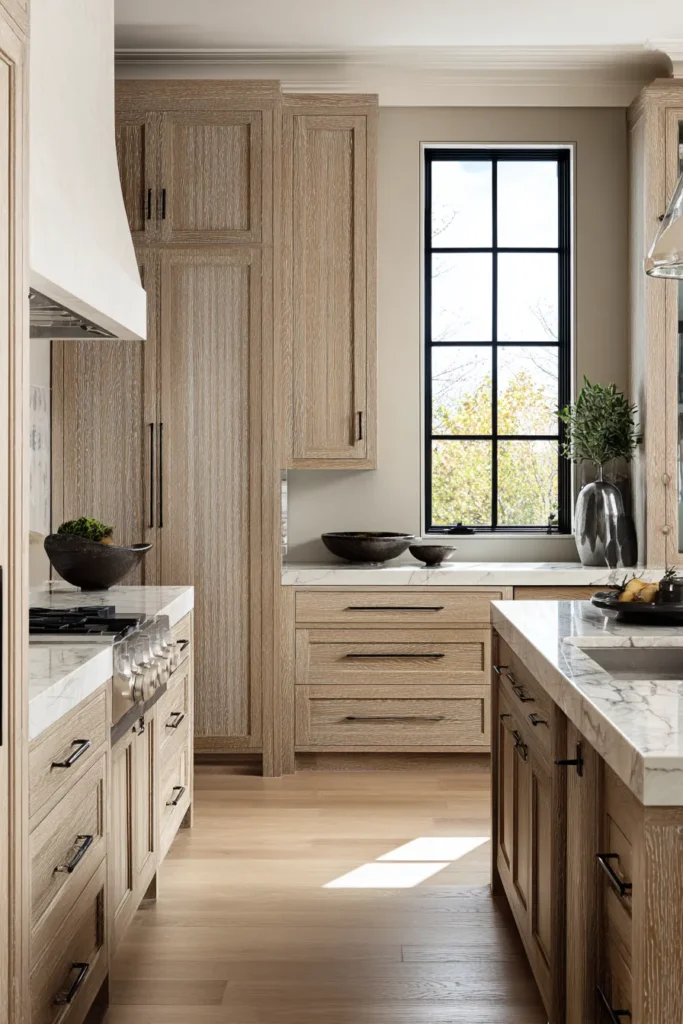
Cerusing—a Renaissance technique where white pigment fills oak’s open grain—creates linear texture that catches raking light. The ivory (LRV 80-85) sits on the surface while the grain remains visible, delivering a dimensional white cabinet that avoids sterility.
Designer’s Secret: Cerusing only works on quarter-sawn oak where the grain runs vertically. Flat-sawn lumber with cathedral grain patterns looks busy rather than refined. Specify quarter-sawn in your millwork drawings or this technique fails.
Design Breakdown:
- Base Material: Quarter-sawn white oak
- Finish: Custom ceruse treatment (white pigment worked into grain, then topcoated)
- Hardware: Polished nickel or crystal
- Counter: Statuary marble or white quartz
Best For: Transitional interiors bridging traditional and modern. Requires custom millwork.
Dusty Rose with Matte Black Hardware
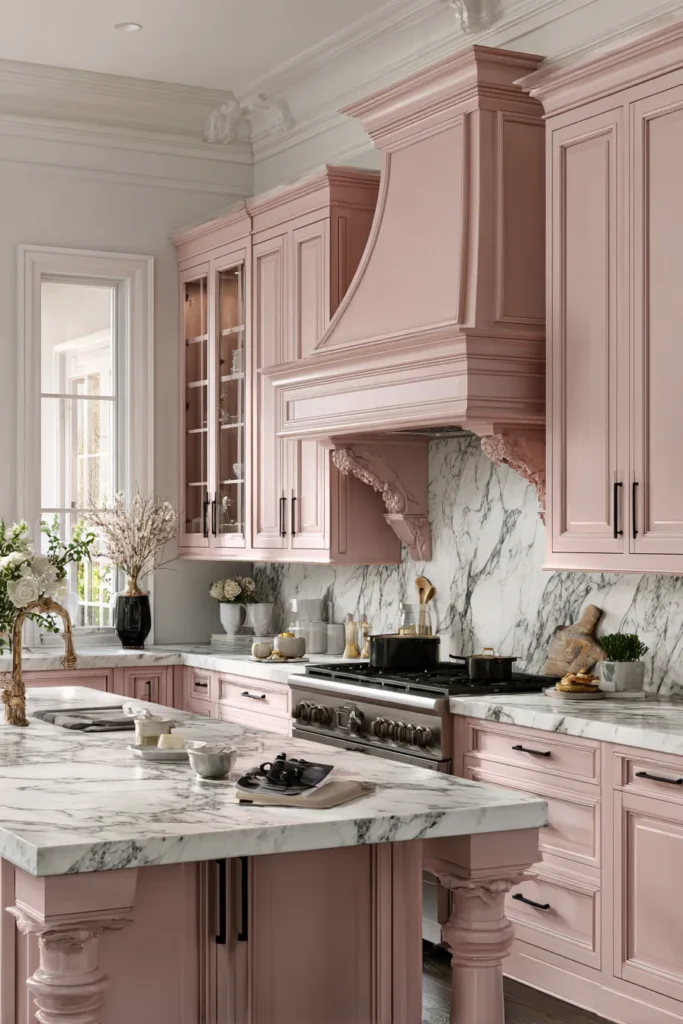
Dusty rose (LRV 50-55)—a clay-based pink with gray undertones—creates a gendered neutral that reads as sophisticated rather than feminine when paired with matte black hardware. The contrast is critical: remove the black, and this becomes cottage-core kitsch.
Designer’s Secret: Dusty rose requires architectural elements in the kitchen—thick crown molding, furniture-style feet on the island, or decorative range hood. In a builder-grade box with flat ceilings, this color lacks the context to succeed. Apply the same architectural richness strategies from entryway decor concepts.
Design Breakdown:
- Finish: Benjamin Moore “Rosy Outlook” (LRV 53)
- Hardware: Matte black T-bar pulls (4-inch length minimum)
- Counter: White marble with gray veining or white concrete
- Floor: Wide-plank white oak or terrazzo
Best For: Victorian and Edwardian homes. Works in lofts with industrial bones.
Forest Green with Aged Patina Brass
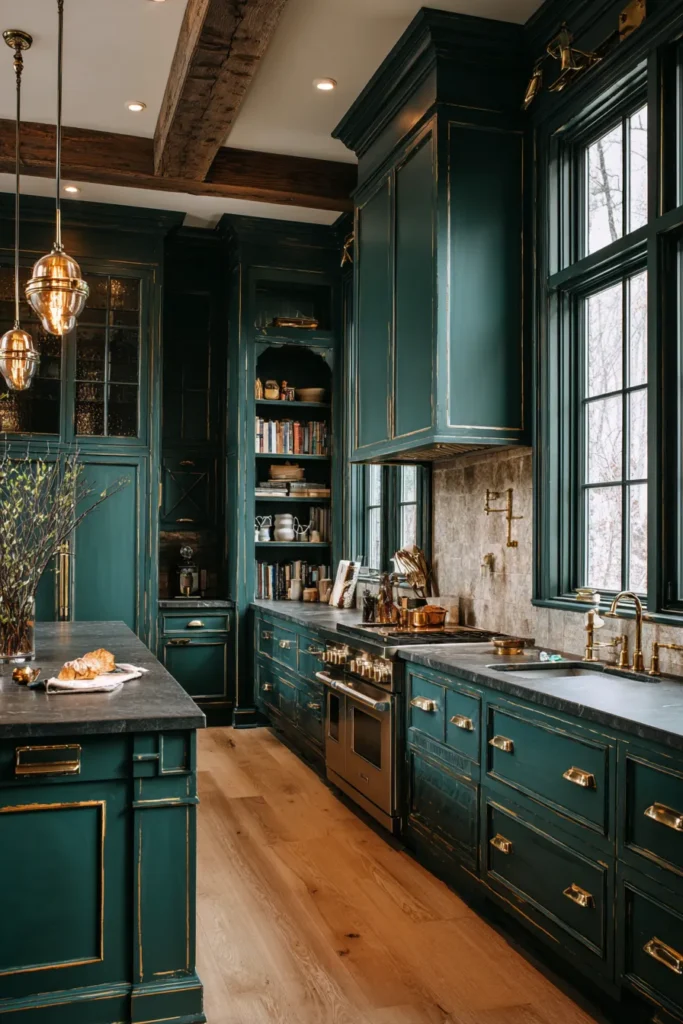
Deep forest green (LRV 15-20) with yellow undertones—not emerald, not teal—paired with heavily patinated brass creates a British club aesthetic. The brass must show use: scratches, darkening in recesses, lighter wear on high-touch areas.
Designer’s Secret: New brass against forest green looks garish. Either buy pre-aged hardware (Restoration Hardware “Vintage Brass”) or chemically patina new brass with salt and vinegar solution. The imperfection is the point—perfect finishes destroy this look’s authenticity.
Design Breakdown:
- Finish: Farrow & Ball “Studio Green” or Benjamin Moore “Forest Green”
- Hardware: Vintage brass or chemically aged brass
- Counter: Soapstone or Verde Alpi marble
- Lighting: 2400K Edison-style bulbs for amber cast
Best For: Library-adjacent kitchens and English Tudor homes. Requires high ceilings (9+ feet).
Soft Beige with Fluted Glass Panels
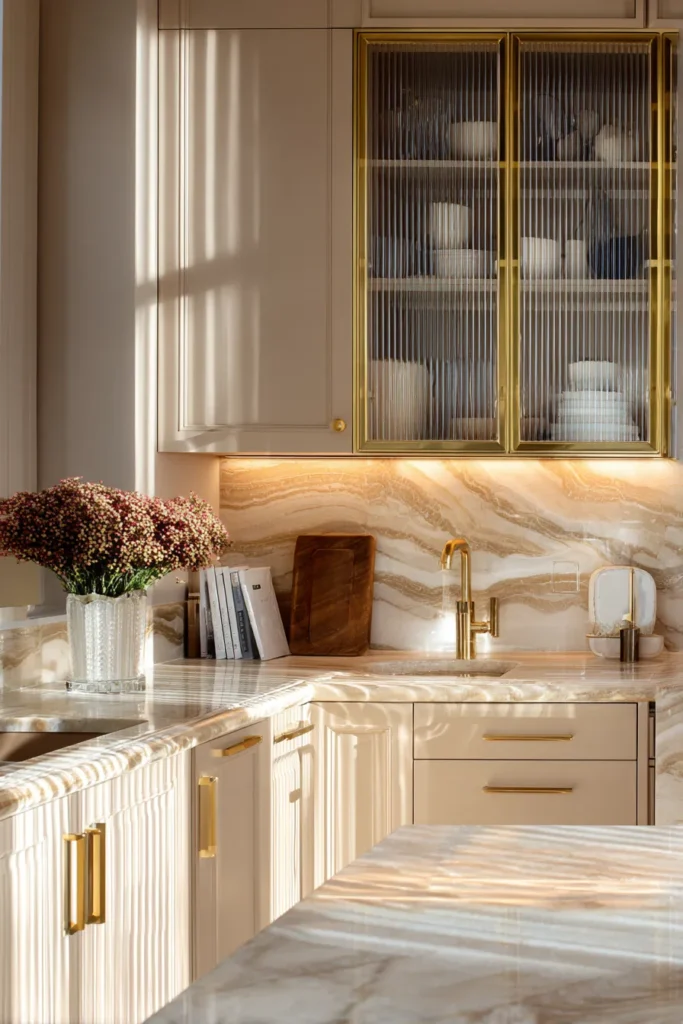
Soft beige (LRV 65-70) with yellow undertones gains sophistication through material juxtaposition—specifically, reeded glass inserts in upper cabinet doors. The vertical ribbing refracts light into linear patterns that animate an otherwise passive color.
Designer’s Secret: Fluted glass requires internal cabinet lighting (2700K LED strips) to create the shadow-play effect. Without lighting, the glass reads as dated 1990s aesthetic. Budget for plug-in or hardwired cabinet lighting—battery pucks don’t provide adequate coverage. Similar detail-oriented approaches work in vanity room ideas where lighting transforms functional spaces.
Design Breakdown:
- Finish: Benjamin Moore “Shaker Beige” (LRV 68)
- Glass: Reeded or fluted glass (vertical orientation only)
- Hardware: Aged brass or bronze
- Counter: Honed marble or quartzite with warm veining
Best For: Art Deco and 1920s-inspired kitchens. Requires professional glass installation.
Slate Blue-Gray with Leather Pulls
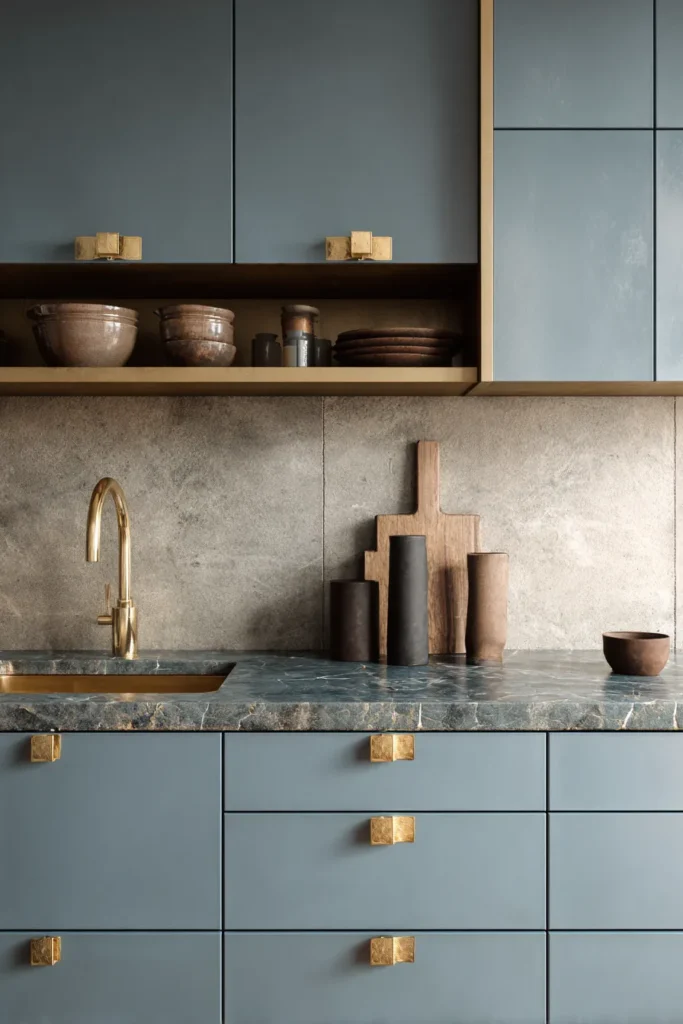
Slate blue-gray (LRV 35-40)—a complex neutral reading as blue in daylight, gray at dusk—paired with leather cabinet pulls introduces tactile luxury. The leather (vegetable-tanned, unsealed) darkens with hand oils over time, creating a personalized patina.
Designer’s Secret: Leather pulls require maintenance—quarterly conditioning with neutral leather balm. They’re inappropriate for high-moisture areas near the sink. Use them on pantry cabinets, island drawers, and upper cabinets only. Position metal pulls (brass or pewter) in wet zones.
Design Breakdown:
- Finish: Benjamin Moore “Boothbay Gray” (LRV 38)
- Hardware: Vegetable-tanned leather pulls + brass backplates
- Counter: Leathered granite or honed soapstone
- Backsplash: Handmade ceramic in mixed grays
Best For: Scandinavian and Japanese-inspired minimalism. Appeals to tactile-focused clients.
Mushroom Brown with Raw Stone Backsplash
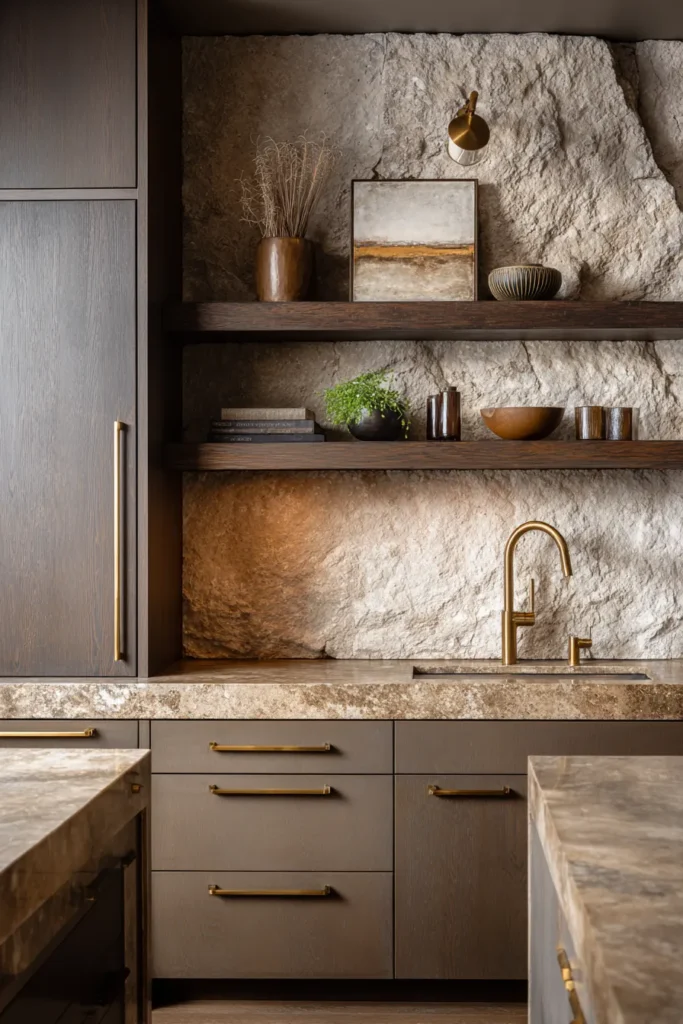
Mushroom brown (LRV 30-35)—a complex neutral with gray and taupe undertones—requires geological pairing: specifically, raw-edge stone backsplash where the natural break line remains visible. The combination creates an organic, unforced aesthetic.
Designer’s Secret: Mushroom brown dies in kitchens with cool lighting. You need 2700K ambient lighting plus natural daylight to reveal the warmth. In north-facing kitchens, this reads as murky gray-brown. Always test samples at different times of day before committing.
Design Breakdown:
- Finish: Farrow & Ball “Mouse’s Back” or Benjamin Moore “Ashley Gray”
- Backsplash: Raw-edge limestone or travertine (irregular cuts)
- Hardware: Unlacquered brass or antique bronze
- Counter: Leathered granite in earth tones
Best For: Organic modern and wabi-sabi aesthetics. Requires rustic architectural elements.
Cream with 2700K Under-Cabinet Lighting
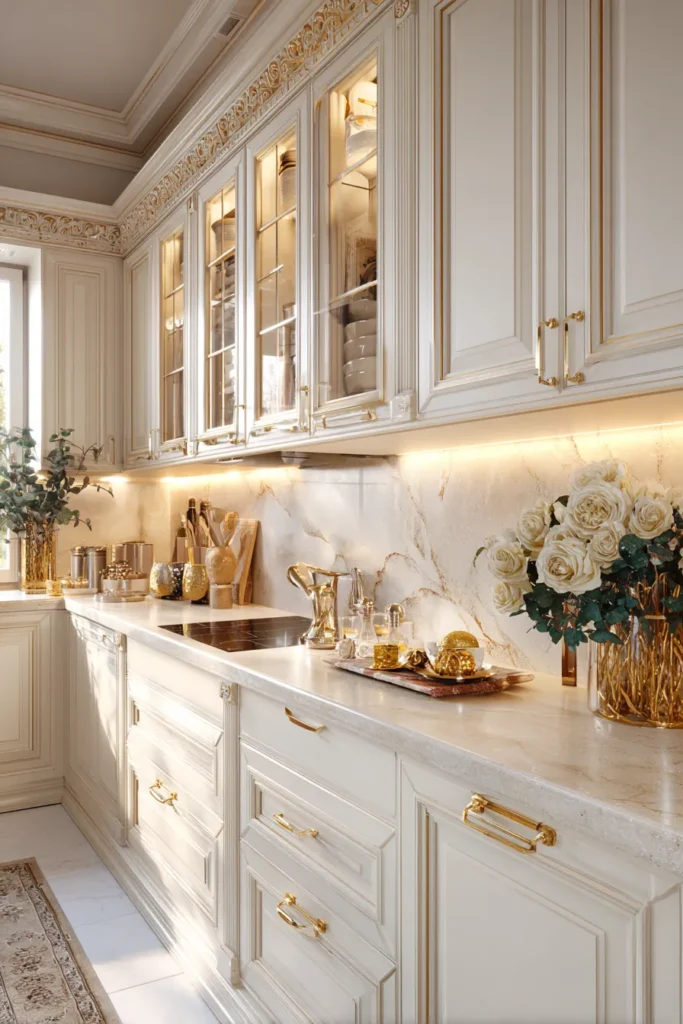
Cream (LRV 75-80) with yellow undertones becomes luminous when paired with 2700K LED strips hidden under upper cabinets. The warm light bounces off the backsplash and counters, creating an amber glow that mimics candlelight.
Designer’s Secret: Cream cabinets fail with 3000K+ lighting—they read as dingy yellow. The light temperature is more important than the paint color itself. I specify 2700K throughout the kitchen (recessed, under-cabinet, and pendants) to maintain color consistency. This cohesive lighting approach mirrors what I recommend in bathroom vanity ideas for flattering illumination.
Design Breakdown:
- Finish: Benjamin Moore “White Down” (LRV 78)
- Lighting: 2700K LED strips with dimmer control
- Hardware: Antique brass or bronze (never chrome)
- Counter: Cream limestone or travertine
Best For: Traditional and French country kitchens. Ideal for evening entertainers.
Charcoal Black with Zebrawood Grain
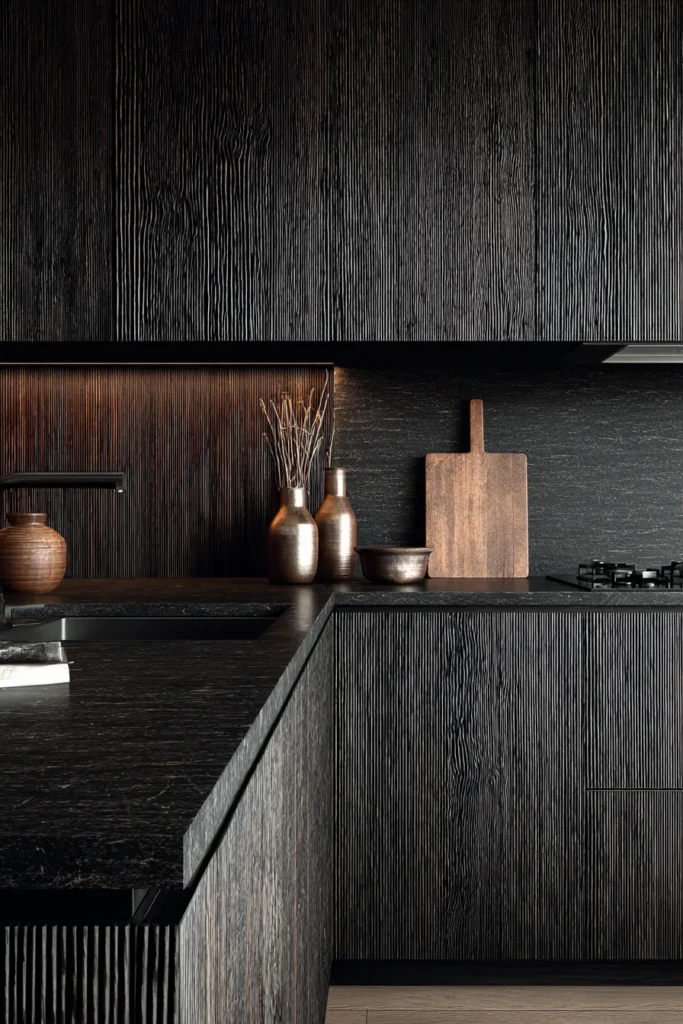
Charcoal black (LRV 5-8) with visible zebrawood grain—achieved through ebonizing rather than solid paint—creates linear drama. The black stain penetrates the wood while the lighter grain remains visible, providing textural relief that solid black lacks.
Designer’s Secret: Ebonizing requires specific wood species: white oak, ash, or maple work well. Zebrawood is expensive, so I often use ribbon-grain sapele as a cost-effective substitute. The grain must run vertically on door faces—horizontal grain reads as busy rather than refined.
Design Breakdown:
- Base Material: Quarter-sawn white oak or sapele
- Finish: Custom ebonizing stain + matte topcoat
- Hardware: Recessed pulls or leather straps (surface hardware competes)
- Counter: Absolute black granite or black concrete
Best For: Modern minimalists and bachelor pads. Not recommended for windowless kitchens.
Two-Tone: Powder Coat White + Natural Oak
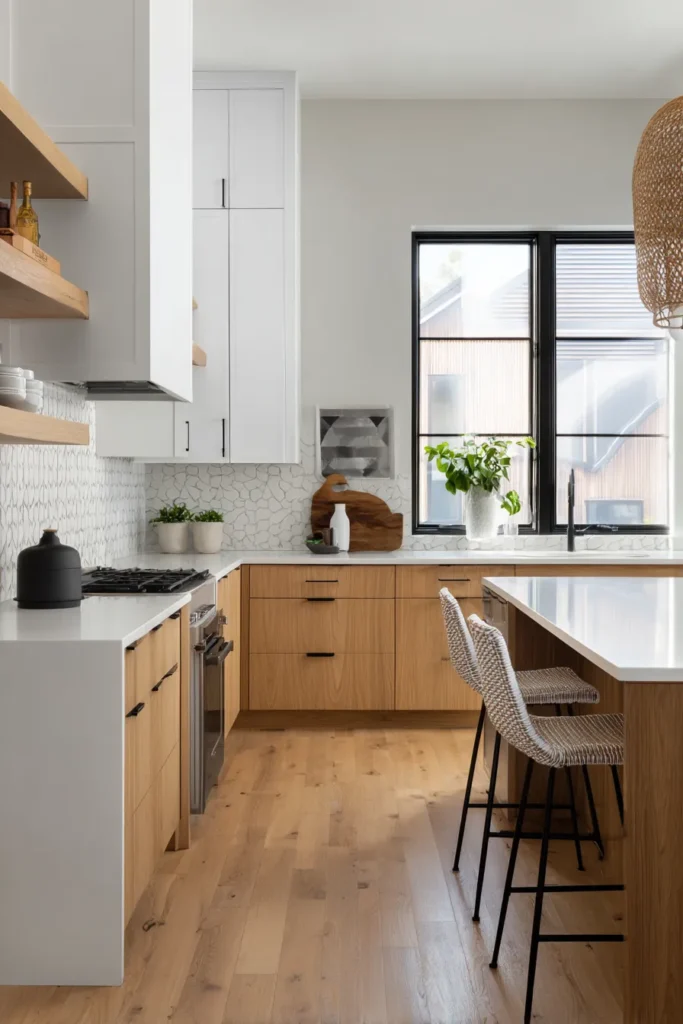
The ultimate tonal balance: powder-coated white upper cabinets (LRV 90+) with natural white oak lowers (LRV 55-60). The matte powder coat provides durability while the wood introduces organic warmth. This isn’t trendy—it’s architecturally sound color theory.
Designer’s Secret: The transition line must follow functional logic: paint for grease-prone areas (near cooking), wood for low-impact zones. I always powder-coat the perimeter cabinets and use natural wood on the island where it’s less exposed to cooking splatter. This practical approach to material selection applies to kitchen cabinets design broadly.
Design Breakdown:
- Upper Finish: Powder-coated white (Benjamin Moore “Chantilly Lace” equivalent)
- Lower Material: Natural white oak with clear matte topcoat
- Hardware: Matte black or aged brass (match throughout)
- Counter: White quartz or honed marble on perimeter; butcher block on island
Best For: Scandinavian and Japanese-inspired kitchens. Appeals to sustainability-focused clients.
Designer’s Warning: Common Cabinet Color Failures
After 15 years specifying cabinet finishes, I’ve witnessed three catastrophic mistakes that plague amateur renovations:
1. Pinterest Color Selection Without LRV Testing That sage green looked perfect on your phone screen, but Pinterest images are color-graded. Always test physical samples (12″x12″ minimum) in your actual kitchen under morning, noon, and evening light. Colors shift dramatically based on directional exposure.
2. Ignoring Your Home’s Architectural Context Navy cabinets in a 1960s ranch house with popcorn ceilings and fluorescent lighting? That’s a context mismatch. Your cabinet color must harmonize with your home’s bones—ceiling height, window size, architectural style, and existing finishes. Consider the holistic spatial relationships I discuss in dining room ideas where context dictates design.
3. Mismatched Sheen Levels Creating Visual Chaos Matte cabinets with glossy counters and semi-gloss backsplash create sheen competition where no surface reads correctly. I maintain sheen consistency: if cabinets are matte (0-5%), counters should be honed (not polished), and backsplash should be matte tile or stone.
The 2026 cabinet color revolution isn’t about chasing trends—it’s about understanding material science, light physics, and spatial psychology. When you select cabinet colors based on LRV mapping, directional light analysis, and material compatibility rather than Instagram inspiration, you create kitchens that improve with age rather than date within months.
The most successful projects I’ve completed share one characteristic: the clients understood that cabinet color is the foundation of spatial harmony, not the decorative finish. These 20 concepts provide technical frameworks, but your specific directional light, ceiling height, and lifestyle requirements will determine which approach serves your space.
Which strategy resonates with your kitchen’s architectural reality? For more on creating cohesive home environments, explore my guides on modern luxury bedroom design and patio interior concepts where similar color theory principles apply across domestic spaces.