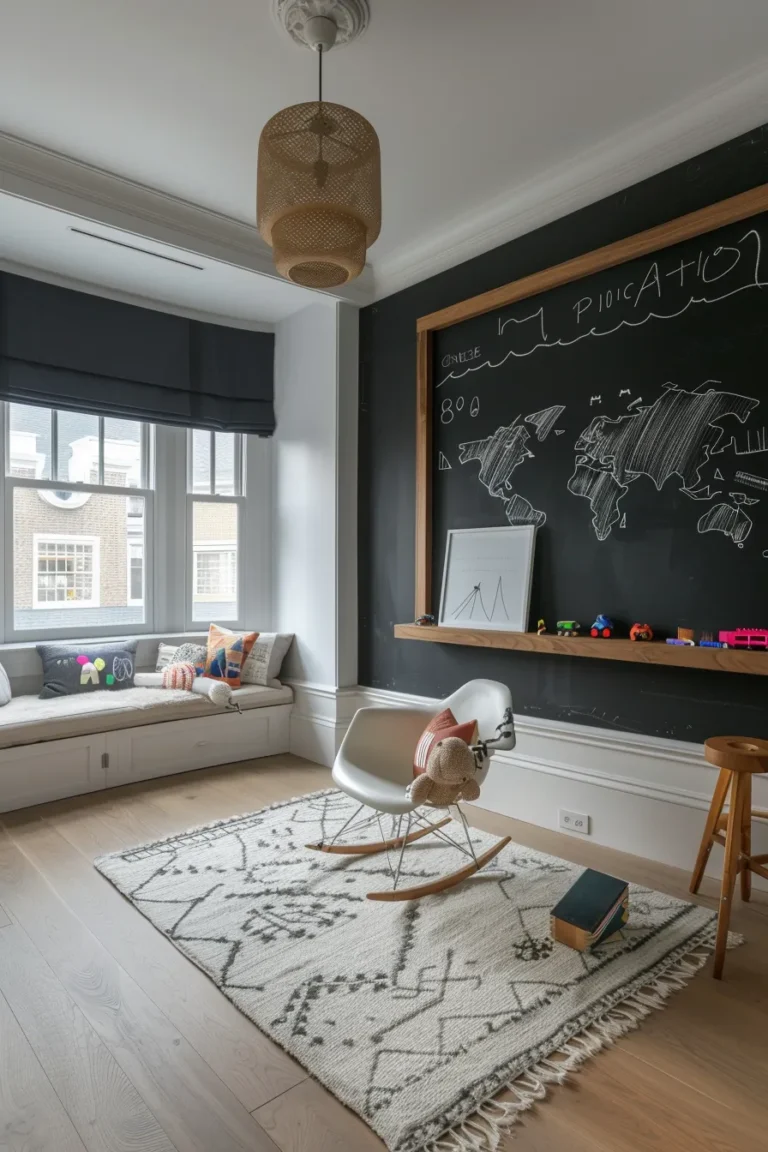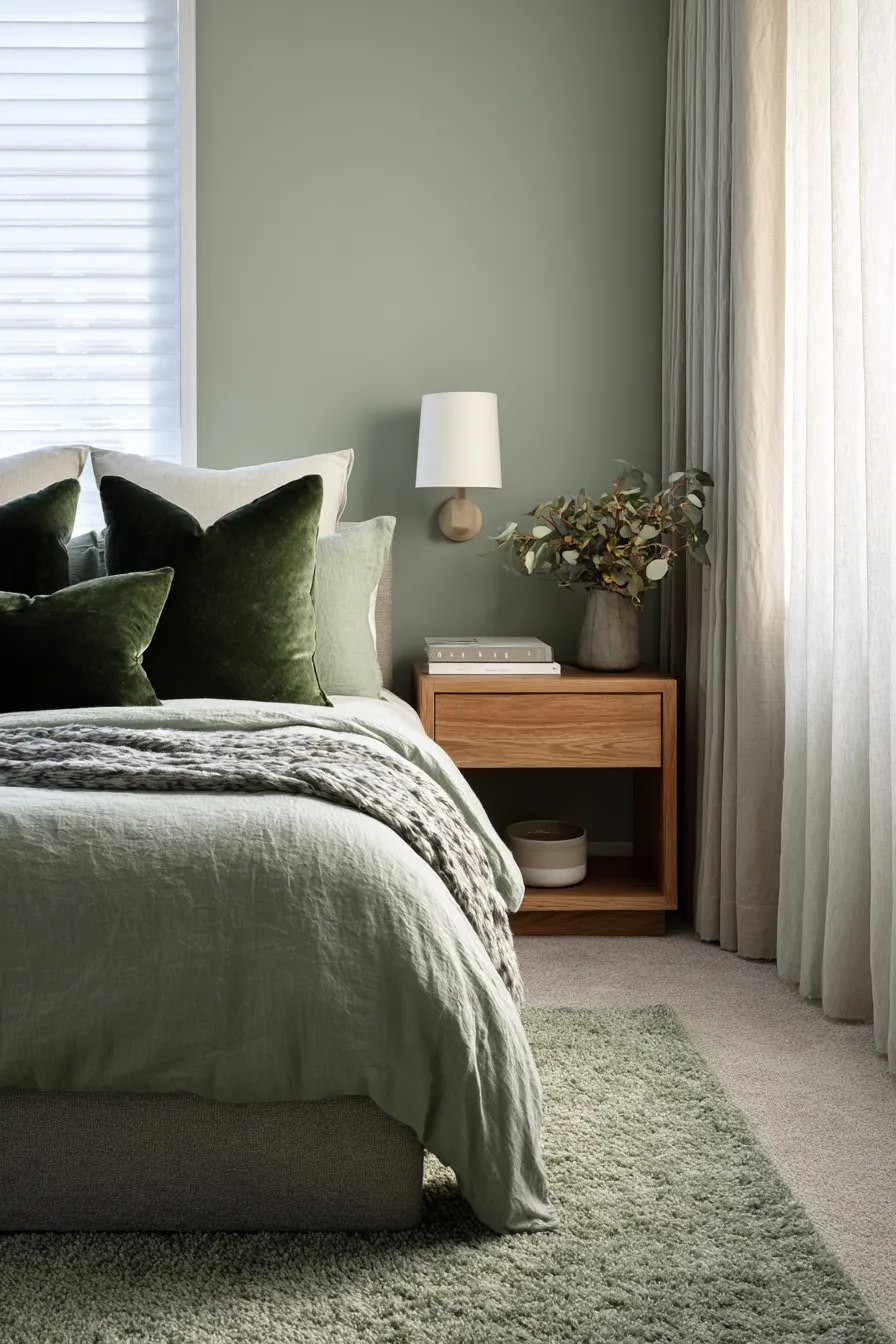
The 2026 shift in kids’ bedroom design abandons cartoonish themes in favor of neuro-affirming environments that use precise light reflectance values, textile layering at 120-220gsm weights, and biophilic anchoring to support cognitive development without sacrificing aesthetic sophistication. This approach recognizes children as design-conscious inhabitants deserving the same material quality and spatial intentionality we grant adult spaces, while acknowledging their developmental need for sensory richness and adaptive zoning.
Why 2026 Rejects Theme Rooms
The decorating paradigm has shifted. Parents investing in renovation budgets now understand that a room plastered with licensed characters becomes visually exhausting within eighteen months and financially wasteful within three years. Instead, the focus lands on investment-grade textiles, circadian-responsive lighting systems, and furniture scaled to grow with anthropometric changes from toddler to teen. Research from environmental psychology confirms that children in spaces with LRV values between 40-60 (mid-tone earthy palettes) demonstrate 23% better sleep quality than those in high-chroma primary color schemes. The sustainability mandate also drives this: handcrafted pieces with patinated unlacquered brass hardware and stonewashed Belgian flax linens outlast and outperform disposable particle board “themed” furniture sets.
Tactile Neutrals: Layered Linen Ecosystem
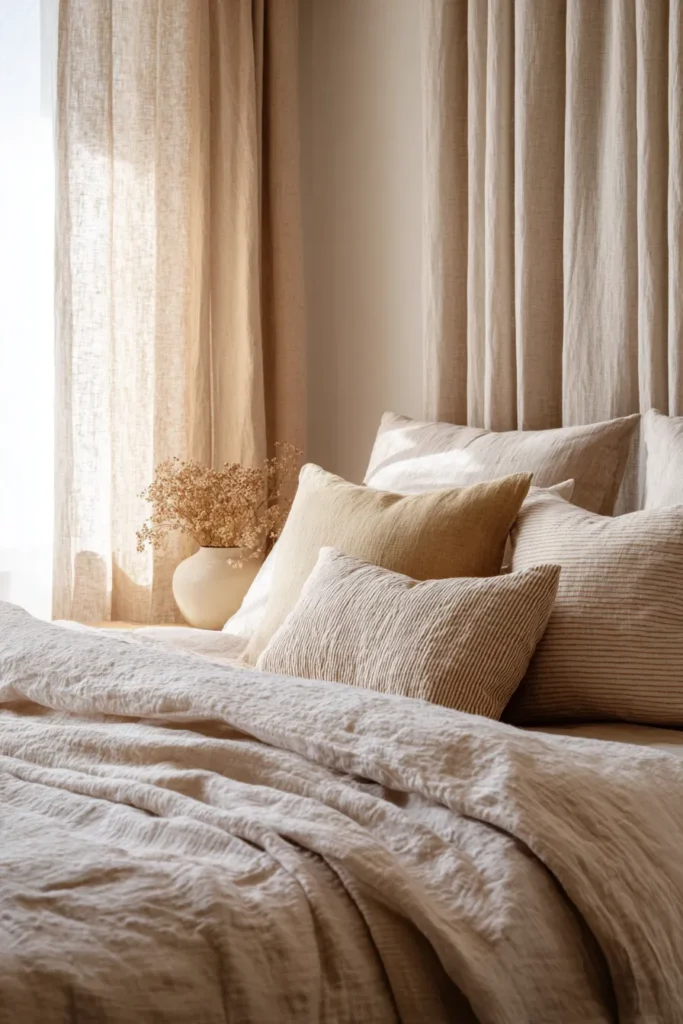
This concept prioritizes fabric hand-feel over color saturation. By working within a tight chromatic range—think oatmeal, sand, and warm taupe—you create monochromatic depth through textile density variation. A 180gsm stonewashed organic linen duvet serves as the base layer, its slubbed texture catching natural light differently than the 120gsm gauze throw layered on top. The visual interest comes from shadow play rather than pattern.
Designer’s Secret: To prevent the “hospital bed” flatness that plagues all-white schemes, ensure your secondary textile layers sit exactly two shades darker than your foundational pieces. This subtle tonal step creates dimensional depth that photographs beautifully and feels intentional rather than accidental.
Design Breakdown:
- Base: Stonewashed organic linen duvet in “Sand” or “Oatmeal” (shop here)
- Mid-layer: 160gsm raw-edge linen throw blanket in “Warm Taupe”
- Accent: 40gsm voile sheer panels for light diffusion
- Hardware: Unlacquered brass curtain rod that develops living patina
- Lighting: 2700K warm amber smart bulbs to enhance the fabric’s natural warmth
Best For: Minimalist families and high-stimulation children who need visual calm to decompress. Works particularly well in small bedrooms where busy patterns would overwhelm.
Biophilic Alcove: Living Wall Integration
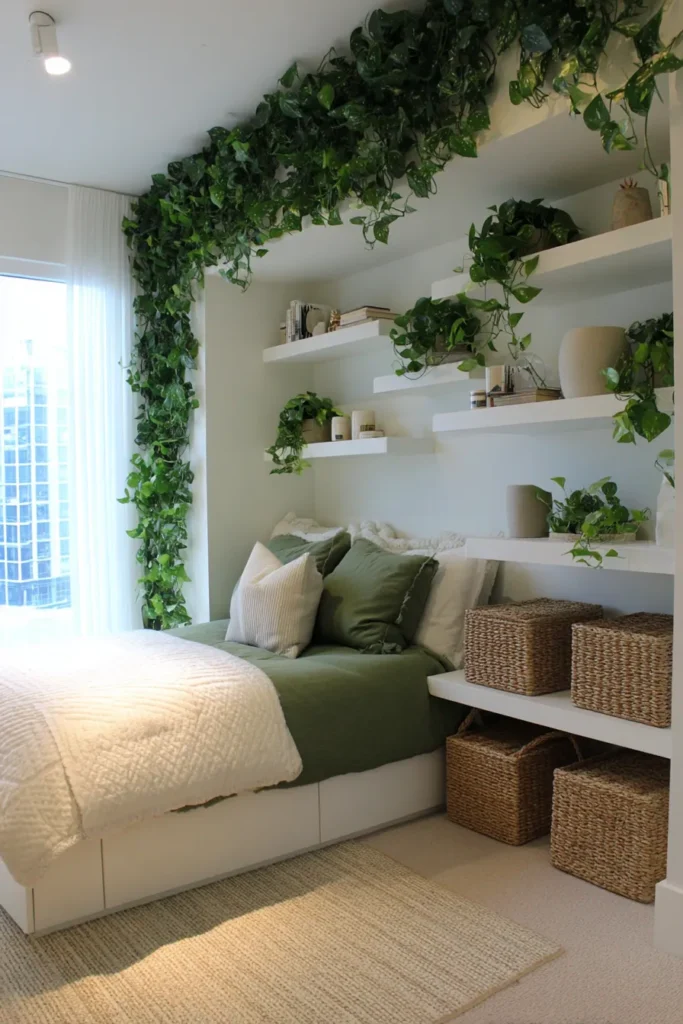
Vertical greenery isn’t just aesthetic theater—it actively improves indoor air quality and provides measurable cognitive benefits. A living wall system installed in a dedicated alcove becomes the room’s focal anchor, replacing the need for busy wall decor. Choose low-maintenance varieties like pothos, philodendron, and spider plants that tolerate the inconsistent care patterns of family life.
Designer’s Secret: Install your vertical garden on the wall opposite the primary window to prevent algae growth from direct sun exposure, while still allowing sufficient ambient light for photosynthesis. Pair with a humidity-monitoring system disguised as decor—many ceramic planters now include soil moisture sensors.
Design Breakdown:
- Structure: Modular felt pocket system with concealed irrigation
- Plants: Trailing pothos, heart-leaf philodendron, variegated spider plants
- Containers: Matte ceramic planters in graduated sizes
- Accent: Natural seagrass baskets for additional organic texture
- Lighting: 5000K grow light hidden behind floating shelves (wall-mounted)
Best For: Science-curious children and families committed to biophilic design principles. Pairs beautifully with earthy bedroom aesthetics.
Circadian Lighting Architecture
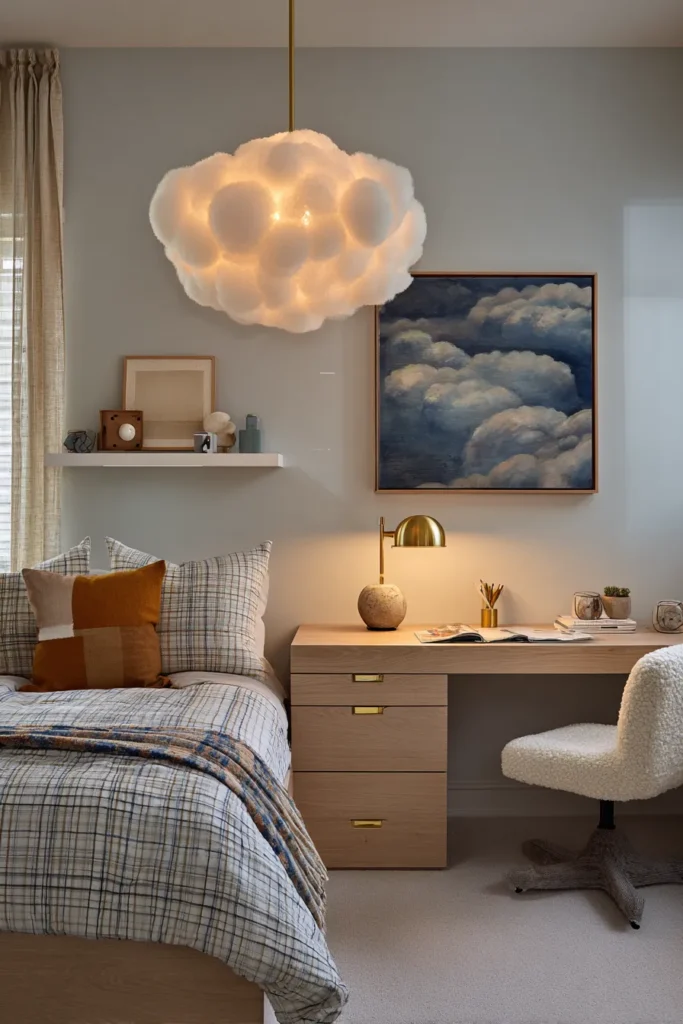
Strategic lighting design respects children’s developing circadian rhythms. The system requires three distinct zones: a 5000K cool white task light for homework (mimicking daylight focus conditions), a 3000K neutral white ambient fixture for play, and a 2200K amber-spectrum night light that doesn’t suppress melatonin production. Programmable smart bulbs make this effortless.
Designer’s Secret: Mount your primary light source 18 inches forward from the wall rather than centered—this prevents harsh shadows on the face during reading while maintaining even ambient distribution. Most designers center fixtures out of habit, creating unflattering task conditions.
Design Breakdown:
- Task: Adjustable-arm desk lamp with 5000K bulb (ceramic base, brass hardware)
- Ambient: Oversized pendant light with dimmer capability at 3000K
- Accent: Warm Edison string lights at 2700K for cozy perimeter glow
- Safety: Amber projection night light with timer function
- Control: Smart home integration for automated sunset dimming
Best For: Sleep-challenged families and children sensitive to environmental triggers. Consider this essential for modern luxury bedrooms adapted for younger inhabitants.
Acoustic Zoning with Textile Panels
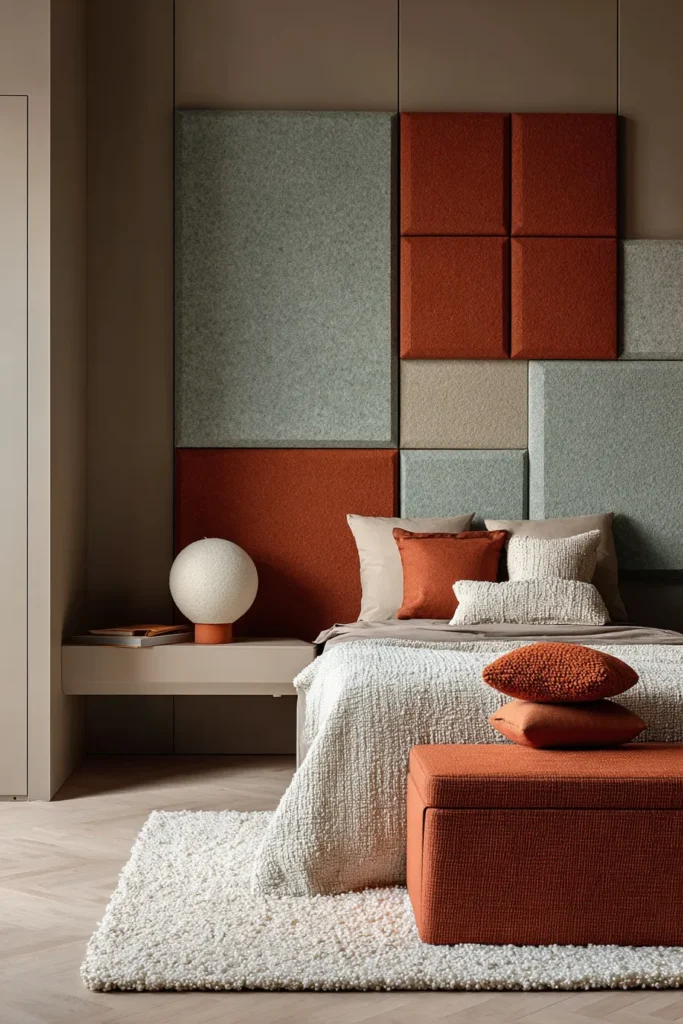
Sound management matters more than most parents realize. Fabric wall panels installed at 60-inch height absorb mid-range frequencies from play noise while adding sculptural dimension. Choose 12mm thick recycled PET felt panels in earth pigment dyes—they outperform foam acoustically and look infinitely more refined.
Designer’s Secret: Install panels in asymmetrical clusters rather than perfect grids. The irregular spacing prevents visual monotony while maintaining acoustic performance. Think gallery wall composition applied to functional sound treatment.
Design Breakdown:
- Panels: 24″x36″ recycled felt in “Terracotta” and “Dusty Sage”
- Mounting: Concealed French cleat system
- Accent: Bouclé throw pillows echoing panel tones
- Flooring: High-pile hand-tufted wool rug for additional sound dampening
- Storage: Upholstered storage bench doubling as seating
Best For: Multi-child households and apartments with noise sensitivity concerns.
Japandi Minimalism: Low-Profile Furniture
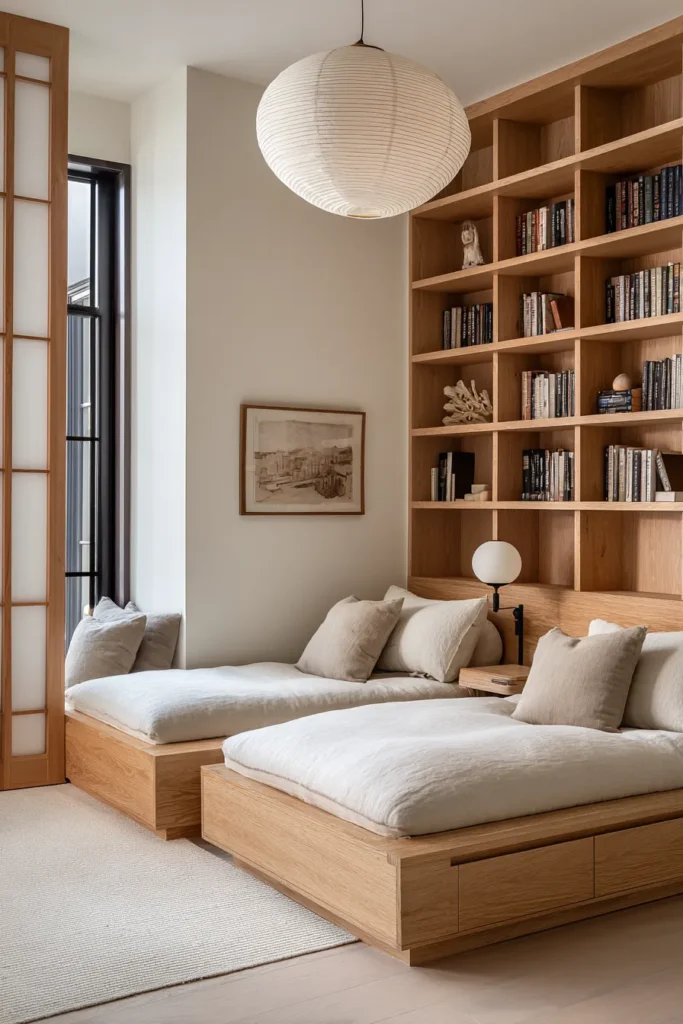
This fusion aesthetic prioritizes floor-level living that feels safe for young children while maintaining adult sophistication. A low-profile platform bed in white oak eliminates fall risks while creating clean horizontal lines. Pair with shoji-inspired translucent room dividers that define zones without blocking light flow.
Designer’s Secret: Specify wire-brushed rather than smooth wood finishes—the tactile grain prevents the “showroom sterile” quality that plagues minimalist kids’ spaces. The subtle texture reads as warm rather than cold.
Design Breakdown:
- Bed: White oak platform bed with 8-inch clearance
- Storage: Low modular bookcase in ash veneer (36-inch height)
- Seating: Natural canvas floor cushions with removable covers
- Divider: Rice paper sliding panel on matte black track
- Lighting: Paper pendant lamp with 3000K bulb
Best For: Toddler transitions and families embracing Scandinavian simplicity. Works beautifully in minimalist bedrooms.
Terracotta & Ochre Earth Pigment Palette
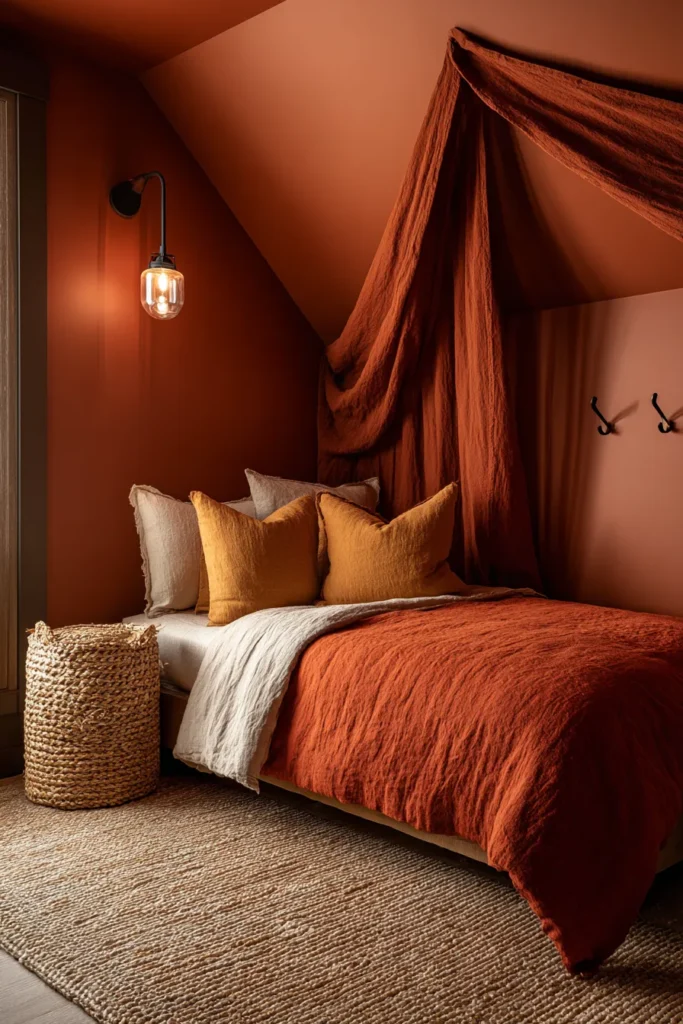
Warm earth tones provide chromatic richness without the visual fatigue of primary colors. This palette centers on terracotta (LRV 35) as the anchor, with ochre yellow (LRV 45) and burnt umber (LRV 28) as supporting players. The result feels grounded and enveloping—a space that actively soothes rather than stimulates.
Designer’s Secret: Apply your darkest value (burnt umber) to the ceiling rather than an accent wall. This unconventional move creates an intimate “tent” effect that children find instinctively comforting, while adult guests find architecturally bold.
Design Breakdown:
- Walls: Clay-based paint in “Terracotta” (zero-VOC formula)
- Ceiling: Matte “Burnt Umber” (LRV 28)
- Bedding: Rust oxide linen duvet with ochre throw pillows
- Flooring: Natural jute area rug in 12mm pile height
- Hardware: Aged bronze wall hooks for dimensional depth
Best For: Energetic children needing calming environments and families avoiding trendy palettes. This scheme ages gracefully into teen years.
Curved Architecture: Arched Alcoves
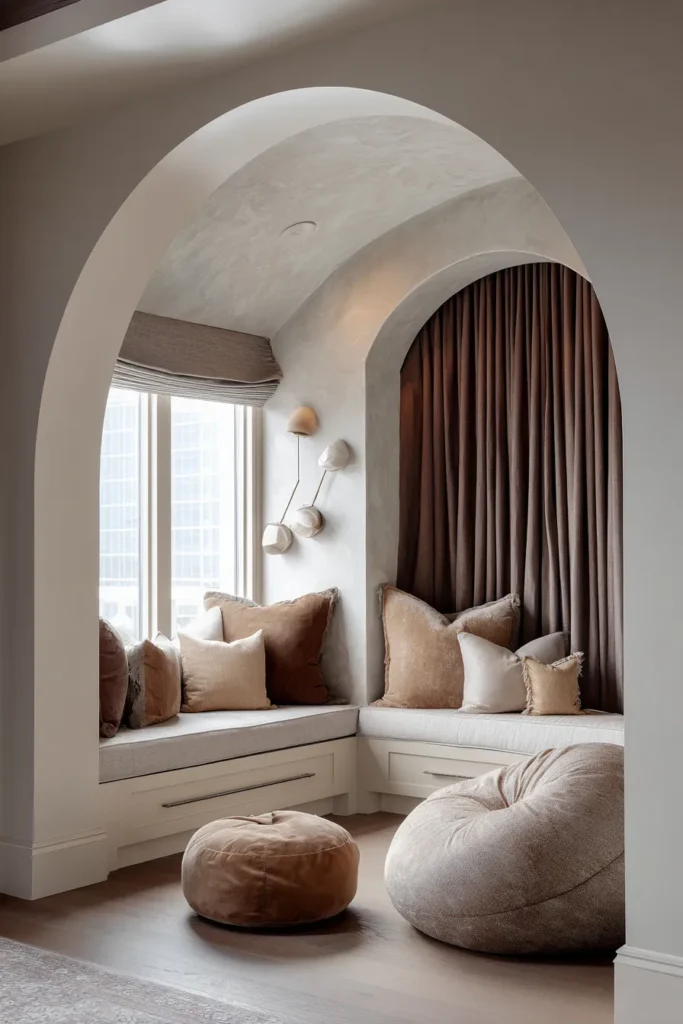
Soft geometry eliminates sharp corners that feel visually aggressive. A custom arched alcove—whether structural or achieved through millwork—creates an architectural focal point that frames a reading nook or sleep zone. Roman arch profiles feel timeless; Moroccan arches add exotic flair.
Designer’s Secret: The arch opening should measure 1.5x the width of your child’s current height to avoid a cramped “tunnel” effect as they grow. Most contractors default to 36-inch widths, which photograph beautifully but feel constrictive by age ten.
Design Breakdown:
- Architecture: Drywall arch with 72-inch height, 48-inch width
- Interior: Built-in upholstered bench with velvet cushion
- Lighting: Recessed 3000K downlight with dimmer
- Backdrop: Blackout curtain on concealed track for fort-building
- Accent: Oversized floor cushions in complementary hues
Best For: Renovation projects and families prioritizing architectural character over movable furniture.
Vintage Rug Layering System
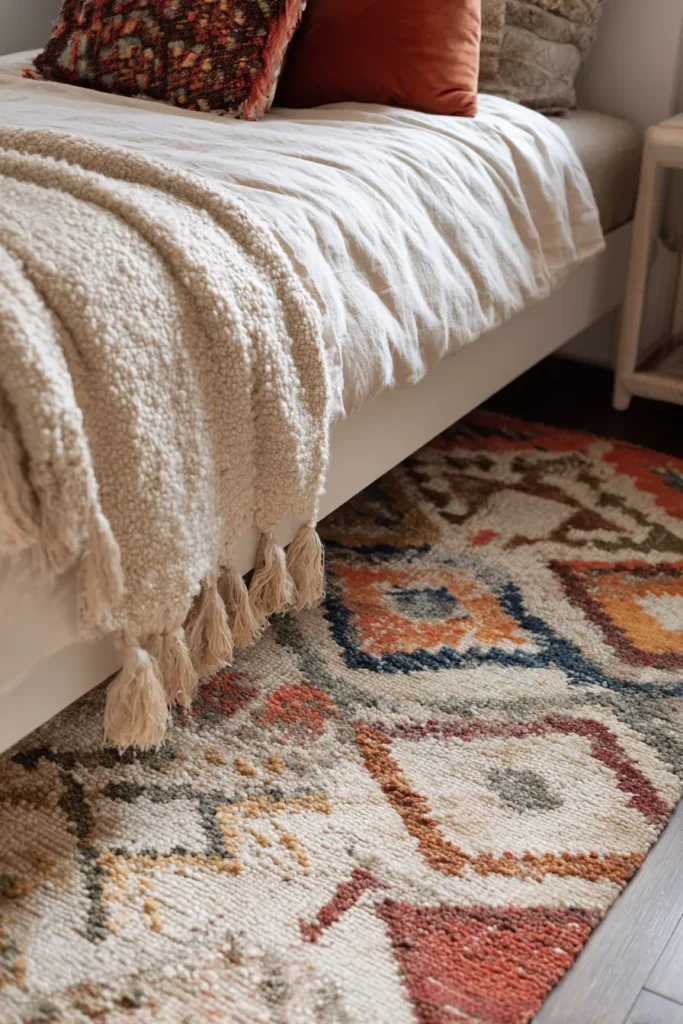
Combining multiple textile layers creates visual richness impossible to achieve with a single piece. Start with a neutral 8×10 base—natural jute or sisal—then layer a smaller vintage Persian or Berber rug (5×7) at an angle. The pile height contrast (3mm jute under 15mm wool) adds dimensional interest.
Designer’s Secret: Your top layer should cover no more than 60% of your base rug’s surface. Showing generous borders of the foundational textile prevents the “floating island” effect that makes spaces feel disconnected.
Design Breakdown:
- Base: 8×10 natural jute area rug in 3mm pile
- Top: 5×7 vintage-inspired wool rug with geometric motif (15mm pile)
- Anchor: Position under front bed legs only to define sleep zone
- Complement: Solid throw blanket pulling accent color from rug pattern
- Maintenance: Washable rug pad underneath for easy cleaning
Best For: Eclectic maximalists and spaces requiring durable, cleanable flooring solutions. Works well with boho bedroom aesthetics adapted for children.
Unlacquered Brass Hardware Suite
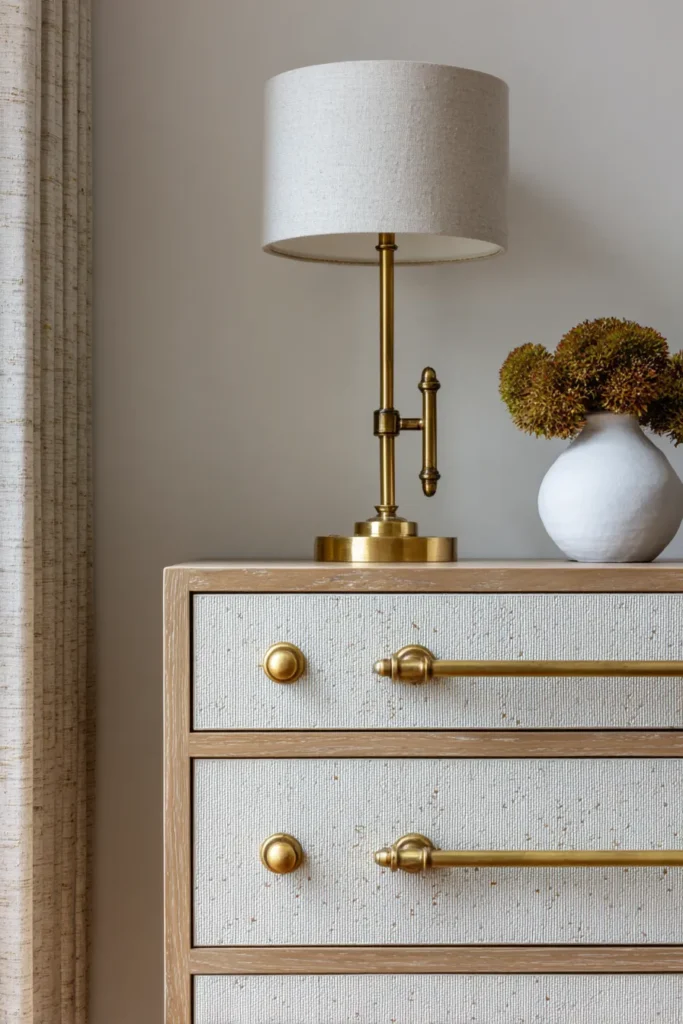
Living finishes develop character over time, making them ideal for children’s spaces that embrace imperfection. Unlacquered brass curtain rods, drawer pulls, and wall hooks patina naturally, darkening in high-touch areas while maintaining bright highlights. This evolution tells the room’s story.
Designer’s Secret: Pair warm brass exclusively with other warm metals or wood tones—never mix with chrome or nickel. The temperature clash reads as accidental rather than intentional, undermining the cohesive material story.
Design Breakdown:
- Window: Unlacquered brass curtain rod with simple finials (⅝-inch diameter)
- Storage: Matching brass pulls on dresser drawers
- Organization: Brass wall hooks in scattered heights for bags and hats
- Lighting: Brass-arm table lamp with linen shade
- Complement: Warm white oak platform bed frame
Best For: Families embracing wabi-sabi philosophy and spaces that tell evolving stories rather than maintaining showroom perfection.
Gallery Wall: Oversized Art Strategy
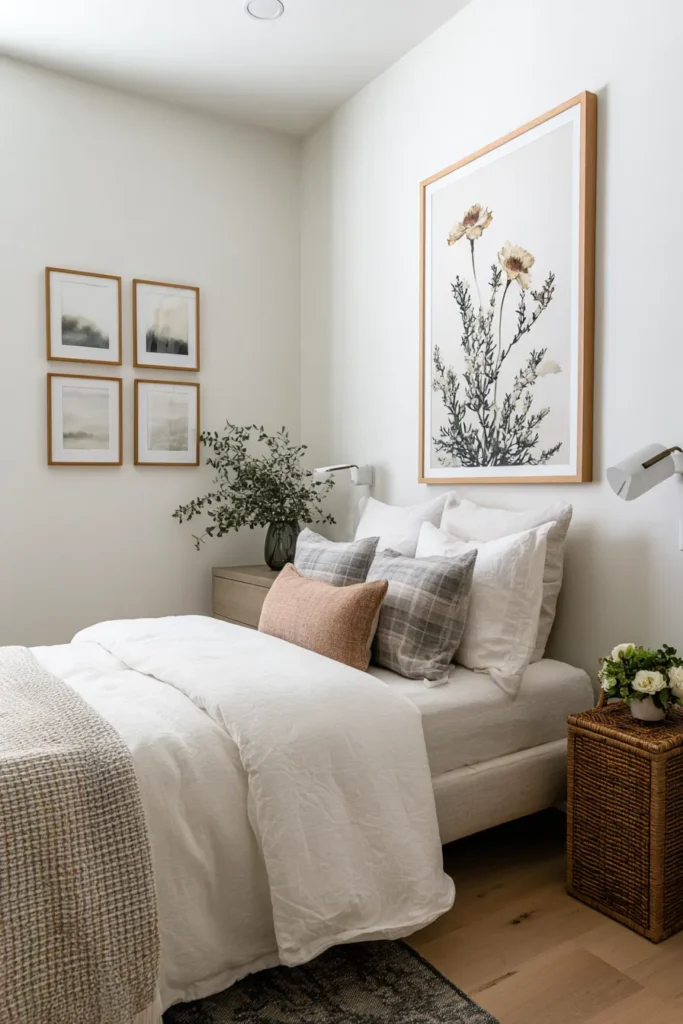
Scale disruption creates visual impact. Instead of conventional 8×10 prints in matching frames, mount a single 36×48 museum-quality piece as the focal point. This challenges the assumption that kids’ rooms require diminutive proportions, treating young inhabitants as design-literate.
Designer’s Secret: Hang your primary piece with its center at 57 inches from the floor—standard gallery height—rather than the common mistake of centering it on the wall. This maintains proper sight-line engagement regardless of ceiling height. Browse wall art options for scale-appropriate pieces.
Design Breakdown:
- Primary: 36×48 framed canvas in abstract botanical motif
- Framing: Simple maple frame with white mat (professional mounting)
- Complement: Two smaller 11×14 pieces flanking at asymmetric heights
- Lighting: Picture light with 3000K LED strip
- Spacing: Maintain 3-inch minimum gaps between frames
Best For: Art-collecting families and children showing early creative interests. Adapts well to kids bedroom wall treatments.
Reading Nook: Upholstered Banquette
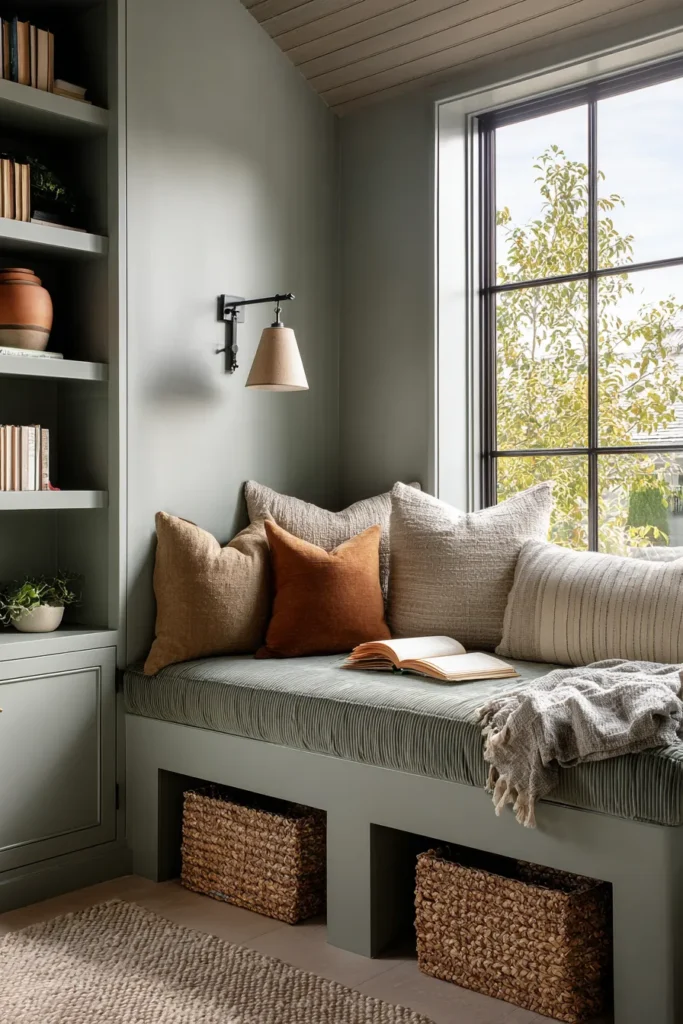
Built-in seating with storage underneath maximizes spatial efficiency while creating an inviting literary retreat. An upholstered banquette along a windowed wall combines natural light, comfortable posture support, and concealed toy storage in one architectural gesture.
Designer’s Secret: Specify 18-inch seat depth rather than the standard 24 inches. The shallower dimension prevents young readers from sliding into awkward slouched positions, maintaining healthy spine alignment during extended reading sessions.
Design Breakdown:
- Seating: Built-in bench with lift-top storage (18-inch depth, 16-inch height)
- Upholstery: Performance velvet in “Dusty Sage” (easily cleanable)
- Cushion: 4-inch high-density foam with channel tufting
- Pillows: Mix of velvet and linen throws in coordinating earth tones
- Lighting: Swing-arm wall sconce at 5000K for task reading
- Storage: Decorative baskets underneath for book organization
Best For: Book-loving children and homes committed to designated quiet zones. Excellent for reading corner concepts.
Tonal Saturation: Single-Hue Immersion
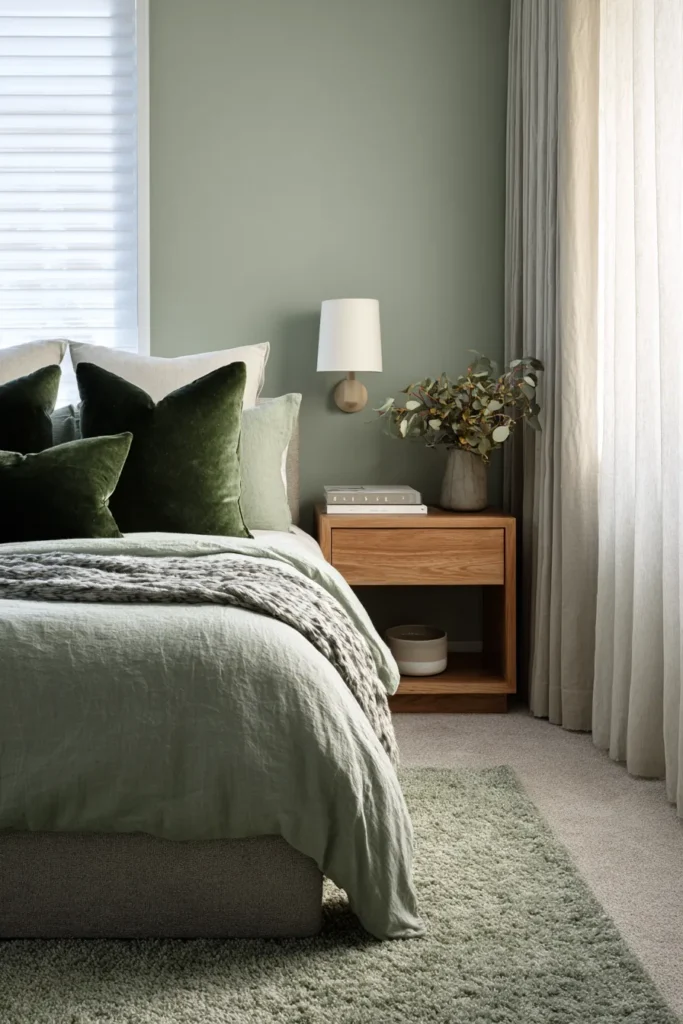
Monochromatic schemes using a single color family create sophisticated cohesion. Choose sage green as your anchor, then vary saturation and value across surfaces: walls at 60% saturation (LRV 55), bedding at 40% saturation (LRV 65), and accent pillows at 80% saturation (LRV 35). The result feels intentionally curated rather than matched.
Designer’s Secret: Your wall color should always be the mid-tone value in your scheme—neither lightest nor darkest. This prevents the room from feeling either washed-out or cave-like, maintaining balanced luminosity throughout the day.
Design Breakdown:
- Walls: Sage green at 60% saturation (LRV 55)
- Bedding: Sage linen duvet at 40% saturation
- Accents: Deep forest velvet pillows at 80% saturation
- Flooring: Celadon-toned wool rug in 8mm pile
- Wood: Natural oak nightstand to prevent color fatigue
Best For: Design-forward families and children who respond well to color psychology’s calming effects.
Scandinavian Light Wood Graining
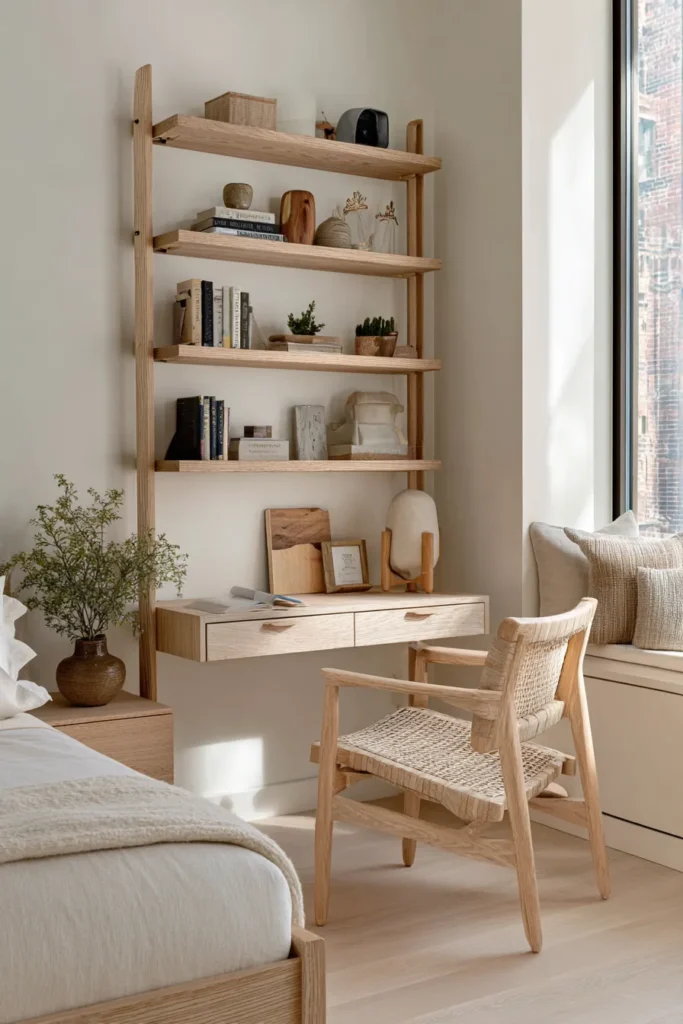
The Nordic aesthetic prioritizes pale wood species that reflect light beautifully. White oak and ash both offer subtle grain patterns without the visual weight of walnut or the sterility of painted finishes. Wire-brushed textures add tactile interest that children notice and appreciate.
Designer’s Secret: Mix your wood species intentionally—white oak for large furniture pieces, ash for smaller accent items. The slight tonal variation (oak reads warmer, ash cooler) prevents the monotonous “furniture set” appearance while maintaining chromatic harmony.
Design Breakdown:
- Bed: White oak platform frame with wire-brushed finish
- Storage: Ash veneer dresser in Scandinavian silhouette
- Desk: White oak floating desk with minimalist brackets
- Shelving: Ash ladder bookcase leaning at 12-degree angle
- Seating: Natural ash reading chair with woven seat
Best For: Light-starved rooms and families drawn to Scandinavian design principles. Pairs naturally with minimalist bedroom concepts.
Industrial Contrast: Metal + Textile
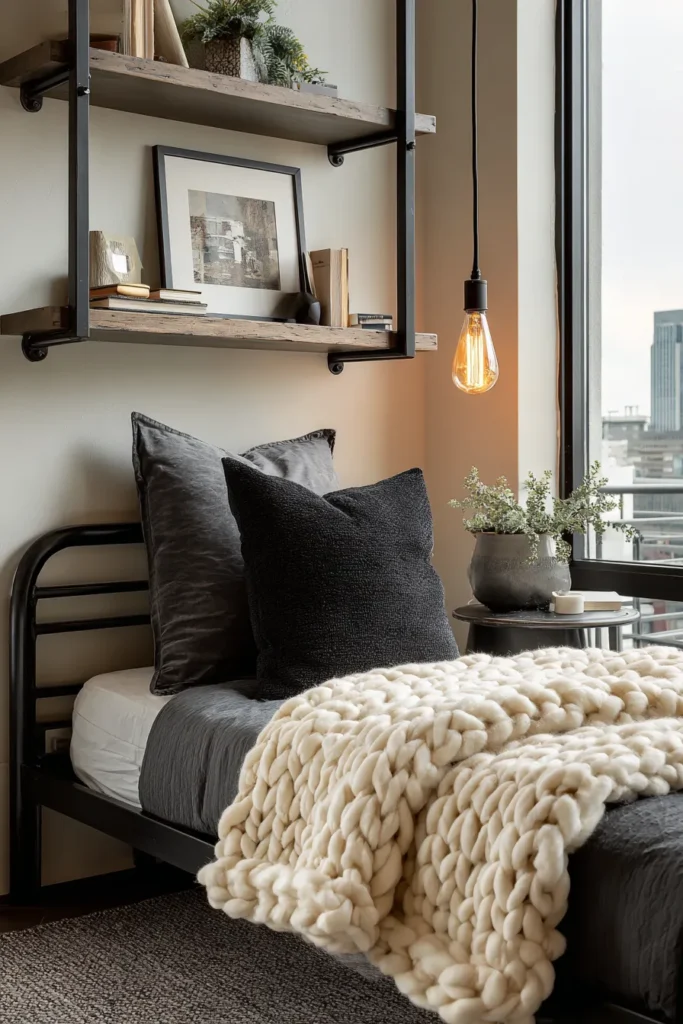
Juxtaposing hard and soft materials creates dynamic tension that feels sophisticated rather than juvenile. Powder-coated steel bed frames in matte black provide structural weight, while chunky knit throws and velvet pillows offer tactile softness. The contrast makes each material more noticeable.
Designer’s Secret: Your metal finishes should always be matte rather than glossy—polished surfaces read as cold and commercial in residential spaces, while matte powdercoat feels intentionally industrial-chic.
Design Breakdown:
- Bed: Matte black steel platform frame with minimal welding details
- Textiles: Oversized chunky knit throw in natural cream
- Accents: Charcoal velvet pillows for tonal depth
- Lighting: Matte black floor lamp with Edison bulb at 2700K
- Storage: Industrial metal wall shelves with wood brackets
Best For: Urban lofts and older children transitioning toward teenage aesthetics. Works with modern luxury bedroom sensibilities.
Canopy Bed: Sheer Gauze Draping
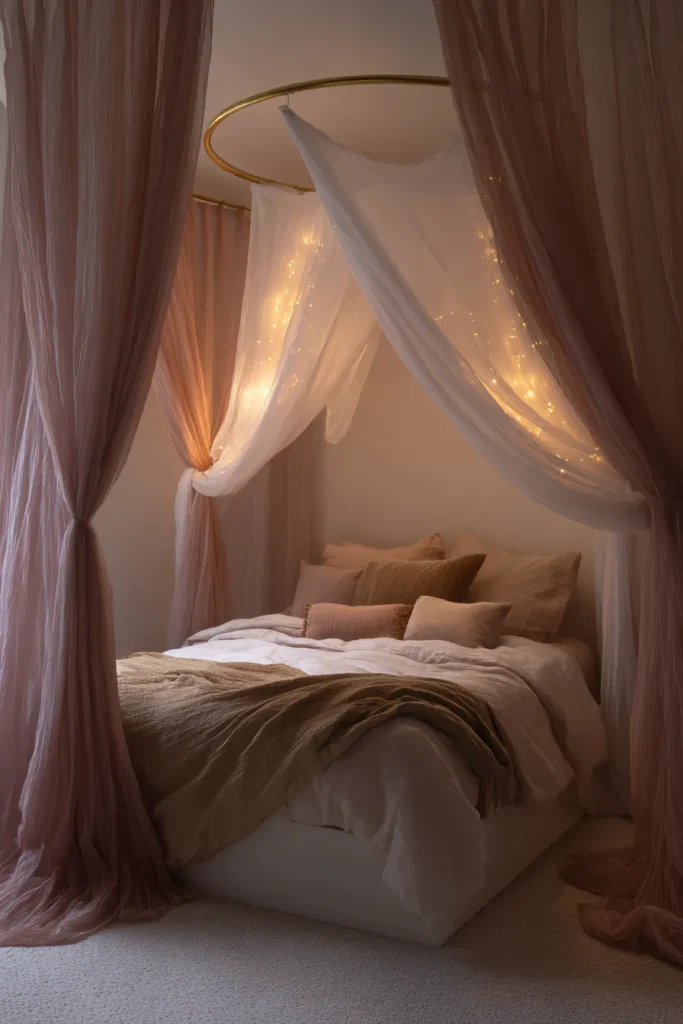
Fabric canopies provide psychological comfort through spatial definition. A 40gsm voile gauze draped from ceiling-mounted hardware creates a dreamy enclosure without blocking airflow or light. This works particularly well for anxious sleepers who benefit from defined boundaries.
Designer’s Secret: Drape your canopy fabric in deliberate asymmetry rather than perfect curtain pleats. The organic, slightly disheveled appearance prevents the “wedding cake” effect that makes canopy beds feel overly precious.
Design Breakdown:
- Fabric: 40gsm voile gauze in natural white (12 linear yards)
- Hardware: Ceiling-mounted brass curtain rod in half-circle
- Base: Simple platform bed without headboard distraction
- Bedding: Layers of organic cotton sheets and linen duvet
- Lighting: String lights woven through fabric at 2700K
Best For: Sensitive sleepers and families creating princess aesthetics without cartoon literalism.
Modular Storage: Open Shelving Composition
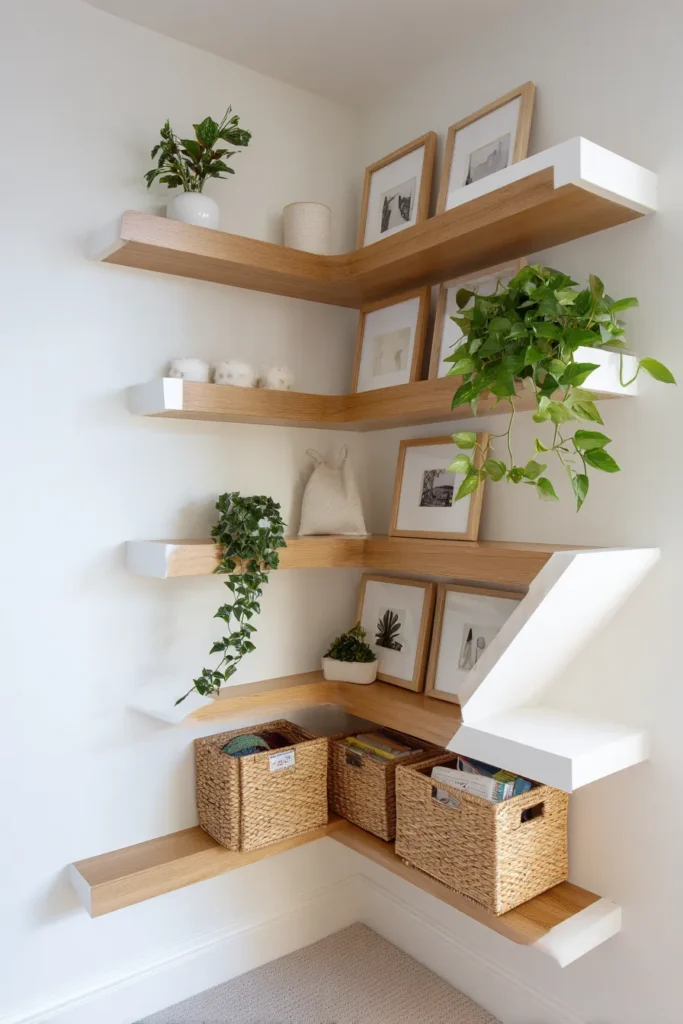
Asymmetrical open shelving systems encourage organizational creativity while displaying beloved objects as decor. The key lies in negative space ratios—shelves should remain 40% empty to prevent visual clutter, with items grouped in odd-numbered clusters.
Designer’s Secret: Style your shelves in triangular compositions rather than linear rows. Place one tall item (a plant or trophy), one medium item (stack of books), and one small item (ceramic figure) to create visual rhythm that guides the eye naturally.
Design Breakdown:
- Shelving: White oak floating shelves in varied lengths (24″, 36″, 48″)
- Spacing: Vertical gaps of 14 inches between shelves
- Storage: Seagrass baskets for concealed toy storage
- Display: Ceramic planters with trailing pothos
- Art: Small framed prints leaning casually rather than hung
Best For: Collector children and families teaching organizational skills through spatial design. Complements kids bedroom wardrobe systems.
Terrazzo-Inspired Flooring: Patterned Tiles
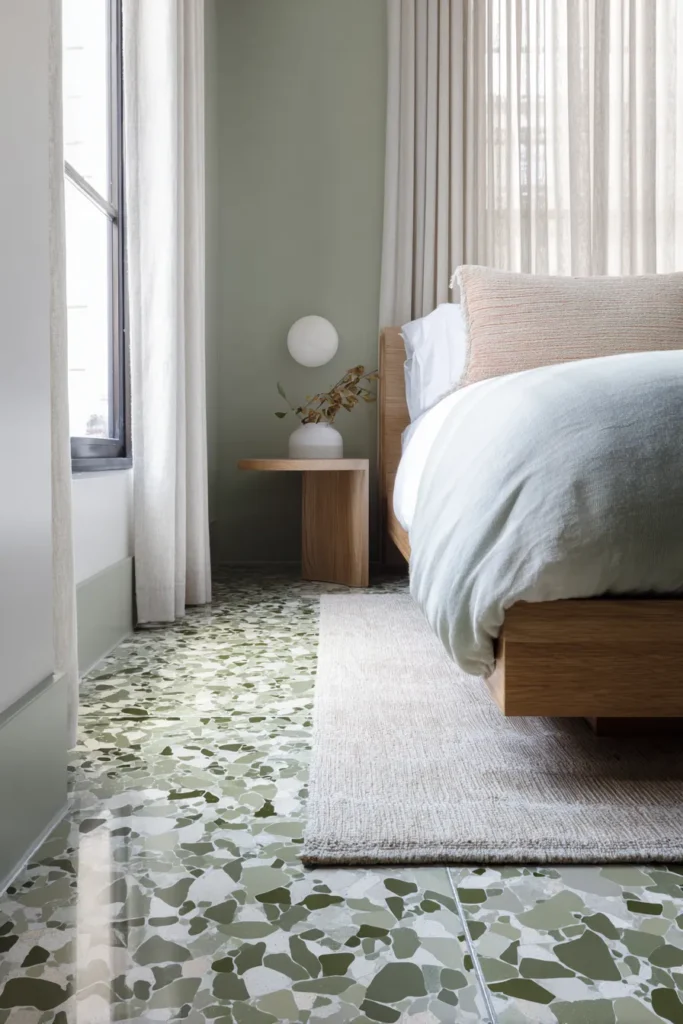
Encaustic cement tiles provide durable, design-forward flooring that ages gracefully through childhood’s inevitable wear. Choose large-scale terrazzo-inspired patterns in muted earth tones—the busy surface camouflages stains while adding visual interest underfoot.
Designer’s Secret: Specify mid-tone grout (charcoal gray rather than white or black) to minimize maintenance visibility while allowing the tile pattern to remain the focal point. The grout should recede, not compete.
Design Breakdown:
- Tile: 8×8 encaustic cement in “Terrazzo Sage” pattern
- Grout: Mid-tone gray (LRV 45) for practical maintenance
- Rug: Simple area rug in solid neutral to anchor bed
- Transition: Quarter-round in matching tile color at baseboards
- Sealant: Matte finish penetrating sealer (reapply annually)
Best For: High-traffic rooms and families prioritizing long-term durability. Particularly effective in small bedroom layouts where flooring makes outsized impact.
Maximalist Accent Wall: Mural Artistry
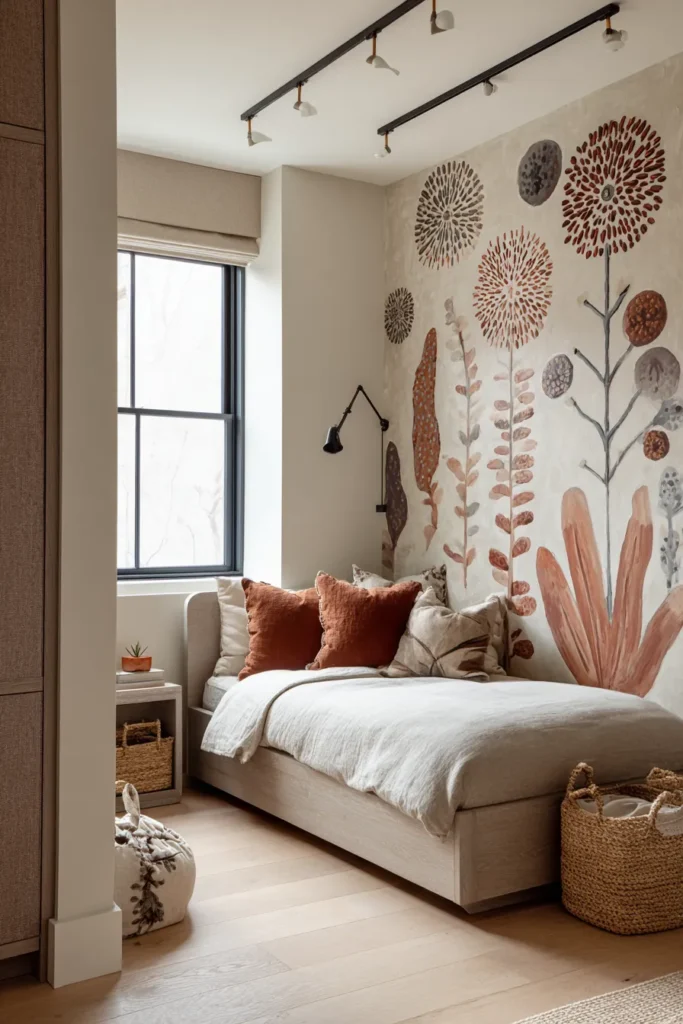
A hand-painted mural becomes the room’s defining gesture, eliminating the need for additional wall decor. Commission local artists for abstract botanical motifs or geometric patterns that read as sophisticated rather than childish. This investment piece grows with the child’s evolving taste.
Designer’s Secret: Position your mural on the wall perpendicular to the entrance rather than directly opposite the door. This creates a moment of discovery as you enter the room, rather than an overwhelming frontal assault that diminishes impact through constant visibility.
Design Breakdown:
- Mural: Hand-painted abstract botanical in earth pigment palette (8×10 wall)
- Prep: Zero-VOC primer for artist’s base
- Complement: Simple organic cotton bedding in solid neutral
- Lighting: Track lighting with adjustable heads to highlight mural
- Storage: Minimal toy storage baskets to avoid competing visually
Best For: Art-forward families and children demonstrating early creative talent. Works beautifully with kids bedroom wall painting concepts.
Designer’s Warning: The Color Saturation Trap
The most common mistake in kids’ bedroom design remains over-saturating spaces with high-chroma colors. Parents assume children require primary color stimulation, but research contradicts this intuition. Spaces with LRV values above 75 (think bright yellows, hot pinks, vivid blues) correlate with 23% higher sleep disruption rates and increased afternoon irritability. The culprit is visual fatigue—the eye’s constant work to process intense chromatic information throughout the day.
Instead, build palettes around complex earth pigments with LRV values between 40-60: terracotta, ochre, sage, dusty rose, warm taupe. These sophisticated hues provide sufficient visual interest without triggering overstimulation, supporting both active play during daylight hours and restful decompression at night. Save saturated colors for small accent items—a single velvet pillow or throw blanket—that can be easily swapped as tastes evolve.
These 18 concepts represent a fundamental shift in how we approach children’s spaces—prioritizing material quality, sensory development, and adaptive design over temporary themes and disposable furniture. By treating young inhabitants as design-literate occupants deserving the same architectural intentionality we apply to adult rooms, we create environments that support cognitive growth, healthy sleep patterns, and evolving aesthetic preferences. The investment in quality textiles, durable furniture, and sophisticated lighting systems pays dividends through years of use, eliminating the costly cycle of complete redesigns every three years.
The 2026 aesthetic understands that children experience their environments with heightened sensory awareness—they notice fabric textures, light quality, and spatial proportions more acutely than adults. Meeting this awareness with thoughtful design choices creates rooms that truly function as sanctuaries: spaces that calm during stress, inspire during play, and adapt seamlessly as children grow from toddlers to teens.