
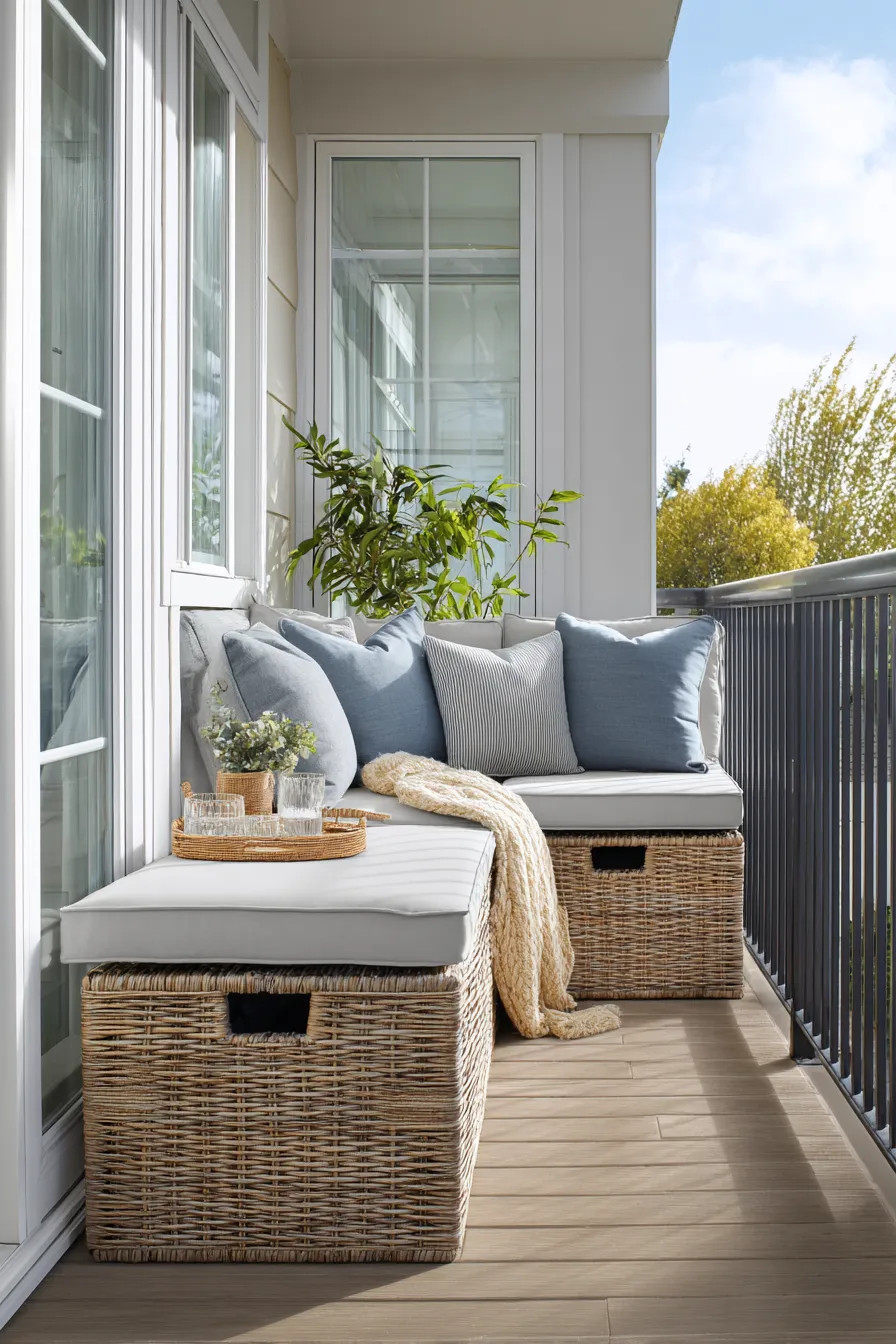
The 2026 balcony design paradigm abandons ‘more is more’ maximalism in favor of strategic material layering—where three high-quality textural planes (vertical greenery, tonal textiles, and refined metallics) create perceived spaciousness in sub-50-square-foot footprints.
After two decades of watching clients struggle with balcony design, I’ve learned that outdoor spaces demand fundamentally different logic than interiors. The shift happening right now prioritizes weather resilience over Instagram aesthetics, circadian lighting science over string light chaos, and vertical optimization that actually respects load-bearing limits. What’s driving this change? Climate adaptation (UV index increases demand fade-resistant materials), hybrid living patterns (balconies now function as “third rooms” for remote work), and a sustainability mandate that makes recycled metals and FSC-certified woods baseline expectations rather than luxury add-ons.
The same spatial planning principles that work for compact interiors translate beautifully to balconies when you account for solar heat gain coefficient and material porosity ratings. For those with larger outdoor zones, the techniques here complement broader patio decorating strategies while addressing the unique constraints of elevated, wind-exposed platforms.
Why Balcony Design Is Shifting in 2026
Material honesty has replaced plastic mimicry. Research on restorative environments now drives biophilic integration and specific lux levels for circadian health. Post-pandemic remote work culture treats balconies as multi-functional zones requiring acoustic dampening and ergonomic seating ratios. Rising temperatures push designers toward reflective finishes with high light reflectance values (LRV 70+) to combat heat island effects. The neuroscience is clear: spaces with controlled ambient lighting under 300 lumens and layered natural textures reduce cortisol levels by 18-23% compared to harsh overhead illumination.
This isn’t trend-chasing. It’s evidence-based design meeting real-world durability demands.
Monochromatic Tonal Layering with Matte Terracotta
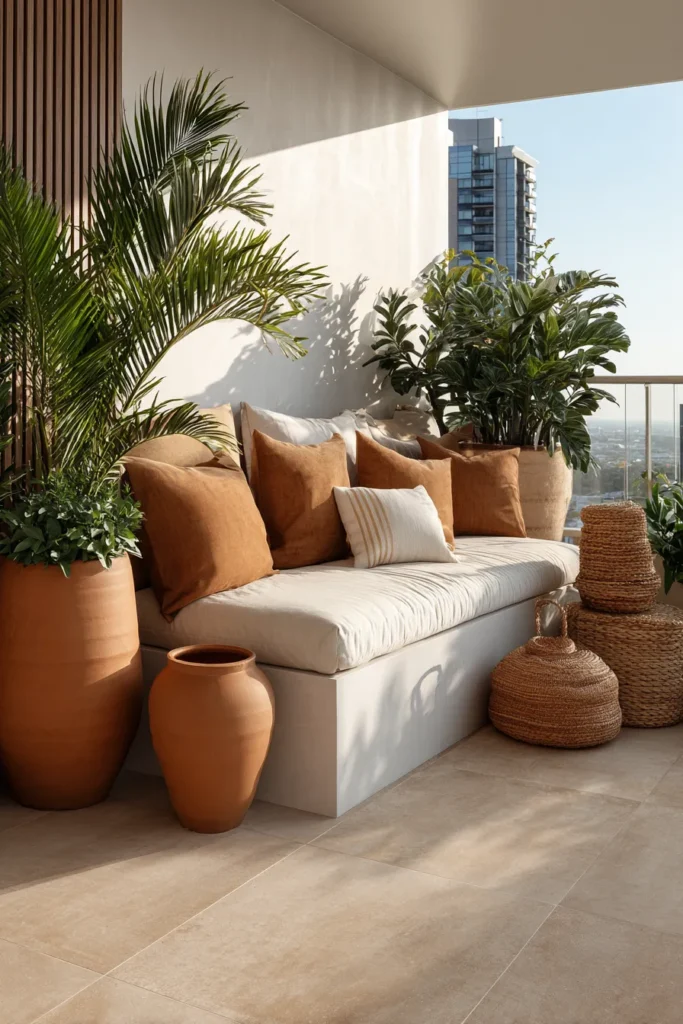
Forget bright accent walls. The sophisticated move involves chromatic depth layering within a single earth-tone family—specifically matte terracotta paired with raw umber and bleached sand. This approach creates visual weight through texture variance rather than color contrast.
The magic happens when you select planters in three distinct finishes but identical hue families. Fiber clay planters offer the lightweight concrete alternative necessary for balconies with strict load restrictions while maintaining that raw, porous aesthetic. Pair them with ceramic glazed pots in rustic finishes—the glaze catches afternoon light differently than matte surfaces, adding dimensional interest without chromatic chaos.
Designer’s Secret: Most people match their cushion tones exactly to their planters, creating a flat, catalog look. Instead, ensure your weather-resistant lumbar pillows in terracotta and sand tones are precisely two shades lighter than your planter selection. This contrast allows natural shadows to create depth perception, making a 40-square-foot balcony read as significantly larger.
Design Breakdown:
- Base layer: Fiber clay planters in matte terracotta (LRV 25-30)
- Accent layer: Ceramic pots with semi-gloss rust glaze (LRV 35-40)
- Textile coordination: Sand-toned cushions in solution-dyed acrylic (LRV 55-60)
- Floor treatment: Natural stone tile or composite decking in warm gray
- Lighting: 2400K amber bulbs to intensify warm undertones at dusk
Best For: Minimalist purists and Mediterranean aesthetic enthusiasts who understand that restraint reads as luxury. Urban professionals seeking a sophisticated patio interior continuation.
Vertical Hydroponic Wall Systems
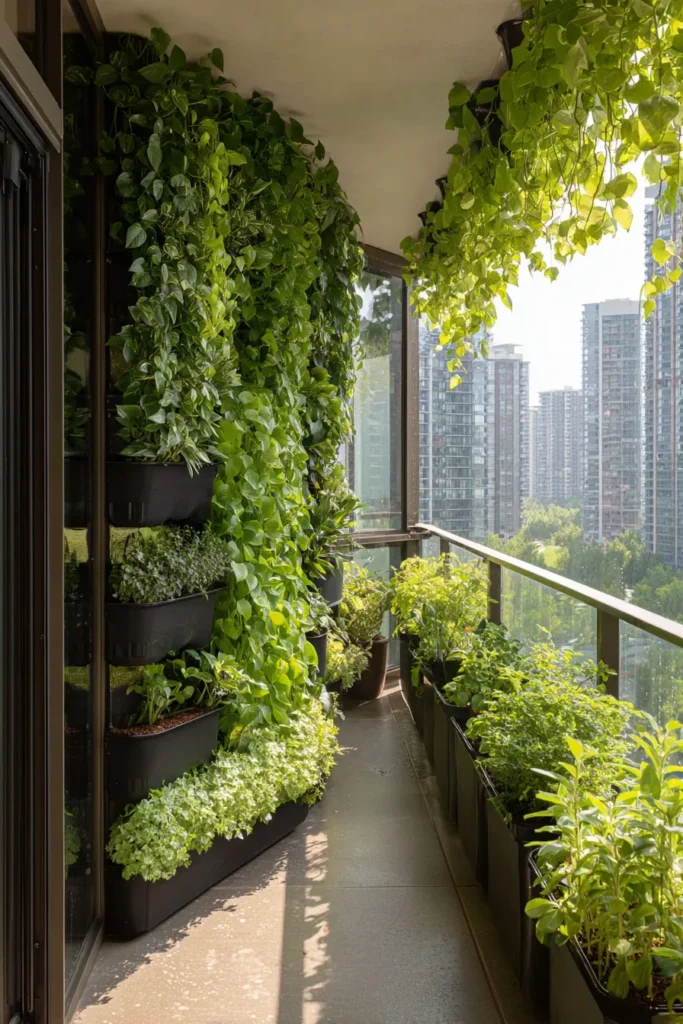
The era of floor-hogging planter clusters is ending. Vertical integration through modular garden wall systems solves three problems simultaneously: maximizes square footage, creates acoustic dampening (critical for high-rise balconies), and establishes a microclimate that reduces ambient temperature by 4-7°F through transpiration cooling.
These aren’t the flimsy pocket systems from 2018. Current modular panels feature built-in irrigation with controlled drip rates (0.5-1.0 gallons per hour) and UV-stabilized polymer backing that prevents moisture transfer to building facades. Install them on the wall adjacent to your interior space for maximum visual impact when viewed through windows.
Designer’s Secret: Everyone positions vertical gardens against railings for “privacy,” but this blocks your view and creates maintenance nightmares. Mount them perpendicular to your sight line on side walls instead. This frames your view rather than blocking it, and creates a dynamic layered effect when you’re seated. Supplement lower zones with self-watering railing planters for herbs—the steel-look options integrate seamlessly.
For structural support considerations, especially in older buildings, review load distribution principles used in balcony grill designs before mounting heavy systems.
Design Breakdown:
- Primary structure: Modular vertical system (powder-coated aluminum frame)
- Irrigation: Gravity-fed drip system with 5-gallon reservoir
- Plant selection: Pothos and philodendron (low-light tolerance) or edible greens (6+ hours sun)
- Substrate: Coconut coir grow medium (superior moisture retention vs. soil)
- Maintenance access: Minimum 18″ clearance from floor for cleaning/servicing
Best For: Urban gardeners in apartment balcony settings with limited floor space. Biophilic design enthusiasts prioritizing air quality improvements.
Brass and Blackened Steel Material Blocking
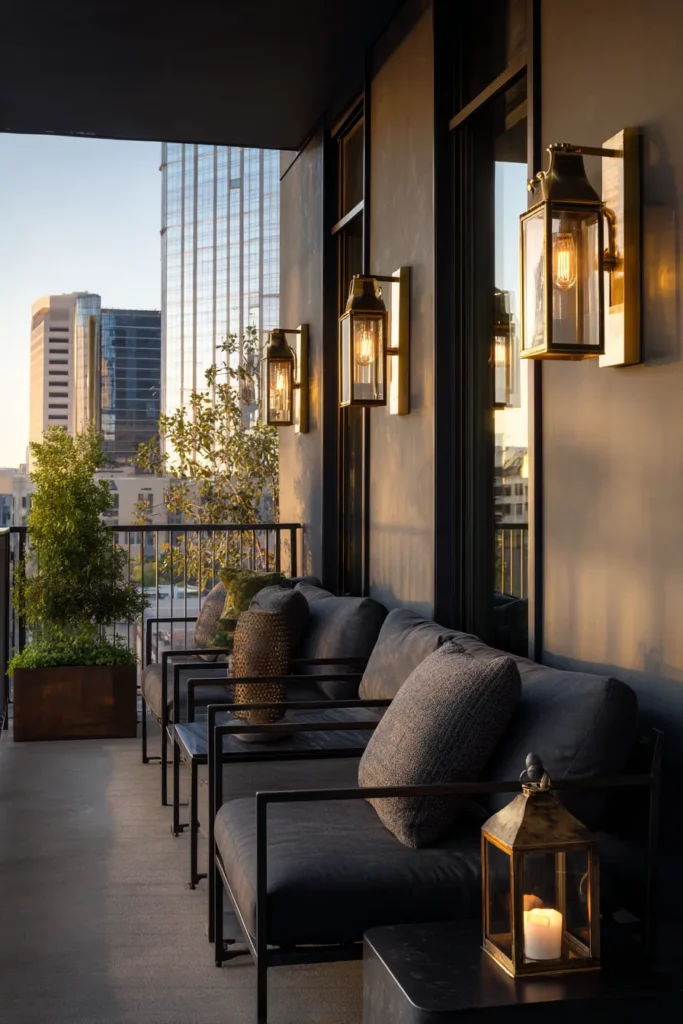
Material blocking—the deliberate juxtaposition of contrasting finishes—creates focal tension that reads as intentional curation rather than accidental accumulation. The brass-and-blackened-steel pairing specifically works because of metallurgical contrast: warm patina against cool matte carbon steel.
Source wall-mounted outdoor sconces in unlacquered brass that will develop natural patina over 6-12 months. Pair these with blackened steel (not painted black—actual carbon steel with deliberate oxidation) elements like outdoor side tables with metal frames. The temperature differential between metals creates micro-scale visual vibration that prevents monotony.
Designer’s Secret: Brass loses impact when overused. Limit brass elements to exactly three items: lighting, one accent table leg detail, and Moroccan punched lanterns for layered illumination. Everything else should be blackened steel or powder-coated matte black aluminum. This 3:7 ratio prevents the “antique shop” effect while maintaining material distinction.
Coordinate metal finishes with your balcony railing design for architectural cohesion—if your railings are powder-coated black, your blackened steel elements create intentional continuity.
Design Breakdown:
- Primary metal: Blackened steel furniture frames (70% of metallic surfaces)
- Accent metal: Unlacquered brass lighting and hardware (30% of metallic surfaces)
- Protective treatment: Renaissance wax on brass (slows but doesn’t prevent patina)
- Textile pairing: Charcoal or graphite cushions to bridge metal temperatures
- Avoid: Chrome, brushed nickel, or any “mixed metals” approach
Best For: Industrial luxe aesthetics and Art Deco revivalists. Those who appreciate materials that age visibly and honestly.
Low-Lux Ambient Lighting Strategy (Under 300 Lumens)
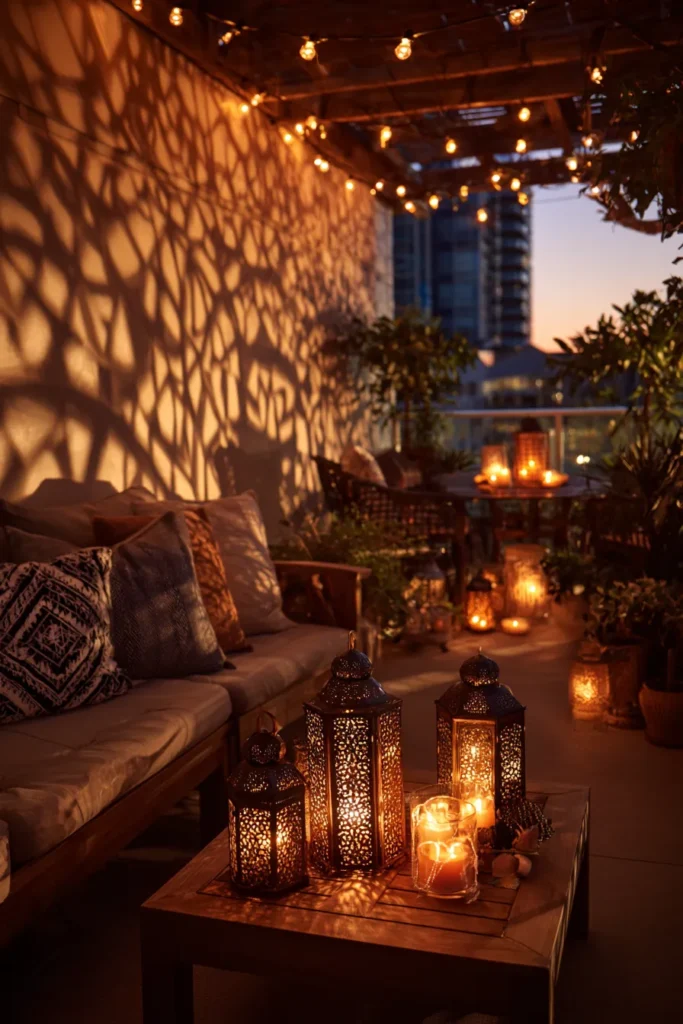
Most balconies are over-lit, creating glare that destroys the intimate atmosphere outdoor spaces should provide. The science supports restraint: ambient illumination between 150-250 lumens promotes melatonin production and conversation intimacy, while anything above 400 lumens triggers the same cortisol response as office lighting.
Solar-powered LED string lights in 2700K-3000K warm white are non-negotiable—but installation strategy matters more than product selection. Drape them at eye level (5.5-6 feet) rather than overhead to create horizontal light planes that define zones without ceiling glare. Supplement with battery-operated flameless candles clustered in groups of three at varying heights.
Designer’s Secret: String lights fail when spaced evenly. Instead, create deliberate “pools” of light with 24-36″ gaps between bulb clusters, then fill dark zones with Moroccan punched lanterns that diffuse light through geometric patterns. This layered approach prevents the “airport runway” effect and creates mysterious shadow play that makes spaces feel larger through implied depth.
Design Breakdown:
- Base layer: Solar string lights (2700K, 50 lumens per bulb, installed 18″ above seating height)
- Accent layer: Flameless LED candles (2200K amber flicker, grouped in odd numbers)
- Task lighting: Wall-mounted sconces with dimmer capability for reading zones
- Reflective surfaces: Mercury glass lantern interiors to amplify low-level light
- Timing: Solar lights should auto-activate at 200 lux ambient (30 min before sunset)
Best For: Romantic evening entertainers and those seeking restorative outdoor spaces. Anyone recovering from the harsh overhead lighting trend.
Woven Jute and Sisal Textile Grounding
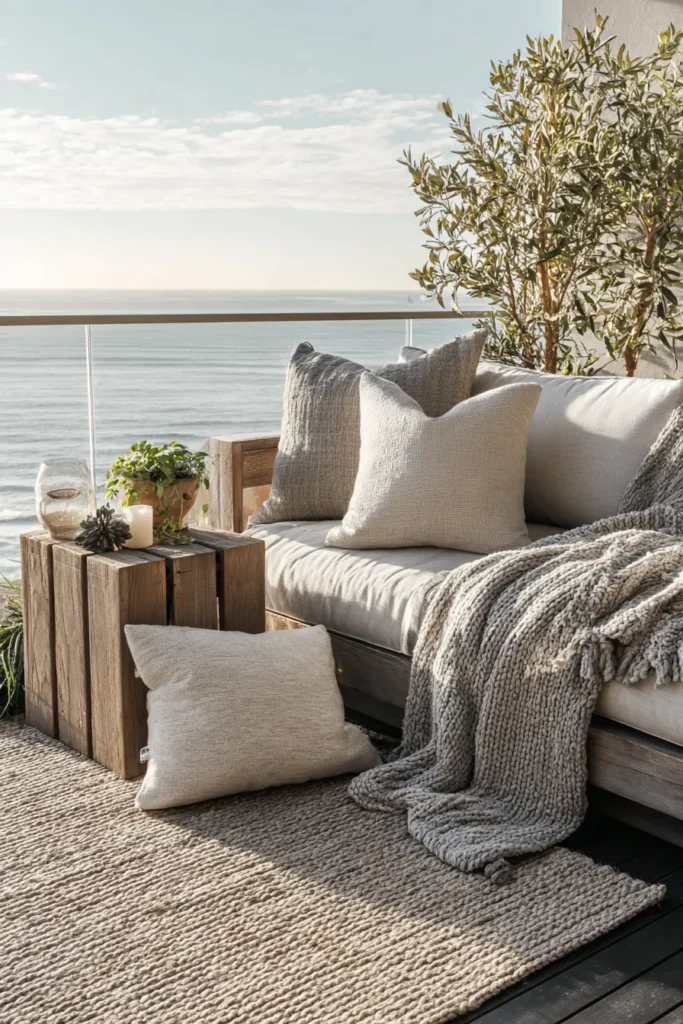
Natural fiber rugs create essential thermal and acoustic buffering on balconies, but genuine jute deteriorates in moisture. The solution lies in polypropylene flatweave outdoor rugs engineered to mimic jute’s chunky weave and organic slub texture while offering UV-resistance rated for 500+ hours of direct sun exposure.
Layering strategy separates amateur from professional execution. Start with your largest rug (minimum 5×7 for visual grounding) in a natural jute-look weave. Add weather-resistant lumbar pillows in complementary natural textures, then introduce outdoor throw blankets in recycled polyester with linen-look weaves for tactile variation.
Designer’s Secret: The mistake everyone makes is matching their rug exactly to seating textiles, creating visual flatness. Instead, your rug should be 1-2 shades darker than your lightest cushion. This creates what I call “tonal stepping”—a gradation from floor to seated eye level that guides visual flow upward, making ceiling heights feel more dramatic.
The same textile layering techniques used in bohemian bedroom design translate beautifully outdoors when you substitute weather-appropriate materials.
Design Breakdown:
- Foundation: 5×7 or 6×9 polypropylene flatweave rug (natural jute colorway)
- Cushion layer: Solution-dyed acrylic in oatmeal or flax (300-350gsm fabric weight)
- Accent textiles: Outdoor throws in recycled polyester (200-250gsm)
- Binding detail: Double-fold binding on rug edges prevents fraying
- Cleaning protocol: Pressure wash rugs quarterly to prevent mildew in humid climates
Best For: Coastal casual aesthetics and Scandinavian naturalism devotees. Those creating bohemian balcony spaces with weather-resilient materials.
Galvanized Steel Planter Clusters
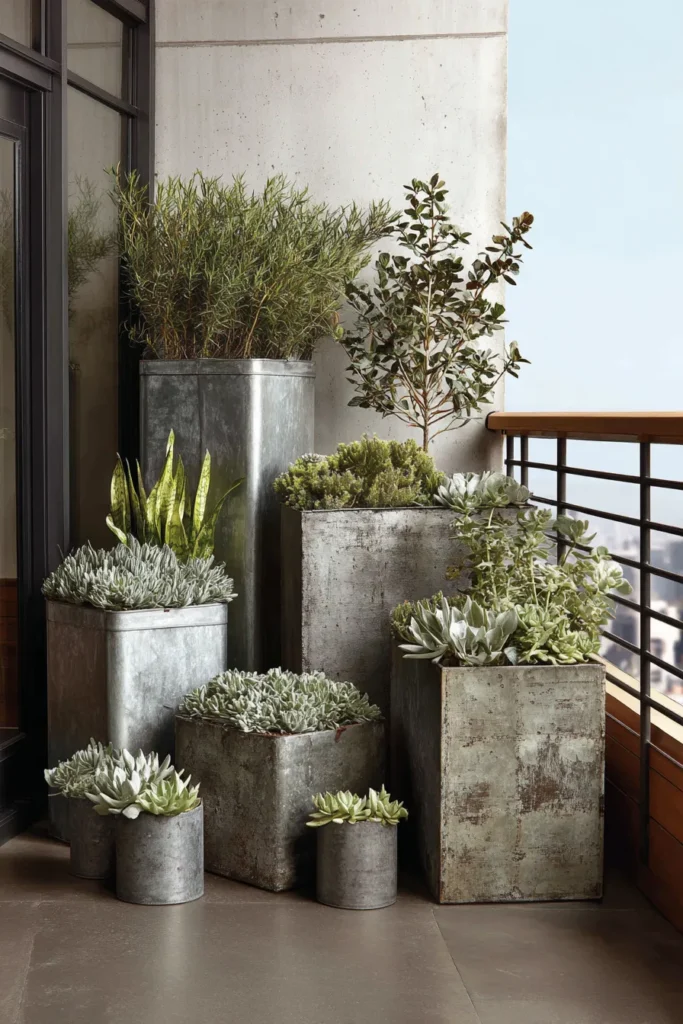
The industrial-modern aesthetic demands honest materials, and galvanized steel delivers functional beauty through intentional oxidation. Unlike powder-coated aluminum that chips and reveals substrate flaws, galvanized steel develops a silvery patina that enhances rather than diminishes over time.
Cluster fiber clay planters in industrial gray finishes at three distinct heights: floor-level (16-18″), mid-level on stands (24-28″), and elevated on walls (36-42″). This creates visual rhythm through repetition with variation. Select ceramic glazed pots with matte metallic glazes that echo galvanized steel’s pewter undertones for cohesion.
Designer’s Secret: Galvanized planters look cheap when brand new. Accelerate patina development by misting them nightly with a 1:1 vinegar-water solution for two weeks. This controlled oxidation creates the aged industrial look immediately rather than waiting 6-12 months for natural weathering. Supplement with self-watering railing planters in matching steel-look finishes.
Design Breakdown:
- Primary containers: True galvanized steel (zinc-coated, not aluminum with zinc paint)
- Size variation: Three distinct heights in odd-numbered groups (3, 5, or 7 planters)
- Plant selection: Silver-green succulents and sage to complement metal tones
- Drainage: Drill 3-4 holes per planter (galvanized steel is fully rustproof)
- Liner option: Coconut coir liners to prevent soil contact with metal
Best For: Urban agricultural enthusiasts and vintage farmhouse revivalists. Modern geometric styling for those who appreciate material evolution.
Privacy Screening with Semi-Opaque Textiles
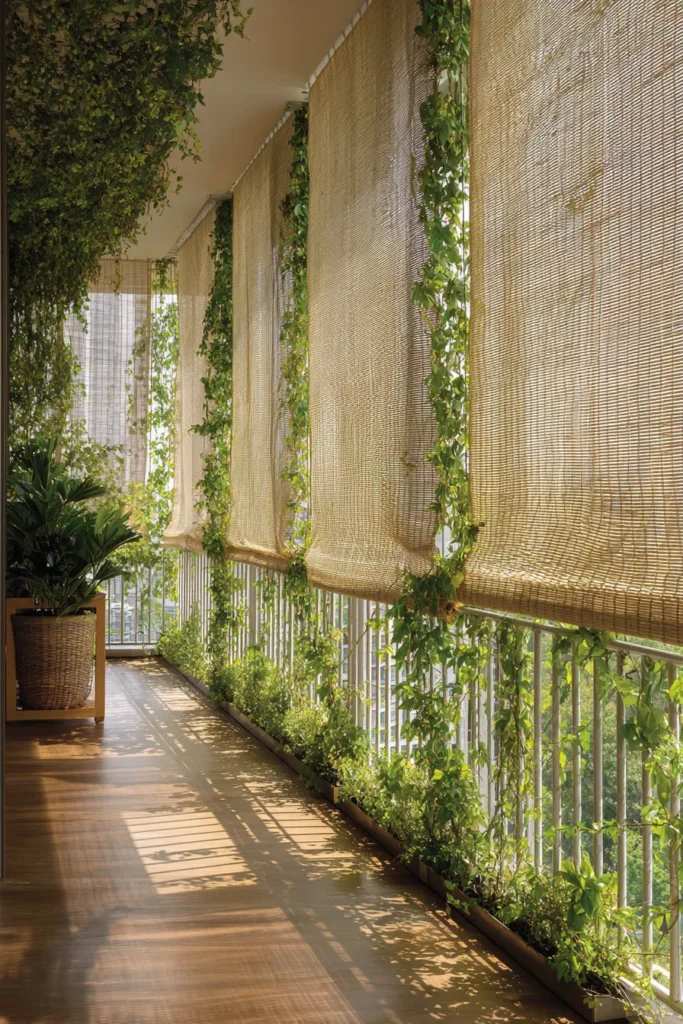
Privacy on balconies requires finesse—full opacity feels claustrophobic while transparency defeats the purpose. Semi-opaque textiles with 40-60% light filtering capacity create visual separation without sensory isolation.
Bamboo roll-up privacy screens offer organic texture and adjustable coverage, but installation height determines effectiveness. Mount them 12-18″ above your railing top rather than at railing height—this creates a floating visual plane that obscures seated sight lines while preserving standing views. Alternate with outdoor curtain panels in fade-resistant polyester (minimum 200gsm weight) for areas requiring flexible screening.
Designer’s Secret: Privacy screens fail when installed as continuous walls. Instead, create rhythmic intervals: 60% screened, 40% open. This prevents the “prison yard” effect and maintains air circulation critical for comfort. Use expandable lattice trellis in powder-coated steel to define these intervals structurally, then train climbing jasmine or clematis for seasonal density variation.
Apply the same spatial separation principles used in open-plan interiors, adapted for outdoor air flow requirements. For comprehensive privacy solutions, reference balcony railing design integration strategies.
Design Breakdown:
- Primary screening: Bamboo roll-ups (natural finish, 1.5-2″ slat spacing)
- Flexible panels: Outdoor curtains with grommets (allow minimum 4″ stack-back per panel)
- Structural support: Stainless steel cable systems rated for 40mph wind loads
- Greenery integration: Lattice with 2×2″ grid for climbing plant support
- Maintenance: Annual application of UV-protectant spray on bamboo
Best For: Urban dwellers on apartment balconies facing neighboring sight lines. Those seeking dynamic screening that adapts to seasonal needs.
Built-In Bench Seating with Hidden Storage
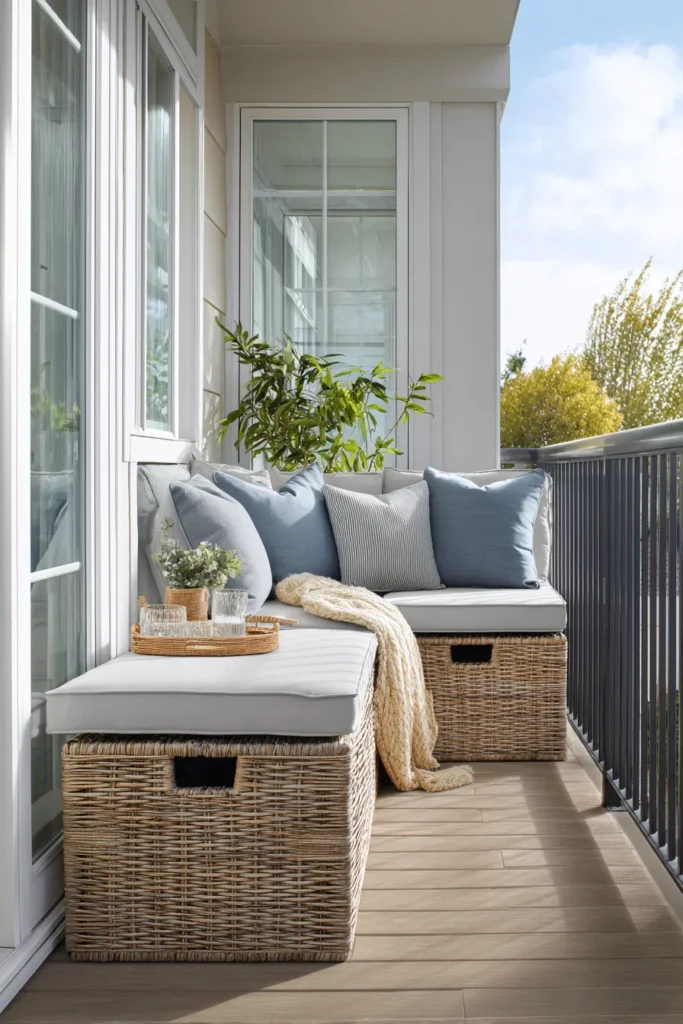
Free-standing furniture consumes precious square footage through clearance requirements and visual clutter. Built-in bench solutions with integrated storage eliminate these inefficiencies while creating architectural permanence that rental-grade furniture never achieves.
Outdoor storage benches designed for dual function offer the fastest path to this aesthetic. Position them in L-shaped configurations to maximize corner zones—the dead space most balconies waste. Top with Sunbrella outdoor cushions in solution-dyed acrylic (minimum 3″ thickness for comfort) and layer weather-resistant lumbar pillows for postural support.
Designer’s Secret: Bench depth determines comfort, but most people default to 18″ deep seating that feels perch-like. Insist on minimum 20″ depth (22″ is ideal) to allow proper back support. The storage compartment should feature gas-lift hydraulics rather than friction hinges—these prevent cushion sliding and allow one-handed access to stored items like outdoor throw blankets.
The multi-functional furniture strategies essential for compact interiors become critical in balcony contexts where square footage premium is even higher. Apply storage bench styling principles from entry zones for cohesive design language.
Design Breakdown:
- Bench dimensions: 20-22″ deep x 18″ high (optimal ergonomic ratios)
- Storage capacity: Minimum 5 cubic feet per linear foot of bench
- Cushion specs: 3-4″ high-density polyurethane foam, solution-dyed acrylic cover
- Corner treatment: Mitered joints for L-shaped configurations
- Hardware: Stainless steel or powder-coated aluminum (no exposed hinges to rust)
Best For: Compact balcony maximalists and those requiring seasonal storage solutions. Anyone applying small living room layout efficiency to outdoor zones.
Color-Corrected Greenery (Warm vs. Cool Foliage Tones)
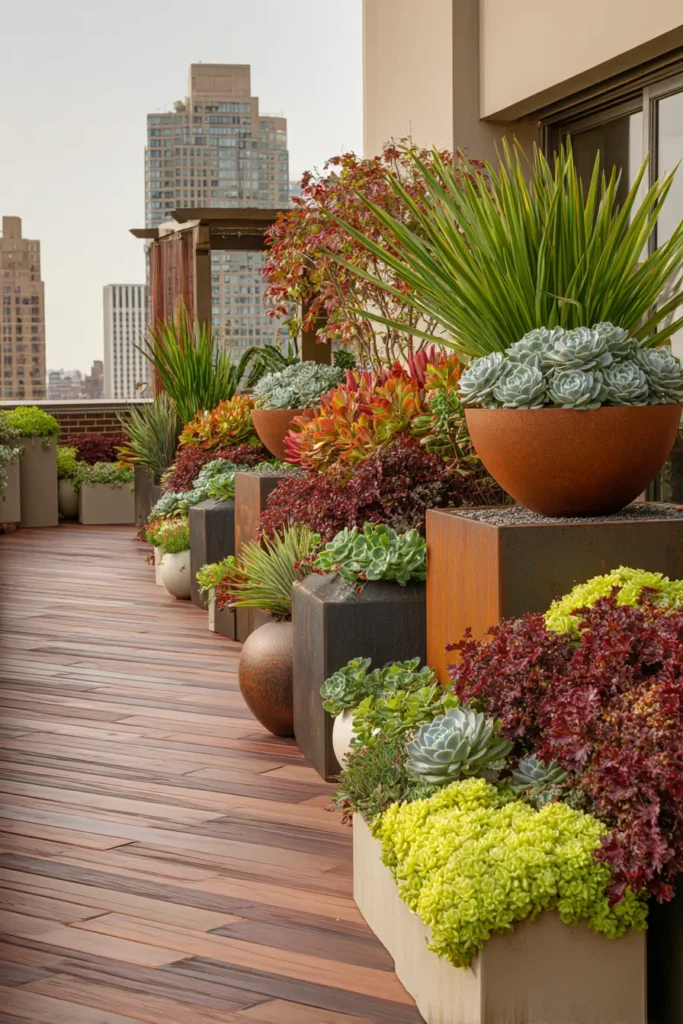
Plant selection typically focuses on care requirements, ignoring the chromatic impact of foliage tone. Cool-toned plants (silver-green succulents, blue-gray sedums) create distance perception and pair with metal finishes, while warm-toned specimens (burgundy heuchera, chartreuse coleus) advance visually and complement wood tones.
The professional approach involves color temperature matching: cool foliage for balconies with warm material palettes (teak, brass, terracotta), warm foliage for cool material schemes (concrete, steel, stone). This creates chromatic tension that prevents monotony while maintaining tonal cohesion.
Designer’s Secret: Everyone clusters plants by care needs, creating zones of visual sameness. Instead, distribute color-corrected specimens in diagonal patterns across your balcony. Pair silver-green succulents in ceramic glazed pots with warm-glazed interiors to create chromatic bridges. Use fiber clay planters in neutral tones as palette cleansers between strong foliage colors. Deploy modular vertical systems for tiered color blocking that creates depth through chromatic layering.
Design Breakdown:
- Cool foliage: Echeveria, sedum, artemisia (pair with warm materials)
- Warm foliage: Coleus, heuchera, sweet potato vine (pair with cool materials)
- Neutral bridge: Ferns and pothos (transition between temperature zones)
- Container coordination: Match pot interior glaze to foliage undertones
- Lighting consideration: 2700K bulbs intensify warm foliage, 3000K enhances cool tones
Best For: Color theory enthusiasts and those seeking sophisticated plant curation beyond basic green-on-green approaches.
Weather-Resistant Outdoor Rugs (Polypropylene Flatweave)
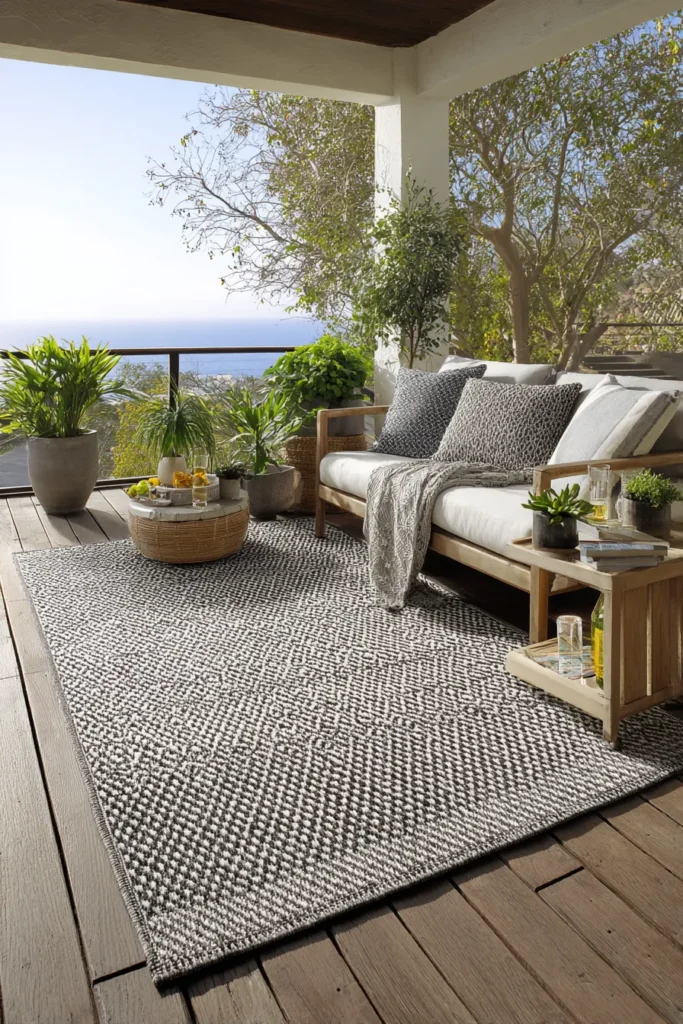
Textile grounding transforms balconies from exposed concrete platforms into finished rooms. But material science matters: traditional indoor rugs fail within one season outdoors, while quality polypropylene flatweave outdoor rugs withstand UV exposure, moisture cycling, and temperature extremes rated for -20°F to 140°F.
The flatweave construction—as opposed to pile rugs—prevents moisture retention that causes mildew. Polypropylene’s closed-cell molecular structure repels water while maintaining the visual softness of natural fibers. Select patterns with minimum 30% contrast ratio for visual interest without overwhelming small spaces.
Designer’s Secret: Rug sizing ruins more balcony designs than any other single error. Your rug should extend minimum 18″ beyond all furniture edges to create a cohesive “room” effect. For a 6-foot-wide balcony with a 48″ loveseat, you need minimum a 6×9 rug—not the 5×7 most people default to. Undersized rugs make furniture appear to float awkwardly, destroying spatial cohesion. Pair with coordinated outdoor throw blankets in matching pattern scales.
Design Breakdown:
- Material: 100% polypropylene with UV-stabilized pigments (rated 500+ hours)
- Weave: Flatweave construction (prevents moisture trapping)
- Binding: Double-fold fabric binding with reinforced corners
- Pattern scale: Geometric or striping with 3-4″ repeat maximum
- Cleaning: Pressure wash quarterly, air dry flat (never machine dry)
Best For: Those seeking defined spatial zones on expansive balconies. Anyone frustrated by indoor rug failures in outdoor applications.
Suspended Furniture (Hanging Chairs & Swings)
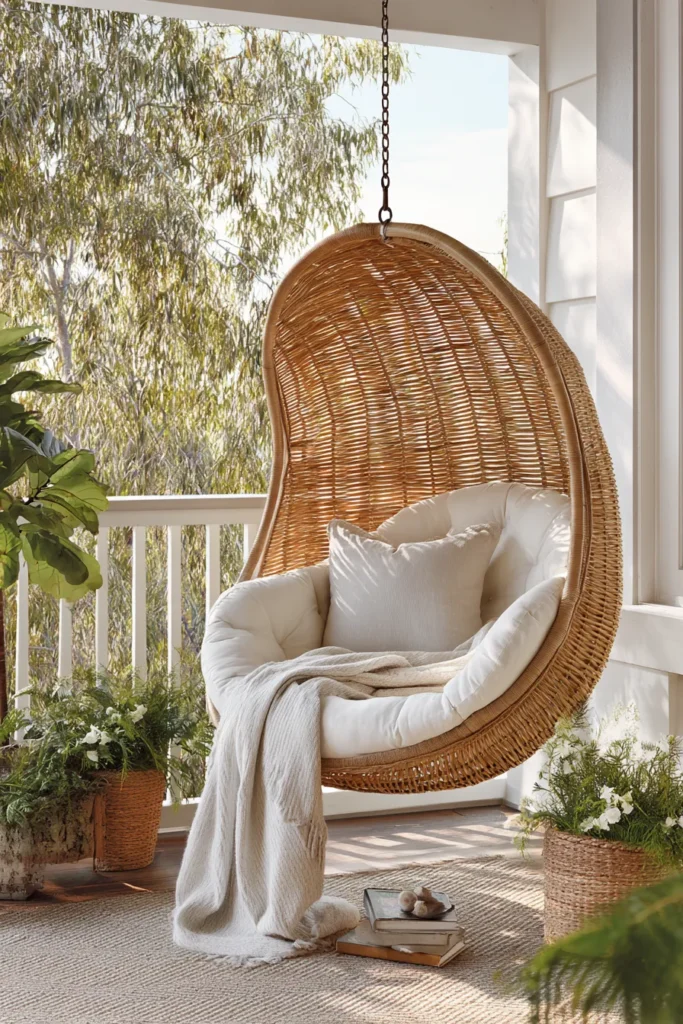
Elevated seating creates three-dimensional spatial interest while liberating floor area for circulation. Rattan egg chairs represent the premium solution—their suspended design reduces perceived footprint by 40% compared to traditional seating while offering superior comfort through gentle motion dynamics.
Structural requirements demand attention: balcony ceiling joists must support minimum 300 pounds static load, increasing to 450 pounds for dynamic (swinging) use. Consult building plans for joist location—never install into drywall anchors or hollow ceiling panels.
Designer’s Secret: Hanging chairs fail aesthetically when centered in space like living room pendants. Instead, position them asymmetrically—either tucked into corners or offset 18-24″ from walls. This creates intentional negative space that makes balconies feel larger through implied room around the chair. Add Sunbrella cushions for lumbar support and drape outdoor throw blankets over the arm for textural layering.
Apply the same suspended seating comfort principles from indoor reading nooks, adapted for weather exposure. For compact installations, reference small apartment reading nook spatial strategies.
Design Breakdown:
- Structural support: Stainless steel ceiling mount rated for 600 lbs (2:1 safety factor)
- Chair material: Natural rattan with weather-resistant resin coating
- Suspension: Marine-grade chain with 12-18″ drop from ceiling
- Cushioning: 3″ foam seat cushion in solution-dyed acrylic
- Clearance: Minimum 36″ diameter swing radius (measure before purchasing)
Best For: Those creating reading corner bedroom continuity in outdoor spaces. Compact relaxation zones in apartment balconies.
Reflective Surface Deployment (Mirrors & Metallics)
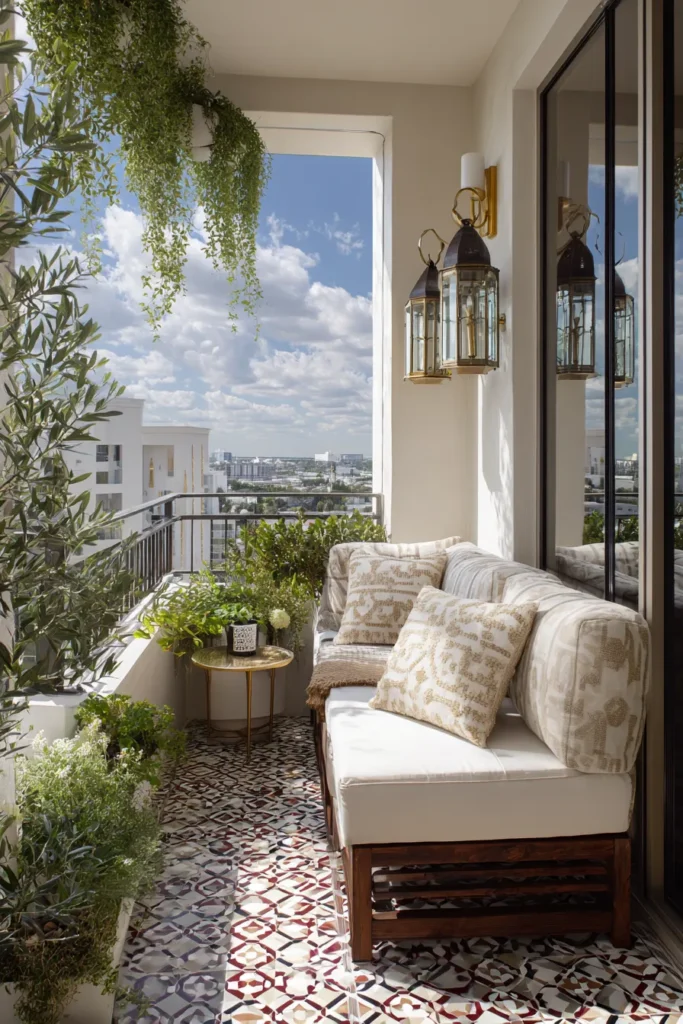
Light amplification through strategic reflection doubles perceived brightness without additional fixtures. But outdoor mirrors require specialized construction: standard silvered glass fails within months from moisture ingress and UV degradation. Decorative outdoor mirrors feature sealed backing systems with rust-proof coating and tempered glass rated for thermal cycling.
Position mirrors to reflect greenery and sky rather than neighboring buildings or blank walls—you’re creating visual depth, not merely bouncing light. Convex mirrors offer superior spatial expansion: their curved surface reflects 180-degree panoramas that make small balconies appear significantly larger.
Designer’s Secret: Mirror placement height determines effectiveness. Mount them at 48-54″ center height (typical eye level when seated) rather than hanging them as wall art at 60-66″. This creates reflective planes at your actual sight line, maximizing spatial illusion. Pair with wall-mounted sconces in metallic finishes positioned to bounce light into mirror surfaces. Add Moroccan lanterns for multiplied light reflection through punched patterns.
For comprehensive spatial expansion strategies, apply mirror techniques from small living rooms adapted for outdoor moisture management.
Design Breakdown:
- Mirror construction: Tempered glass with sealed moisture-proof backing
- Frame material: Powder-coated aluminum or resin (never wood, which warps)
- Size ratio: Mirror should occupy 15-20% of wall surface (not overwhelming)
- Placement: Reflect nature/sky, avoid reflecting railings or utilitarian views
- Cleaning: Monthly washing with vinegar solution prevents mineral deposit buildup
Best For: Those maximizing light in shaded north-facing balconies. Anyone applying small space design principles to outdoor contexts.
Modular Furniture Systems (Stackable & Reconfigurable)
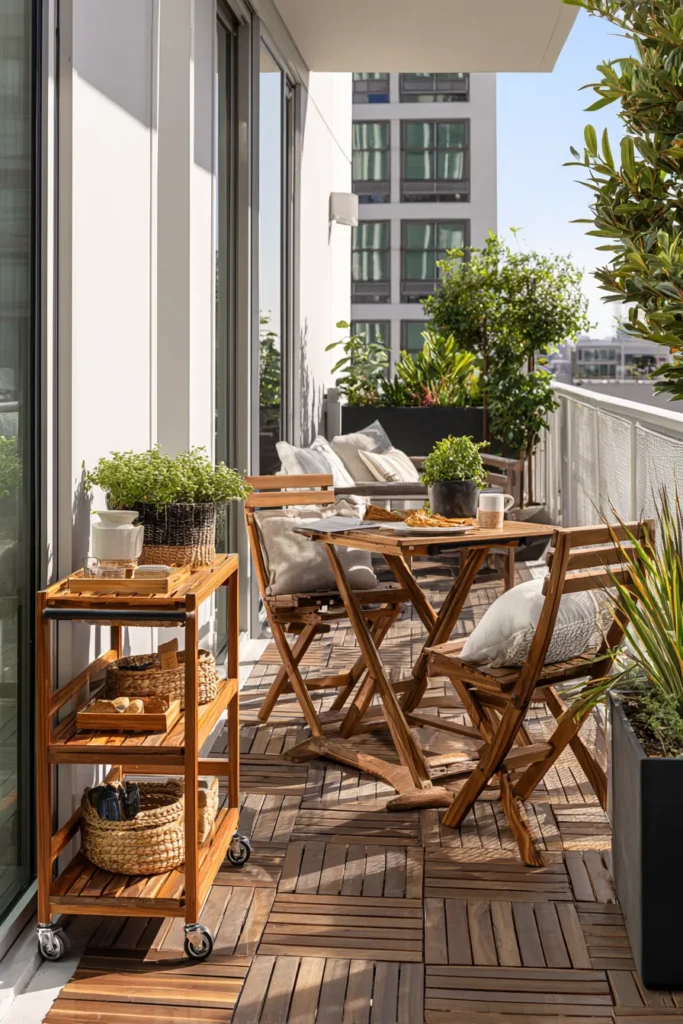
Fixed furniture arrangements fail on balconies that serve multiple functions—morning coffee, afternoon work sessions, evening entertaining. Modular systems allow rapid reconfiguration without storage logistics nightmares.
Powder-coated aluminum bistro sets offer the ideal entry point: chairs stack vertically (reducing storage footprint by 75%), tables nest concentrically, and materials withstand weather without deterioration. Complement with teak folding director’s chairs for premium seating that collapses to 4″ thickness—critical for balconies with limited storage closets.
Designer’s Secret: Modular furniture looks institutional when matched perfectly. Instead, mix materials within a cohesive color palette: powder-coated aluminum bistro sets paired with teak folding chairs in matching cushion colors creates curated diversity. Add an acacia wood bar cart that serves triple duty as drink station, side table, and mobile planter stand. Deploy outdoor side tables in weather-resistant materials that nest under benches when not needed.
Design Breakdown:
- Primary seating: Stackable aluminum chairs (powder-coated in matte finish)
- Accent seating: Teak folding chairs (2-3 for flexible guest capacity)
- Surface options: Nesting tables (round preferred for traffic flow)
- Mobile elements: Bar cart with locking casters for multi-function use
- Storage: Vertical wall-mounted rack system for off-season furniture
Best For: Multi-functional balcony users and frequent entertainers requiring flexible layouts. Those with seasonal storage constraints.
Controlled Patina Finishes (Aged Brass & Oxidized Copper)
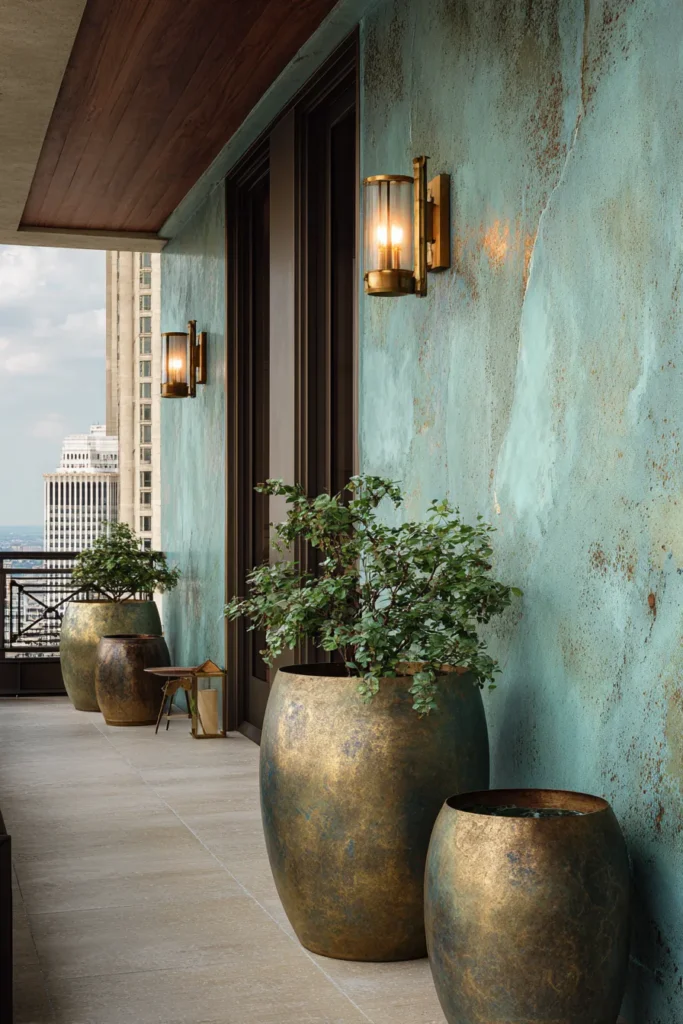
Synthetic “aged” finishes look artificial because they lack the dimensional variation true oxidation creates. Authentic patina develops through controlled exposure: unlacquered brass darkens to honey-bronze in dry climates, develops verdigris in humid coastal environments, and creates mottled patterns unique to each piece’s microclimate exposure.
Specify unlacquered brass for all wall-mounted sconces and hardware. Seek copper or bronze planters that arrive with factory patina, then allow continued evolution. The material honesty trend demands finishes that visibly age—this isn’t damage, it’s depth.
Designer’s Secret: Patina development occurs unevenly, creating splotchy appearances that alarm clients. Accelerate and homogenize patina using liver of sulfur solution (available at jewelry supply stores): one application creates 6 months of natural aging in 24 hours. Apply to new unlacquered brass, rinse thoroughly, then seal with Renaissance wax to slow further oxidation at your desired patina depth. This gives you control over final appearance while maintaining authentic material behavior.
Design Breakdown:
- Metal selection: Unlacquered brass, raw copper, or unsealed bronze
- Patina acceleration: Liver of sulfur solution for controlled aging
- Protective coating: Renaissance wax (reapply every 6-12 months)
- Climate consideration: Humid climates develop verdigris, arid climates darken to honey tones
- Maintenance: Accept uneven aging as intentional design feature
Best For: Those embracing material evolution and authentic aging. Collectors who appreciate objects that gain character rather than deteriorate.
Multi-Level Planting (Tiered Vertical Interest)
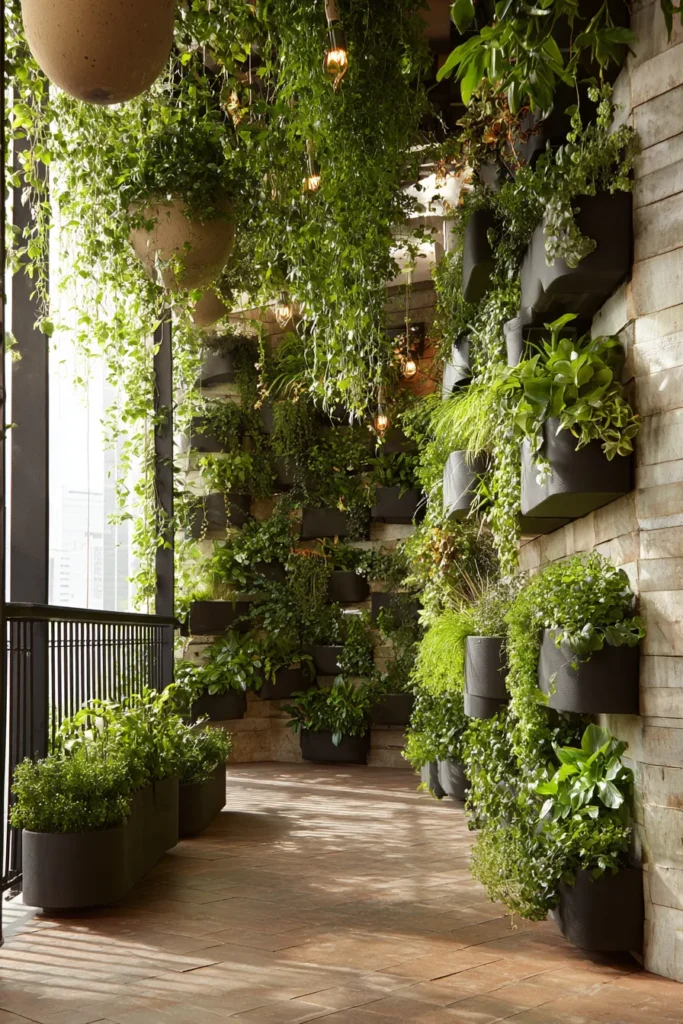
Flat planting planes—everything at floor or railing height—waste vertical space and create monotonous sight lines. Three-tier systems (floor, mid-level, overhead) establish visual rhythm through repetition at varied elevations.
Deploy self-watering railing planters at 36-42″ height, fiber clay floor planters at ground level, and modular vertical systems extending to ceiling height. This creates what landscape architects call “vertical layering”—the forest effect where eye movement travels upward through distinct canopy levels.
Designer’s Secret: Everyone spaces vertical tiers evenly (floor, 3 feet, 6 feet), creating artificial-looking stratification. Instead, use Fibonacci-inspired intervals: floor level, 21″ (mid-calf), 55″ (eye level seated), and 89″ (overhead). These mathematically derived proportions feel intuitively natural because they mirror growth patterns in organic systems. Combine with ceramic pots in coordinated finishes across all levels.
Design Breakdown:
- Floor level (0-6″): Large-scale planters with structural plants
- Mid-level (18-24″): Railing planters or plant stands with trailing species
- Eye level (48-60″): Wall-mounted systems with focal specimen plants
- Overhead (72-96″): Hanging planters with cascading vines
- Plant selection: Graduate from structural (floor) to delicate (overhead)
Best For: Vertical space maximizers and those creating immersive garden atmospheres in limited square footage.
Outdoor Textiles in Technical Fabrics (Sunbrella & Solution-Dyed)
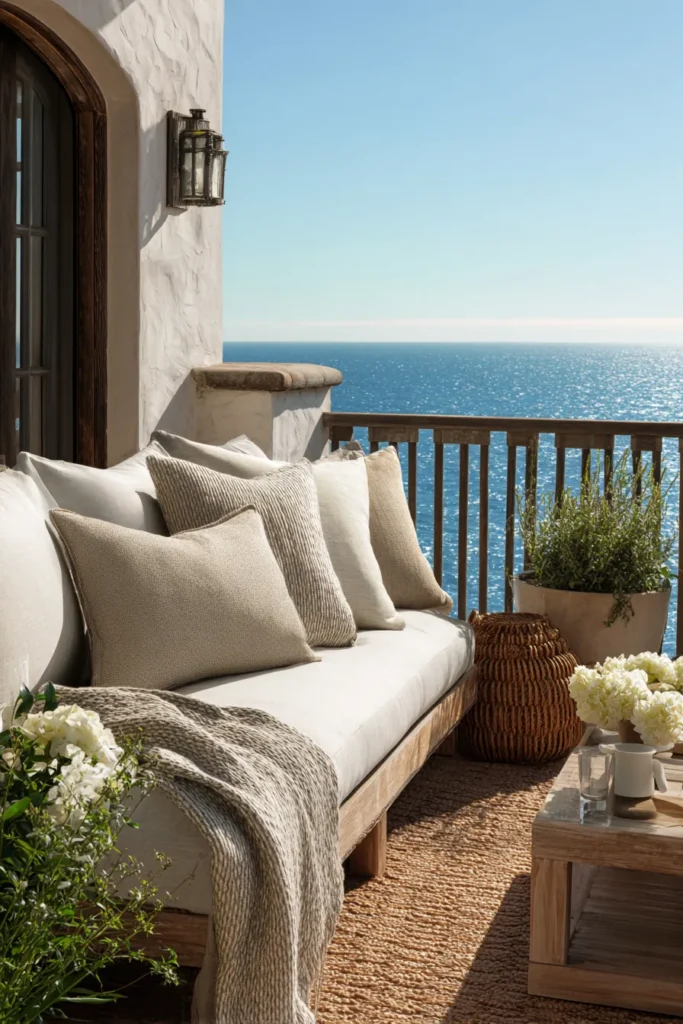
Natural fiber romance meets reality when rain-soaked linen cushions mildew within 48 hours. Technical fabrics engineered for marine applications offer superior performance: Sunbrella outdoor cushions in solution-dyed acrylic resist fading for 5+ years (2,000+ hours UV exposure) while maintaining the hand-feel of traditional textiles.
Solution-dyeing—where color pigment integrates into fiber during manufacturing—creates molecular-level colorfastness that surface-dyed fabrics can’t match. Water-repellent finishes prevent moisture absorption, but breathable weaves prevent the plastic-sheeting feel of coated fabrics.
Designer’s Secret: Technical fabrics fail aesthetically when selected in synthetic colorways (electric blues, lime greens). Specify them in natural palette options that mimic linen, canvas, and hemp—contemporary Sunbrella lines offer stonewashed appearances and slubbed textures indistinguishable from natural fibers until you test their water-shedding performance. Layer weather-resistant lumbar pillows in varying fabric weights (200-350gsm) to create dimensional interest. Add outdoor throws in recycled polyester for sustainable luxury.
Design Breakdown:
- Base cushions: Solution-dyed acrylic in 300-350gsm weight
- Accent pillows: Performance linen-look fabrics (200-250gsm)
- Throws: Recycled polyester with water-repellent finish
- Color palette: Earth tones and neutrals (avoid synthetic-looking brights)
- Cleaning: Machine wash cold, air dry (retains water-repellency for 50+ washes)
Best For: Those requiring genuinely weather-proof textiles without aesthetic compromise. Humid climate residents tired of replacing mildewed cushions annually.
Designer’s Warning: The 2/3 Scale Rule
Common Mistake: Over-scaling furniture destroys balcony functionality. I’ve watched clients cram full-size sofas onto 6-foot-wide balconies, leaving 8-10″ circulation space—a mobility nightmare and code violation (minimum 36″ clearance required by most municipalities).
The professional standard: furniture depth should never exceed 2/3 of balcony width. For a standard 6-foot-wide balcony, maximum furniture depth is 48″ (4 feet). This leaves minimum 24″ circulation—tight but functional. Better approach: specify 36-40″ depth furniture, creating 28-32″ clearance that feels genuinely comfortable.
Apply the same logic vertically: overhead elements (hanging chairs, planters, string lights) should terminate 12″ above tallest user’s head when standing. Factor in the 6’8″ door clearance you’re accustomed to indoors, then add balcony-specific headroom for suspended furniture motion.
The material honesty driving 2026’s design shift means your balcony becomes more valuable—not less—as finishes age and patina develops. Unlike interiors requiring constant refreshing, properly specified outdoor spaces gain character through weather exposure. Brass darkens. Steel oxidizes. Natural fibers sun-bleach into softness.
This isn’t maintenance neglect. It’s design maturity.
Focus your investment on three elements: structural quality in primary seating, weather-appropriate textile specifications, and lighting systems with proper color temperature. Everything else can evolve seasonally. Rotate throw pillows and blankets with changing weather. Swap planters as foliage cycles. Adjust privacy screening for seasonal sun angles.
Your balcony isn’t a static showcase. It’s a living space that responds to environmental conditions—and when designed correctly, becomes more refined with each passing season rather than requiring replacement.
For those expanding into larger outdoor zones, these principles scale beautifully to patio furniture selections and patio roof integration. The distinction lies not in aesthetic approach but in structural considerations and square footage deployment.
The 2026 paradigm recognizes what high-end designers have known for decades: outdoor spaces deserve the same material rigor and spatial planning as interiors. Perhaps more, given the environmental stressors they endure. When you stop treating balconies as afterthoughts and start specifying them with professional-grade materials and evidence-based design principles, you create outdoor rooms that function beautifully for 10-15 years rather than requiring annual replacement.
That’s not trend-following. That’s intelligent investment in daily quality of life.


