
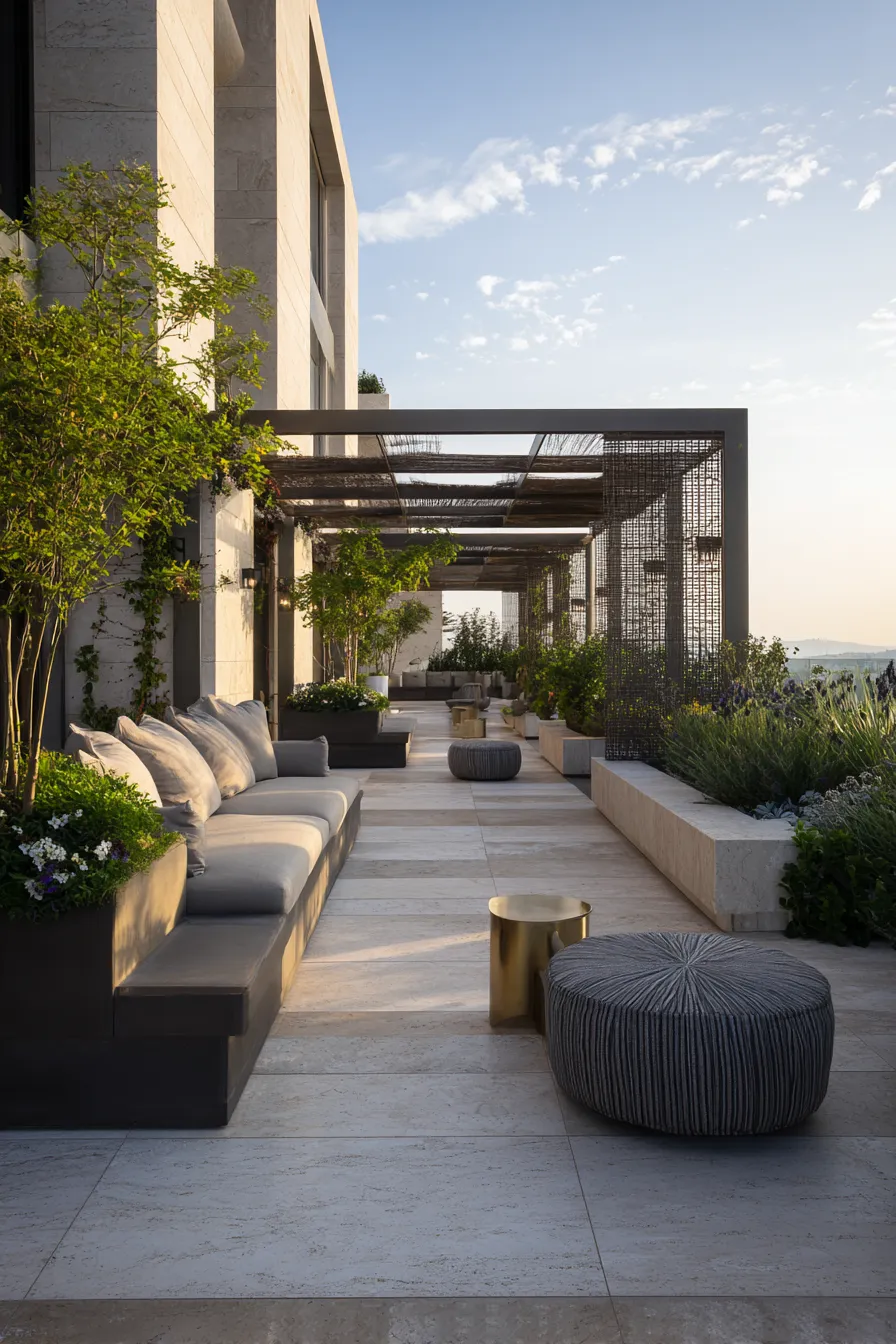
The 2026 balcony aesthetic abandons Pinterest’s decorative clutter for what European architects call stratified materiality—where every surface decision answers to light behavior, seasonal temperature flux, and haptic memory rather than color coordination.
This shift mirrors the broader movement in small living room layout design, where spatial intelligence trumps decorative excess. The balcony, once treated as an afterthought dumping ground for mismatched furniture, now demands the same material rigor as interior architecture. What follows are fifteen approaches that prioritize surface authenticity, microclimate response, and sensory depth over the tired “string lights and potted succulents” formula.
Understanding Material Logic Over Theme Decoration
Before diving into specific strategies, grasp this fundamental principle: your balcony exists in constant negotiation with weather. Every material you introduce will either resist or collaborate with wind, UV exposure, temperature swings, and precipitation. The designers getting balcony projects published in 2026 aren’t asking “what color should this be?” but rather “how will this surface age over eighteen months?”
This philosophical shift applies equally to patio decorating ideas and balcony ideas apartments contexts. Material honesty has replaced material imitation. Composite decking that mimics wood grain now reads as design cowardice—real cedar that silvers to platinum gray demonstrates confidence in temporal aesthetics.
1. Thermal Mass Flooring: Stone Architecture That Remembers Heat

Mediterranean villas have understood this for centuries. Limestone pavers or honed concrete slabs don’t just provide walking surfaces—they function as thermal batteries that absorb midday heat and radiate warmth through cool evenings.
For a 60-square-foot balcony, specify 24″x24″ natural stone tiles in 1.5″ thickness. This isn’t decorative; it’s physics. The mass moderates temperature extremes by 8-12°F compared to hollow composite decking. Choose stones with high silica content for maximum thermal capacity.
Design Breakdown:
- Base: Limestone pavers in Jura Gray or Jerusalem Gold (honed, not polished—wet stone becomes skating rink)
- Joints: Dry-laid with 1/8″ gaps filled with polymeric sand for drainage and weed suppression
- Edge detail: Flush mount with steel edging in raw finish, allowing rust patina
- Underlayment: 1/4″ rubber membrane for waterproofing without sacrificing thermal transfer
Designer’s Secret: Install stone with varied surface planes—mix flamed (rough) and honed (smooth) finishes in a checkerboard pattern. Your bare feet will unconsciously register the texture change before your eyes do, creating subconscious spatial zoning.
Best For: West or south-facing balconies where afternoon heat accumulation extends usable evening hours. Avoid on north-facing exposures where thermal mass becomes thermal sink.
Common Mistake: Using thin porcelain tiles that look like stone but lack thermal mass. They’ll rattle hollow underfoot and negate the entire strategy. Authentic travertine pavers or nothing.
2. Kinetic Fabric Panels: Designing With Wind as Collaborator

Stop fighting wind. Textile designers in coastal Scandinavia have mastered semi-transparent linen scrim curtains that don’t block breeze but diffuse it into gentle turbulence. The fabric becomes a visible record of air movement—a living surface.
Specify 180-200 GSM (grams per square meter) Belgian flax linen in raw, undyed natural. This weight provides body without stiffness. Heavier fabrics (300+ GSM) don’t move responsively; lighter weights (120 GSM) look cheap and flutter chaotically.
Design Breakdown:
- Fabric: Raw linen curtain panels in 180 GSM, cut 20% longer than floor-to-ceiling for deliberate puddling
- Hardware: Stainless steel cable systems with turnbuckles (not flimsy curtain rods)
- Hem: Raw edge with 1/4″ fraying encouraged as texture detail
- Color: Natural flax (L*60-65 in CIE color space) or overdyed with walnut hull for tobacco brown
Designer’s Secret: Install fabric 6″ proud of the balcony edge so it catches upper-altitude wind before it hits your seating zone. This creates a pressure differential that actually reduces wind speed at body height by 30-40%. Physics, not decoration.
Best For: High-rise balconies (8+ floors) with persistent wind shear. Also solves harsh western sun without total opacity—you’ll get 40% light transmission with 80% UV blockage.
Pair this approach with the textile thinking in minimalist bedroom design where fabric weight ratios create visual temperature.
3. Unlacquered Metal Frameworks: Patina as Living Finish

Architects call this “designed decay.” Commission a welder to fabricate custom steel planter boxes in 1/8″ plate, then specify no protective coating. Within three months, you’ll have a rust patina that stabilizes into a matte burnt-orange surface that never needs maintenance.
This contradicts every box-store garden center’s advice. Good. The 2026 aesthetic embraces oxidation as evidence of time passing, similar to how vanity mirror designs now prefer aged brass over chrome.
Design Breakdown:
- Material: Weathering steel planters (COR-TEN or A588 grade) in 1/4″ plate thickness
- Dimensions: 18″H x 48″L x 14″D for visual mass that grounds the space
- Drainage: 1/2″ weep holes every 8″ along bottom seam
- Liner: Galvanized steel insert to prevent rust staining plant roots (visual patina on exterior only)
Designer’s Secret: Accelerate patination by wiping surfaces with hydrogen peroxide mixed with white vinegar (1:1 ratio). You’ll achieve six months of natural weathering in 48 hours. Control the process rather than letting it happen randomly.
Best For: Industrial loft conversions, modern minimalist interiors, anyone who understands that “maintenance-free” actually means “characterless.” This is adult design.
Integrate with steel privacy screens using the same material—create a unified material family rather than introducing six different metals that compete visually.
4. Shadow Architecture: Pergolas Engineered for Light Choreography

A pergola isn’t a decorative hat your balcony wears. It’s a light-filtering device that choreographs shadow movement across surfaces throughout the day. Get this wrong and you’ve installed an expensive sun blockage. Get it right and you’ve created temporal drama.
The critical specification: horizontal slat spacing. For 2″x6″ cedar beams, set them 14″ on-center (not 12″, not 16″). This ratio creates 60% shade coverage at solar noon while maintaining visual transparency to sky. As the sun angle drops, coverage increases to 80% during low-angle morning and evening light.
Design Breakdown:
- Structure: 4×4 pressure-treated posts with 2×6 cedar cross beams in clear grade (minimal knots)
- Spacing: 14″ on-center for temperate latitudes (adjust to 12″ for tropical, 18″ for northern zones)
- Finish: Clear penetrating oil sealer that allows wood to gray naturally, not film-forming stain
- Optional: Adjustable aluminum louvers retrofitted for seasonal angle changes
Designer’s Secret: Orient slats perpendicular to your primary seating axis. If you sit facing north, run slats east-west. This creates shadow bars that move across your field of vision rather than with it—subtle movement that prevents visual stagnation.
Best For: Balconies with 10+ feet of overhead clearance. Below that, vertical shade sails become more spatially appropriate. Match this thinking with the ceiling plane strategies in living room 70s modern design.
5. Monochromatic Depth: Single-Hue Material Variation

Color theory is over. Material theory is here. Instead of “gray and white with pops of yellow,” think “six shades of gray across stone, metal, textile, and ceramic.” This is how museum-quality interiors avoid looking like catalogs.
Build a gray spectrum: polished concrete floors (N7 on Munsell scale), raw steel furniture frames (N4), felted wool cushions (N6), slate tile accents (N3). Every surface reads as “gray” but catches light differently based on reflectance and texture.
Design Breakdown:
- Floor: Concrete overlay troweled smooth with 15% white cement for light gray (LRV 45)
- Furniture: Powder-coated aluminum chairs in matte charcoal (LRV 18)
- Textiles: Merino wool throws in natural gray fleece (LRV 40)
- Accents: Slate coasters and soapstone planters (LRV 8-12)
Designer’s Secret: Introduce exactly one material in near-black (LRV under 10) to anchor the composition—a single cast iron side table or black ceramic vase. Without this tonal floor, monochrome reads as washed out. With it, every other gray pops into relief.
Best For: Modernists, colorphobes, anyone attempting the spatial calm of minimalist bedroom aesthetics outdoors. Also solves small balconies where color variation fractures space.
This approach works brilliantly with the earth-tone variation in boho bedroom design—same strategy, warmer palette.
6. Biophilic Layering: Plant Placement by Microclimate Mapping

Stop buying plants based on appearance. Start mapping your balcony’s microclimate zones: full sun exposure (6+ hours), partial shade (3-6 hours), constant shade, wind-protected corners, wind-exposed edges.
Each zone demands different plant strategies. Western-exposure full-sun zones need xeriscaping with native grasses—blue oat grass, Mexican feather grass, fountain grass—that don’t just tolerate but thrive in heat stress. Northern shade zones want ferns and hostas that would scorch in sun.
Design Breakdown:
- Wind zone: Ornamental grasses (Miscanthus, Calamagrostis) in cor-ten steel planters for root protection
- Sun zone: Succulents and sedums in shallow terracotta bowls (12″ diameter max for proportion)
- Shade zone: Japanese forest grass and maidenhair ferns in ceramic cachepots with drainage
- Transition: Small shrubs (boxwood, dwarf mugo pine) as visual bridges between zones
Designer’s Secret: Plant in odd-numbered clusters (3, 5, 7) with tallest at rear, but introduce one “rule-breaker” plant forward in the composition. This prevents the predictable tiered-stadium look while maintaining visual order.
Best For: Patient gardeners who understand that plant design takes two seasons to mature. Year one looks sparse and strategic—year two delivers the layered abundance everyone photographs.
Link this thinking to reading corner ideas where plants frame intimate spaces.
7. Task-Specific Lighting: Kelvin Temperature Zoning

Your balcony needs three lighting circuits, not one. Morning coffee demands different light than evening wine. Install dimmable LED strip lighting at three color temperatures: 2200K (amber), 2700K (warm white), 3000K (neutral).
2200K mimics candlelight—use this for low recessed floor lights that uplight plant foliage after dark. 2700K provides functional task light for dining—install in a single pendant fixture over a table. 3000K serves reading zones—aim a directional wall sconce at seating.
Design Breakdown:
- Ambient: 2200K LED tape light recessed in aluminum channel under seating or planters, 24V DC
- Task: 2700K globe pendant in hand-blown glass (not molded, you’ll see the difference)
- Accent: 3000K adjustable picture lights in brass with aged patina
- Control: Three separate dimmer switches or smart system with scene programming
Designer’s Secret: Never use 4000K+ “daylight” bulbs outdoors after dark. They trigger physiological alertness that contradicts the balcony’s relaxation purpose. The blue spectrum suppresses melatonin—you’re literally lighting yourself into insomnia.
Best For: Evening-use balconies where artificial light matters more than daytime sun. Also critical for balconies serving double duty as home office ideas overflow space.
8. Compression and Release: Spatial Sequence Planning

Even a 40-square-foot balcony benefits from spatial sequencing. Borrow from Japanese garden design: compress the entry, open the center, compress the destination. This tricks perception into reading the space as larger and more complex than it is.
Create entry compression with tall narrow planters flanking the threshold—force someone to move between them. The center zone stays open (negative space is space). The far end compresses again with a low-backed chair pushed into the corner, making it a deliberate destination rather than leftover space.
Design Breakdown:
- Entry: Two 36″H x 12″W fiberglass column planters in charcoal, planted with bamboo or tall grasses
- Center: 60% of floor area left clear, defined by area rug in flat weave sisal
- Destination: Single lounge chair (not a set—sets are for retailers) with side table tucked at arm height
Designer’s Secret: Make the entry compression threshold narrower than 30″—just tight enough that two people can’t walk through side-by-side. This forces single-file entry that slows movement and signals transition from interior to exterior mindset.
Best For: Narrow balconies (under 6′ wide) where the length dimension becomes your design asset. Also applies to entryway table decor ideas where compression/release creates drama in compact spaces.
9. Textile Weight Mixing: Layering 100 to 800 GSM

Textile weight creates visual temperature. A balcony with only 180 GSM linen cushion covers reads as summer regardless of season. Add an 800 GSM wool throw blanket and the space gains year-round credibility.
Build three textile layers: heavy base (600-800 GSM canvas cushion covers), medium transition (180-220 GSM linen throw pillows), light accent (80-100 GSM cotton gauze table runner). This hierarchy gives the eye a gradient to travel rather than a single-note surface.
Design Breakdown:
- Base: Outdoor canvas cushions in 600 GSM duck cloth (Sunbrella or equivalent UV rating)
- Mid: Belgian linen pillows in 180 GSM with invisible zipper closures
- Light: Gauze throw blanket in 100 GSM organic cotton, deliberately wrinkled
- Accent: Jute floor cushions with leather handles for movable seating
Designer’s Secret: Introduce one textile that’s deliberately “wrong” for outdoors—a thin cashmere throw or silk pillow—but keep it protected under a roof overhang. This small indoor/outdoor transgression makes the space feel less like “patio furniture” and more like room.
Best For: Textile-sensitive designers who understand that fabric communicates before color does. Also those extending cozy reading nook comfort to exterior spaces.
10. Water Features: Sound Masking and Humidity Micro-Regulation

Urban balconies battle traffic noise. A small recirculating fountain doesn’t eliminate street sound but masks it with white noise that’s psychologically preferable. The sound of water tricks your brain into lowering cortisol response to urban chaos.
Functionally, moving water adds 10-15% relative humidity to the immediate 6-foot radius—meaningful for balconies with drought-sensitive plants or clients with dry skin in arid climates.
Design Breakdown:
- Fountain: Overflowing bowl design in cast concrete (30″ diameter, 12″ height)
- Pump: Submersible with 200 GPH flow rate for gentle overflow, not aggressive spray
- Sound: Adjust water level to control sound frequency—higher level = lighter trickle, lower = deeper burble
- Winter: Drain and cover with weatherproof tarp in freezing climates
Designer’s Secret: Position fountain to reflect in a window or glass door—you’ll see movement peripherally from inside, extending the sensory experience beyond physical balcony boundaries.
Best For: High-density urban settings where street noise exceeds 65 decibels, or arid climates (Phoenix, Palm Springs) where every bit of humidity helps. Link to bathroom decor where water sounds create spa atmosphere.
Warning: Avoid multi-tiered fountains that scream “mall courtyard circa 1997.” Simple geometric forms age better.
11. Furniture as Sculptural Mass: Volume Over Decoration

Balcony furniture should occupy space with authority, not apologize for existing. Replace spindly bistro chairs with a single low-profile concrete bench (18″H x 60″L x 18″D) that doubles as seating and occasional table. This is furniture that stakes a claim.
Mass-forward furniture reduces visual clutter because one substantial piece reads cleaner than five delicate ones. It also solves the wind problem—heavy furniture stays put during gusts that send lightweight resin chairs tumbling.
Design Breakdown:
- Primary: Cast concrete bench with teak wood seat insert for warmth (order from architectural concrete fabricator, not garden center)
- Secondary: Teak daybed in oversized proportion (72″L minimum) with modular foam cushions
- Tertiary: Steel side table in 1/4″ plate, 18″ cube dimension
Designer’s Secret: Choose furniture with horizontal emphasis (low and long) rather than vertical. This makes the balcony ceiling feel higher by contrast—a spatial illusion that counters the compression of outdoor rooms.
Best For: Modernists who prefer fewer, better things. Anyone fleeing the “complete patio set” retail trap. Also applies to living room paint colors where furniture becomes architecture.
Source custom benches from local concrete artisans—this isn’t Amazon territory.
12. Privacy Gradients: Translucent-to-Opaque Layering

Total privacy screens read as defensive. Graduated privacy reads as intentional. Layer three transparency levels: 70% open perforated metal screen at balcony edge, 40% open slatted wood panel at mid-zone, solid planted wall at most private corner.
This gives you control over sight lines without creating a bunker. Someone on the street gets filtered glimpses. Someone in the adjacent building hits visual resistance. Someone directly across faces total opacity.
Design Breakdown:
- Edge: Powder-coated aluminum screen with 1/2″ holes at 1″ centers (40% perforation ratio)
- Middle: Cedar slat panels with 2″ slats and 3″ gaps, 6’H total
- Back: Vertical planter wall with trailing ivy or clematis at full coverage
- Frame: Steel posts in square tube 2″x2″ for minimal visual weight
Designer’s Secret: Align perforation patterns with eye level (58″-62″ floor-to-center) so someone standing gets maximum privacy while seated views remain open. You’re choreographing sightlines based on body position.
Best For: Dense urban contexts, ground-floor balconies, anywhere you need privacy without sacrificing light. Coordinate with balcony railing design for integrated systems.
13. Seasonal Material Swaps: Summer vs. Winter Surface Palettes

Professional designers don’t redecorate—they re-surface. Summer demands evaporative cooling through natural linen and light stone. Winter requires thermal retention through wool textiles and dark ceramics that absorb weak sun.
Build two material libraries: Summer = open weave, light reflectance, evaporative fabrics. Winter = closed weave, light absorption, insulative materials. Swap them twice yearly.
Design Breakdown:
- Summer: Linen cushions (180 GSM), limestone floors (light gray), cotton canvas umbrellas
- Winter: Wool throws (600 GSM), dark slate accents, thermal curtains in velvet (400 GSM)
- Storage: Weatherproof deck box for off-season textiles with cedar blocks for moth prevention
Designer’s Secret: Don’t swap everything—change only 40% of surfaces. This maintains spatial identity while signaling seasonal shift. Swap cushions and throws, keep furniture and rugs.
Best For: Four-season climates where temperature swings exceed 40°F between summer and winter. Less relevant in coastal zones with narrow temperature bands.
Apply this thinking to kids bedroom walls where seasonal swaps keep spaces evolving.
14. Reflective Surface Strategy: Bouncing Natural Light Deeper

North-facing balconies lose light fast. Combat this with high-LRV (Light Reflectance Value) surfaces that bounce available light deeper into space. Paint one wall in high-gloss white (LRV 92+), add a mirror-polished stainless steel planter, position water feature to catch sky.
This isn’t about adding light sources—it’s about multiplying the light you have. A balcony that receives 4 hours of indirect sun can feel like 6 hours with strategic reflectance.
Design Breakdown:
- Wall: Exterior acrylic paint in ultra-white with gloss finish (Sherwin Williams Extra White at high gloss)
- Metal: Polished stainless steel (not brushed—you need mirror finish) planter boxes
- Water: Shallow reflecting pool in dark granite (black surfaces reflect sky better than light)
- Ceiling: White painted wood slats to bounce light downward
Designer’s Secret: Position reflective surfaces to catch 10am-2pm sun angles, not evening. Morning light has higher blue content that reflects better than warm afternoon light. Use a sun path diagram for your latitude.
Best For: North-facing balconies, deeply recessed balconies with overhead coverage, anywhere natural light is precious. Similar strategy to bathroom storage where mirrors multiply space.
15. Hardscape-to-Softscape Ratio: The 60/40 Balance Rule

Every balcony needs a ratio: hard surfaces (stone, metal, wood) to soft surfaces (plants, textiles, soil). Lean too hard (80/20) and you’ve built a landing pad. Lean too soft (20/80) and you’ve created a maintenance nightmare.
The sweet spot: 60% hardscape, 40% softscape. This ratio balances visual weight, maintenance demands, and seasonal flexibility. It also happens to match the proportions found in Italian villa gardens that have worked for 400 years.
Design Breakdown:
- Hard (60%): Stone flooring (30%), furniture (20%), metal screens (10%)
- Soft (40%): Planted areas (25%), textiles (10%), seasonal decor (5%)
- Measure by visual weight, not square footage—a 6’H plant occupies more perceptual space than its 2’x2′ planter footprint
Designer’s Secret: When in doubt, add hardscape. Amateurs over-plant because plants feel like “life.” Professionals understand that negative space (hard surfaces) makes plants readable as intentional design rather than apologetic greenery.
Best For: Anyone seeking low-drama outdoor design that doesn’t demand weekend maintenance. Also ideal for patio furniture planning where hardscape becomes the foundation.
Urban balconies especially benefit from this ratio—you’re creating a room, not a garden.
Material Sourcing and Long-Term Thinking
The difference between a balcony that photographs well and one that lives well is material authenticity. Source stone from quarry suppliers, not big-box tile departments. Commission metal work from fabricators, not Amazon. Purchase textiles by GSM weight, not brand recognition.
This approach costs 30% more upfront and lasts 300% longer. More importantly, it looks intentional rather than assembled. When someone asks “where did you get that?” and your answer is “a welder in the industrial district,” you’ve succeeded.
The 2026 aesthetic rewards patience, research, and material fluency. It punishes shortcuts. Your balcony will age beautifully or poorly based entirely on whether you prioritized surface authenticity or surface imitation.
For continued exploration of material-first design thinking, examine how these principles extend to dining room chandelier selection, kitchen island ideas spatial planning, and farmhouse dining room material palettes.
The balcony is no longer an afterthought. It’s an architecture laboratory where material behavior, microclimate response, and sensory design converge. Treat it accordingly.


