The 2026 apartment patio aesthetic abandons matchy-matchy furniture sets in favor of ‘microclimate engineering’—strategic material layering that extends your living season by 8-10 weeks through thermal mass manipulation and wind disruption. Designers now approach these compressed outdoor zones with the same spatial rigor once reserved for yacht interiors: every square inch must perform multiple functions while maintaining visual breathing room.
This shift reflects a broader reckoning with urban density. As apartment living becomes the dominant American housing model, patios have evolved from seasonal decoration zones into year-round extensions of interior square footage. The design language that follows prioritizes climate adaptation, material longevity, and biophilic density over the superficial “outdoor room” concepts that dominated the 2010s.
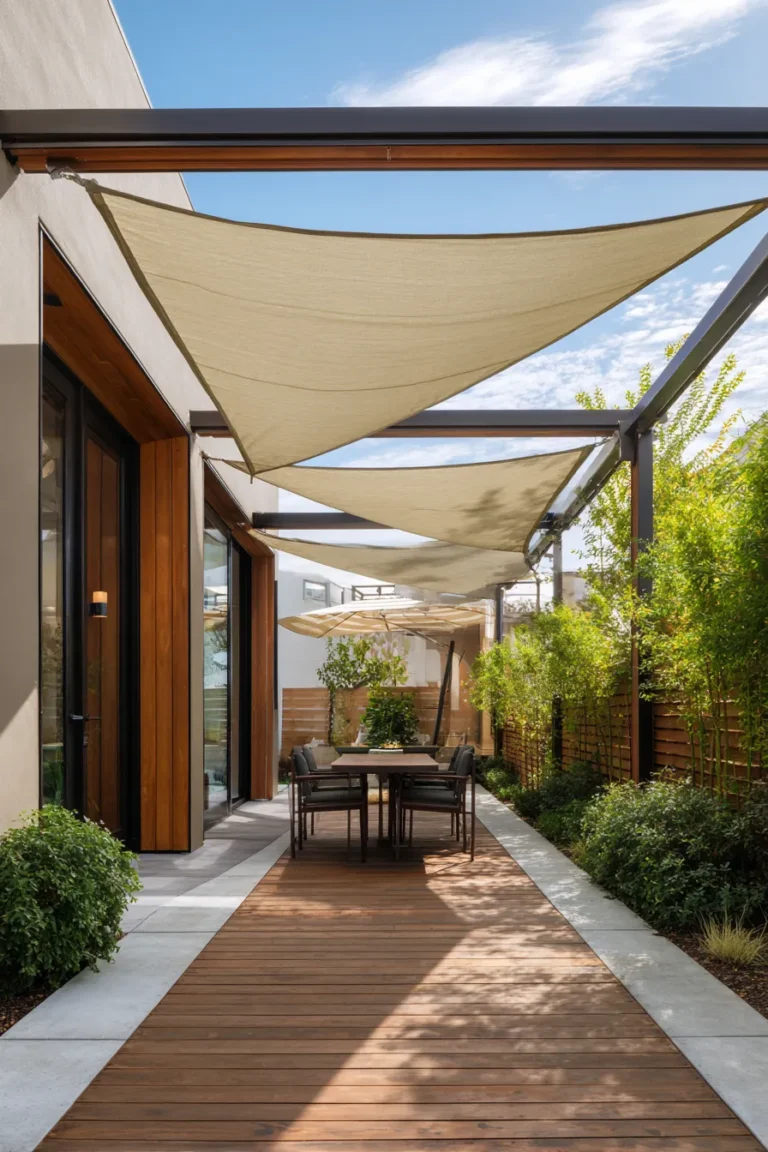
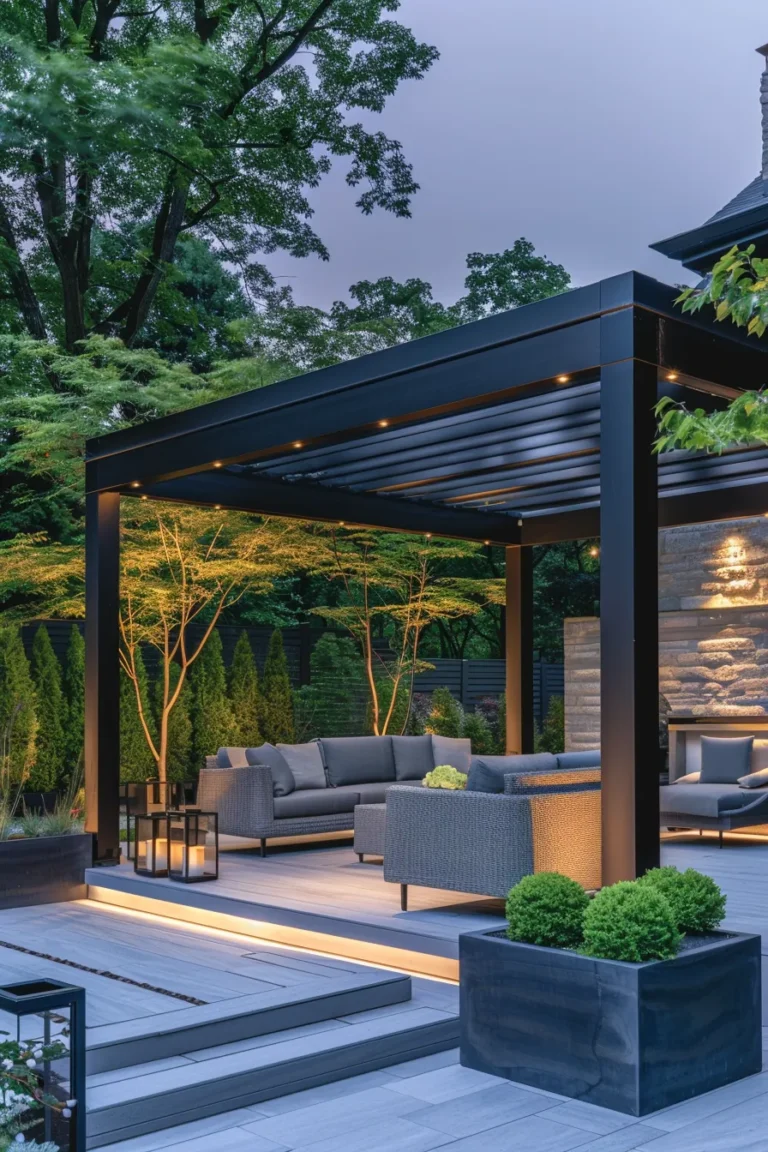
Layered Canopy Opacity Control
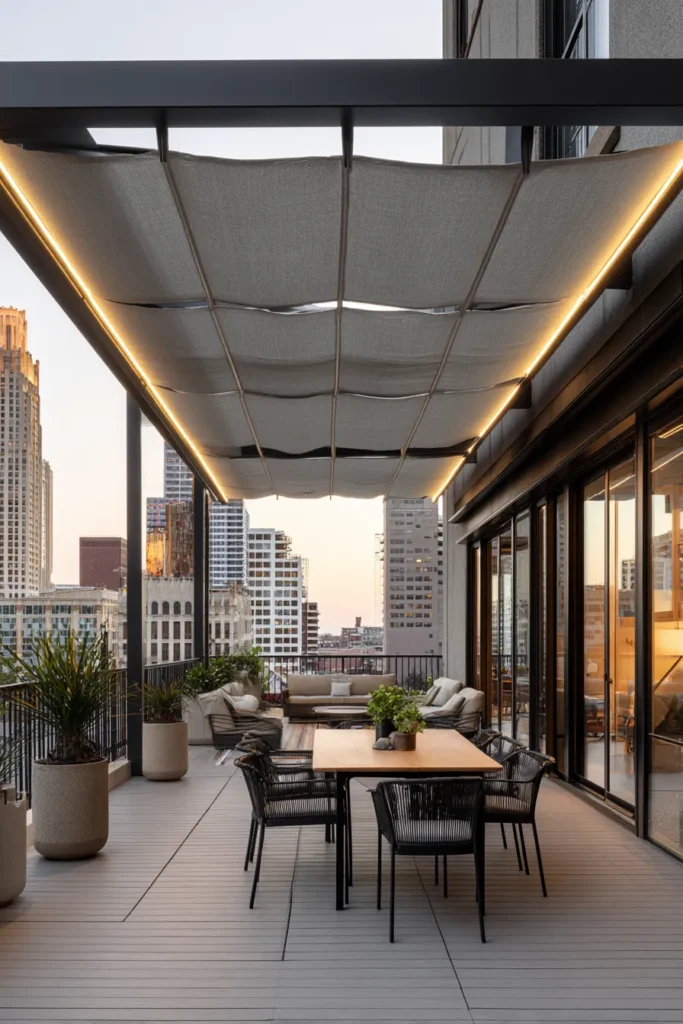
Fixed pergolas paired with retractable shade sails create what lighting designers call “temporal dappling”—the ability to modulate light penetration from 15% to 85% throughout the day without moving furniture.
The sophistication lies in contrasting material weights. A permanent structure in powder-coated aluminum (RAL 7016 anthracite gray) anchors the space architecturally, while a secondary layer of 185gsm solution-dyed acrylic fabric provides the flexibility urban microclimates demand. This dual-system approach mirrors how professional conservatories manage solar heat gain.
Designer’s Secret: Install your fixed canopy beams running east-west, not north-south. This orientation creates natural shade corridors during peak UV hours (10 AM–2 PM) while allowing oblique morning and late afternoon light to penetrate—critical for maintaining healthy circadian rhythms in apartment dwellers who spend 90% of waking hours indoors.
Design Breakdown:
- Structure: Aluminum pergola with 200mm x 100mm beams, matte black powder coat
- Secondary shade: Waterproof acrylic sail in ‘Dove Gray’ with stainless marine-grade hardware
- Lighting integration: Recessed LED strips (3000K) within pergola beams for 50-lux ambient glow
- Anchor method: Through-bolt mounting for concrete slabs; consult building engineering for load limits
Best For: South or west-facing patios where summer heat gain exceeds 6 hours daily; ideal for professionals who use outdoor space for remote work.
Shop the Look: Premium shade solutions offer adjustable coverage systems that adapt to seasonal sun angles.
Thermal Mass Flooring Intervention
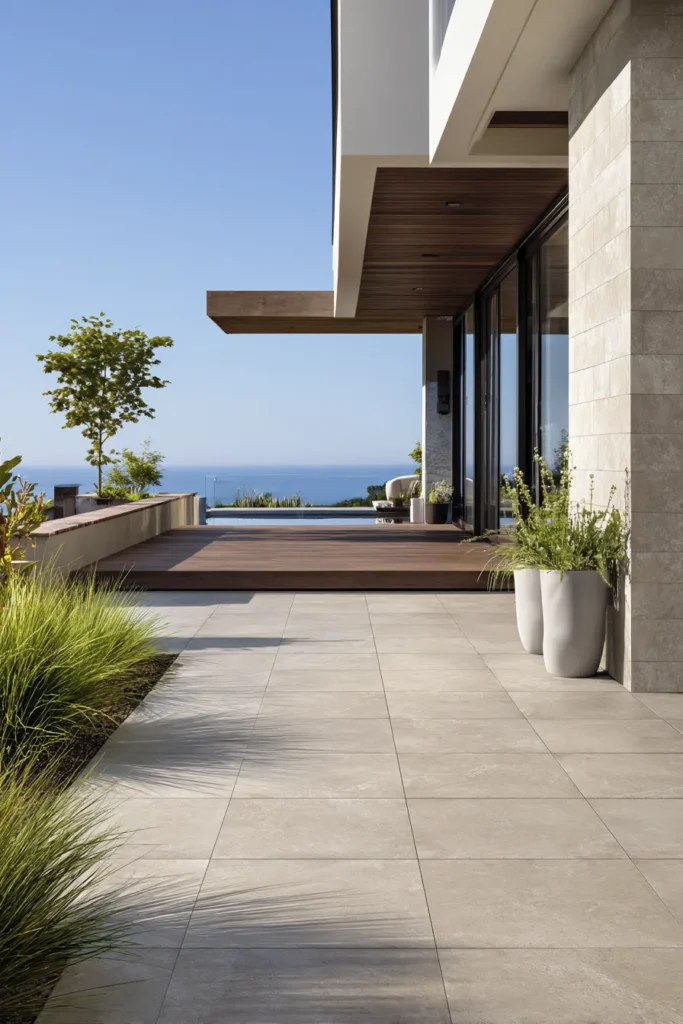
Porcelain pavers installed as a floating deck system over existing concrete transform apartment patios from radiant heat traps into temperature-stabilizing zones that remain 8-12°F cooler during peak summer months.
The physics is straightforward: dense ceramic materials absorb daytime heat slowly, then release it gradually after sunset—extending comfortable outdoor hours into early evening without auxiliary heating. Specify 20mm thick pavers in honed (not polished) finishes to avoid glare while maximizing slip resistance in wet conditions.
Designer’s Secret: Choose pavers with a Solar Reflectance Index (SRI) above 50. Most manufacturers don’t advertise this specification, but it’s the difference between a patio that feels oppressive at 3 PM versus one that remains hospitable. ‘Warm Gray’ and ‘Taupe’ colorways in the 60-70 SRI range outperform darker “design-forward” options by measurable degrees.
Design Breakdown:
- Material: 600mm x 600mm porcelain pavers, honed surface, 20mm thickness
- Color palette: Limestone replicas in ‘Greige’ or ‘Warm Concrete’ tones
- Installation: Raised pedestal system with 25mm air gap for drainage and thermal break
- Perimeter detail: Leave 10mm expansion gap, fill with matching flexible grout
Best For: Concrete slab patios with direct sun exposure; apartments where existing flooring shows weathering or staining.
Shop the Look: Modular flooring systems include interlocking pavers designed for no-drill installation.
Wind-Disrupting Vertical Screens
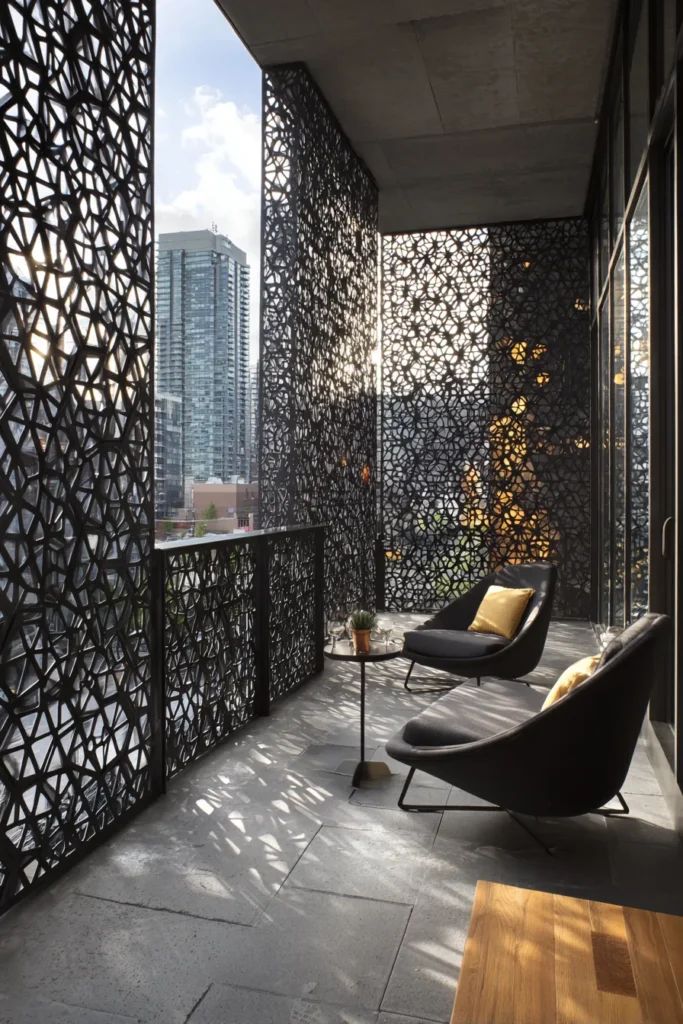
Perforated metal panels with 40% open ratios reduce wind velocity by 60-70% without creating the claustrophobic enclosure that solid barriers impose—critical for high-rise apartment patios where wind speeds can render outdoor space unusable 200+ days annually.
The engineering principle is counterintuitive: screens with strategic perforation patterns outperform solid walls by breaking wind into smaller eddies rather than deflecting it upward (where it creates turbulent downdrafts). Specify 3mm aluminum with laser-cut geometric patterns; the material thickness provides acoustic dampening as a secondary benefit, reducing urban noise pollution by 8-12 decibels.
Designer’s Secret: Position screens 600mm away from your patio’s perimeter railing rather than directly against it. This buffer zone allows wind to dissipate between the two barriers, creating a microclimate zone where air movement drops to comfortable levels (5-8 mph) even when ambient winds exceed 20 mph. The gap also prevents moisture accumulation that causes mildew on adjacent textiles.
Design Breakdown:
- Material: 3mm aluminum sheet, powder-coated matte black (RAL 9005)
- Pattern: Geometric hexagonal or linear slot perforations at 40% open ratio
- Dimensions: Panels 1800mm height x 900mm width for modular flexibility
- Mounting: Freestanding weighted bases or clamp systems for rental-friendly installation
Best For: Corner patios on floors 8+ where cross-winds create uncomfortable turbulence; urban environments with persistent street noise.
Shop the Look: Privacy screens include freestanding options that don’t require permanent mounting.
Modular Galvanized Steel Planters
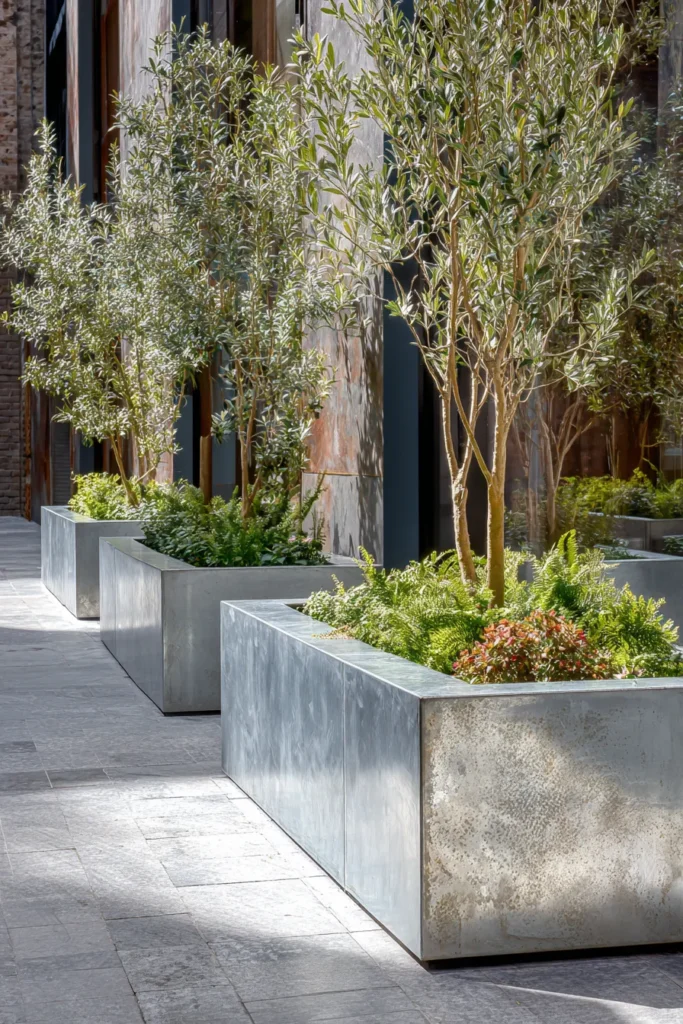
Commercial-grade galvanized steel troughs with 1.5mm wall thickness provide the structural integrity apartment patios require for multi-season planting while weighing 40% less than equivalent concrete vessels—critical when building load limits restrict decorative weight to 45-60 kg per square meter.
The material choice reflects changing maintenance expectations. Unlike powder-coated aluminum (which chips) or resin composites (which degrade under UV), hot-dip galvanized steel develops a self-protecting zinc patina that actually becomes more weather-resistant over time. Size specifications matter: 800mm length x 300mm width x 350mm depth allows root systems to establish properly for small trees and substantial perennials.
Designer’s Secret: Paint the interior with rubberized waterproofing membrane before adding soil. Galvanized steel is non-reactive, but the real threat to plant health is thermal conductivity—metal planters can heat root zones to damaging temperatures (above 95°F) during summer. A 3mm rubber barrier provides thermal buffering while extending planter lifespan by preventing interior corrosion from constant moisture exposure.
Design Breakdown:
- Material: Hot-dip galvanized steel, 1.5mm wall thickness, natural silver patina
- Dimensions: 800mm L x 300mm W x 350mm D for substantial plantings
- Drainage: Pre-drilled 12mm holes every 200mm along base with mesh covers
- Mobility: Welded steel legs with adjustable leveling feet for uneven surfaces
Best For: Minimalist aesthetics where industrial materials complement concrete architecture; renters who need relocatable large-scale plantings.
Shop the Look: Designer planters include lightweight options suitable for weight-restricted balconies.
Multi-Zone Lighting Architecture
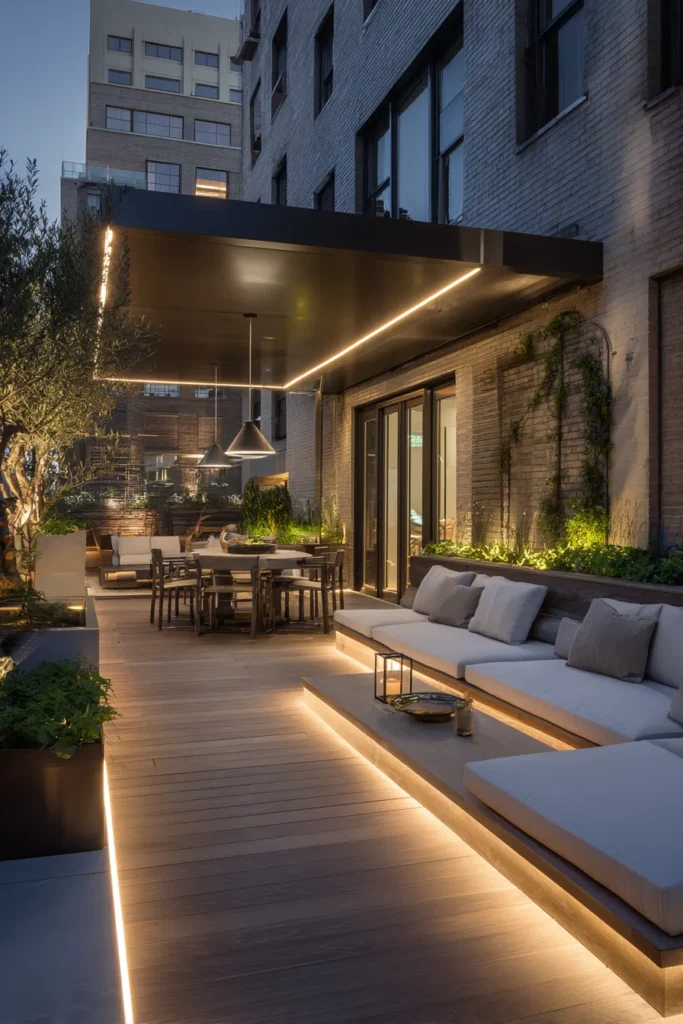
Apartment patios demand three distinct lighting circuits operating at different lux levels: ambient path lighting (50 lux), social zone illumination (100-150 lux), and task lighting for dining (200+ lux). Single-source overhead fixtures create the flat, cafeteria-like ambiance that marks amateur outdoor spaces.
Professional designers layer light sources at three heights—ground-level uplighting for architectural elements, mid-level (900-1200mm) for social zones, and overhead pendants (2100mm) for functional areas. The color temperature specification is equally critical: warm white (2700-3000K) bulbs mimic candlelight’s relaxing spectral qualities, while cool white (4000K+) creates institutional harshness that contradicts the sanctuary goal.
Designer’s Secret: Install all lighting circuits on separate dimmer switches, even if you think you won’t use them. The ability to modulate intensity transforms a single patio into multiple experiential zones—bright and energizing for morning coffee (80% output), softly ambient for evening relaxation (30% output). This flexibility costs an additional $40 in materials but multiplies your space’s functional versatility by a factor of three.
Design Breakdown:
- Ambient layer: LED strip lighting (2700K) installed under seating or behind planters for 50-lux glow
- Social layer: Battery-powered table lamps or wall sconces at 1000mm height, 100-150 lux
- Task layer: Hardwired pendant fixture (IP65-rated) at 2100mm above dining surface, 200+ lux
- Control: Smart dimmers on all circuits for scene programming
Best For: Patios used for multiple activities throughout the day; spaces where ambiance significantly impacts usage frequency.
Shop the Look: Outdoor lighting systems offer weatherproof LED options with adjustable color temperature.
Textile Weather Resistance Stacking
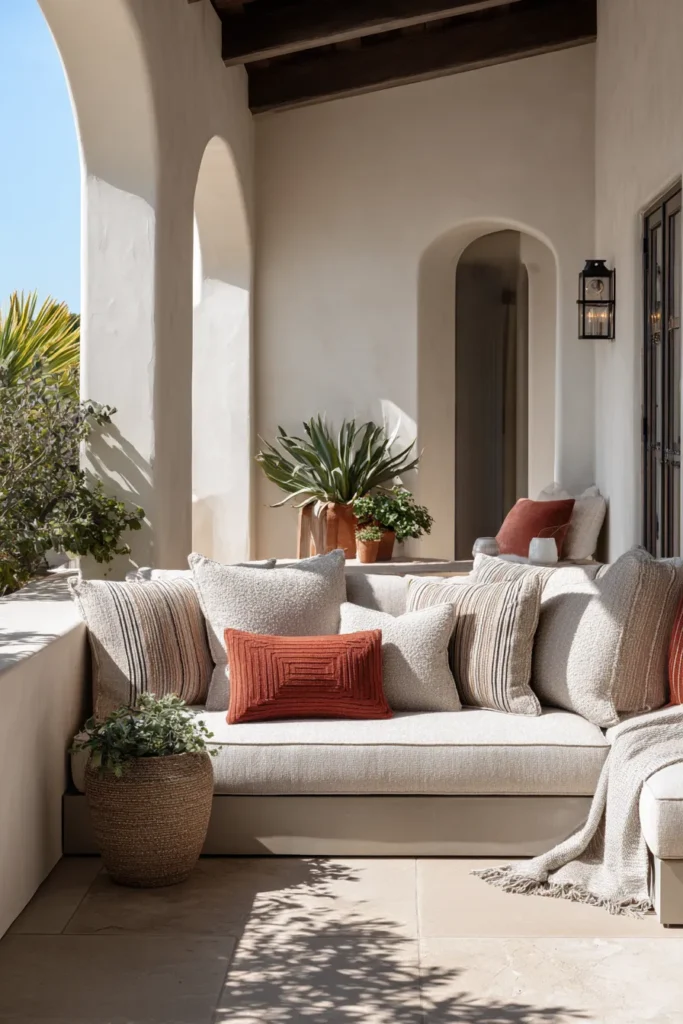
Solution-dyed acrylic cushions with 450gsm fabric weight provide the durability apartment patios require—where textiles remain outdoors 24/7/365 rather than being stored seasonally—while maintaining the tactile softness that makes outdoor seating actually comfortable for extended use.
The distinction between solution-dyed and piece-dyed fabrics determines whether your investment lasts two seasons or ten. Solution-dyeing integrates color pigment into synthetic fibers during extrusion; piece-dyeing applies color topically after weaving. The former resists UV degradation and chlorine bleaching (critical for patios near pools) with color fastness ratings of 1500+ hours, while the latter fades within 18 months of sun exposure.
Designer’s Secret: Layer outdoor textiles using the “3-2-1 color rule”: three neutral shades, two accent colors, one pattern. This formula prevents the chaotic “souvenir shop” aesthetic while providing enough visual interest to photograph well. For 2026, specify your three neutrals in different surface textures—smooth solution-dyed acrylic, nubby outdoor bouclé, and waffle-weave—to create depth without relying on color contrast.
Design Breakdown:
- Base cushions: Solution-dyed acrylic in ‘Flax’ or ‘Natural Linen’, 450gsm fabric weight
- Accent pillows: Weather-resistant bouclé in ‘Terracotta’ and ‘Sage’, 380gsm
- Pattern layer: Geometric stripe or ikat in coordinating palette, 320gsm
- Fill: Quick-dry polyester fiber batting, not foam, for moisture management
Best For: High-use seating zones where textiles endure daily contact and weather exposure; coastal environments with salt air.
Shop the Look: Performance textiles include UV-resistant cushions designed for year-round outdoor use.
Vertical Hydroponic Edible Walls
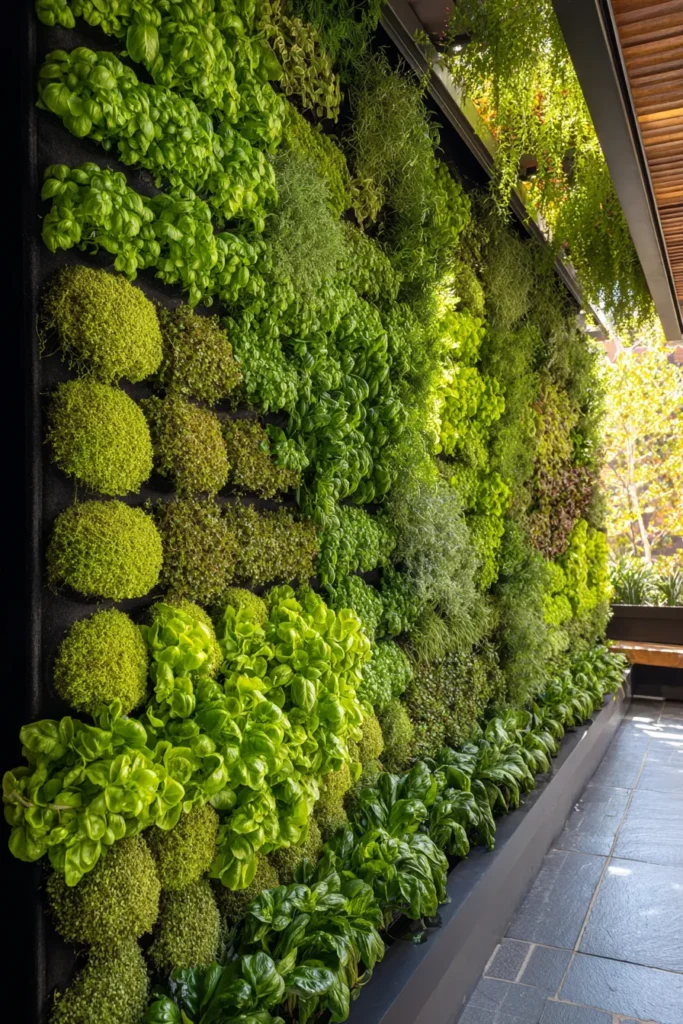
Wall-mounted growing systems achieve 40 plants per square meter density—transforming a single vertical surface into productive kitchen garden space that yields 12-15 kg of leafy greens, herbs, and compact vegetables annually while occupying zero floor area.
The innovation lies in closed-loop irrigation systems that eliminate the constant watering burden traditional container gardens impose. Reservoir-fed drip lines maintain consistent soil moisture while preventing the water damage that makes building managers prohibit apartment patio gardening. Modern systems integrate grow lights for north-facing spaces, extending the growing season to 52 weeks in temperate climates.
Designer’s Secret: Specify only systems with removable growing pockets. First-generation vertical gardens used fixed planting cells that became biohazard zones when plants died or soil became contaminated. Current modular pocket systems allow individual plant replacement without disturbing neighboring specimens—critical for maintaining a lush wall appearance year-round rather than the “Swiss cheese” look of partially dead installations.
Design Breakdown:
- Structure: Powder-coated aluminum frame with felt growing pockets, 1200mm x 900mm panels
- Irrigation: Self-watering reservoir system with 15L capacity, gravity-fed drip lines
- Plant selection: Compact cultivars only—’Spicy Globe’ basil, ‘Tom Thumb’ lettuce, strawberries
- Lighting: Optional full-spectrum LED bars (6500K) for shaded exposures
Best For: Food-conscious urbanites prioritizing freshness over grocery convenience; north-facing patios lacking adequate natural light for traditional gardening.
Shop the Look: Vertical garden systems include complete kits with irrigation and structural components, similar to setups used in balcony decor projects.
Articulating Privacy Louver Systems
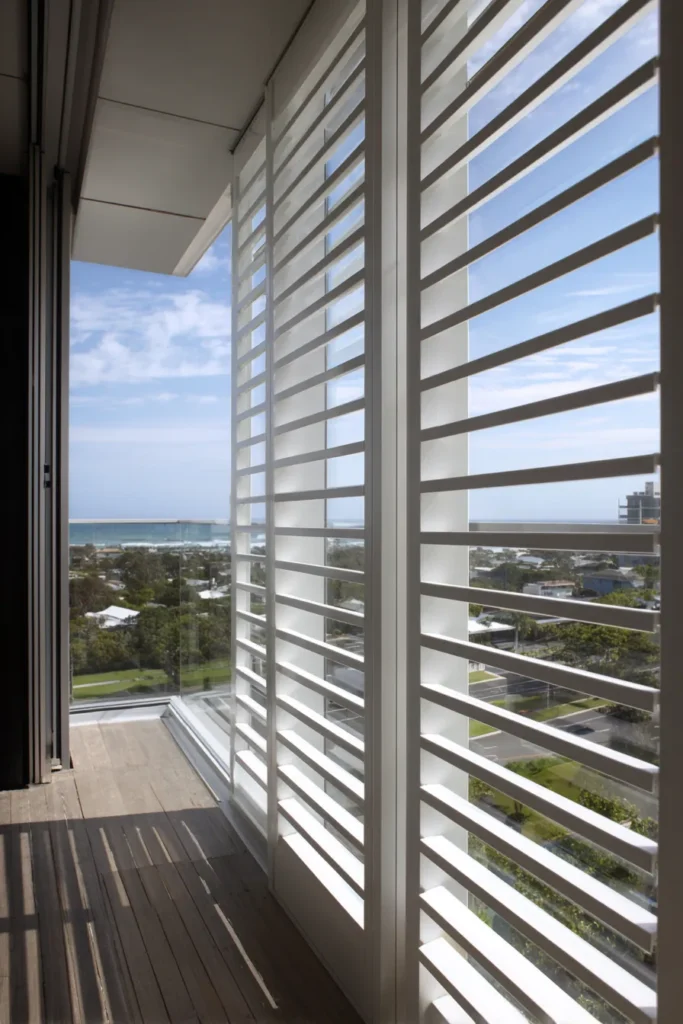
Adjustable aluminum blade screens with 135-degree rotation capability provide the visual privacy apartment patios require without sacrificing the cross-ventilation that makes outdoor space habitable during summer months—a balance fixed privacy walls cannot achieve.
The mechanical sophistication rivals interior plantation shutters. Individual louvers pivot on stainless steel pins, allowing users to modulate privacy from 20% (fully open, maintaining views) to 95% (closed, blocking sightlines) while always permitting airflow through the blade gaps. Specify 100mm wide blades in matte finishes; narrower profiles create a venetian blind aesthetic that reads as cheap, while gloss finishes produce glare.
Designer’s Secret: Install louver systems at eye level only—1400mm to 1900mm height—rather than floor-to-ceiling. This targeted approach provides privacy where it matters (blocking views into seating zones) while maintaining open space above and below that prevents the boxed-in feeling full-height screens create. The partial installation also reduces material costs by 40% while delivering equivalent functional privacy.
Design Breakdown:
- Material: Extruded aluminum blades, 100mm width x 3mm thickness, powder-coated RAL 7043
- Mechanism: Manual worm-gear control rod for synchronized blade rotation
- Dimensions: Panels 1400-1900mm height (eye-level zone only) x custom width
- Mounting: Side-mount to existing railings or freestanding posts
Best For: Ground-floor patios with pedestrian sightlines; units facing neighboring buildings at close proximity (less than 6 meters).
Shop the Look: Adjustable privacy screens offer modular systems for customized coverage, complementing the approaches shown in our patio decorating guide.
Outdoor Rug Materiality Hierarchy
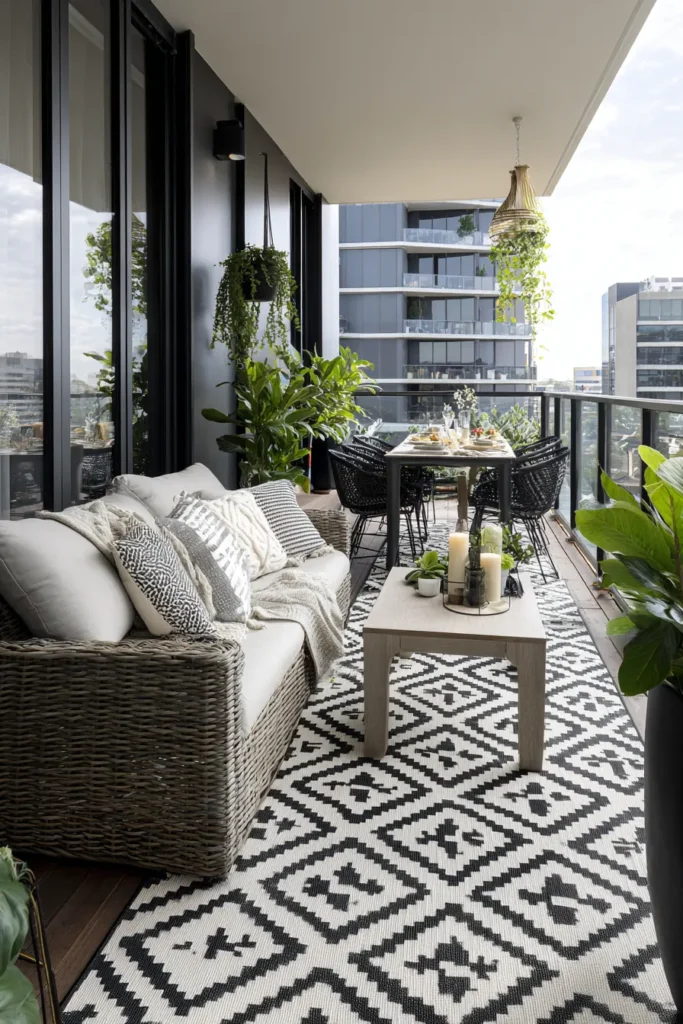
Polypropylene flatweave rugs with 4mm pile height and UV stabilizers provide the foundational layer apartment patios need—defining spatial zones while withstanding the moisture cycling and sun exposure that destroy natural fiber rugs within a single season.
The performance gap between outdoor and indoor rugs is substantial. Polypropylene’s synthetic structure resists mold, mildew, and fading with minimal maintenance, while cotton and jute alternatives require weekly cleaning and annual replacement. Size specifications follow interior design principles: rugs should extend 300mm beyond furniture footprints on all sides, anchoring seating groups visually while protecting underlying flooring from furniture leg damage.
Designer’s Secret: Contradict the “bigger is better” instinct. On small apartment patios (under 15 square meters), use two smaller rugs (1800mm x 1200mm each) to define separate zones—dining and lounging—rather than one large rug that consumes the entire floor plane. This strategy creates the perception of abundant space by establishing distinct “rooms” rather than a single undifferentiated surface.
Design Breakdown:
- Material: 100% polypropylene flatweave, UV-stabilized for 1500+ hour colorfastness
- Pile: 4mm height for easy furniture movement and drainage
- Color: Geometric patterns in high-contrast colorways—’Charcoal/Ivory’ or ‘Navy/Natural’
- Size: Two 1800mm x 1200mm rugs for zoning versus one oversized rug
Best For: High-traffic areas where spills and moisture exposure occur daily; renters seeking non-permanent spatial definition.
Shop the Look: Performance outdoor rugs feature machine-washable construction and fade-resistant patterns.
Corner Banquette Built-Ins
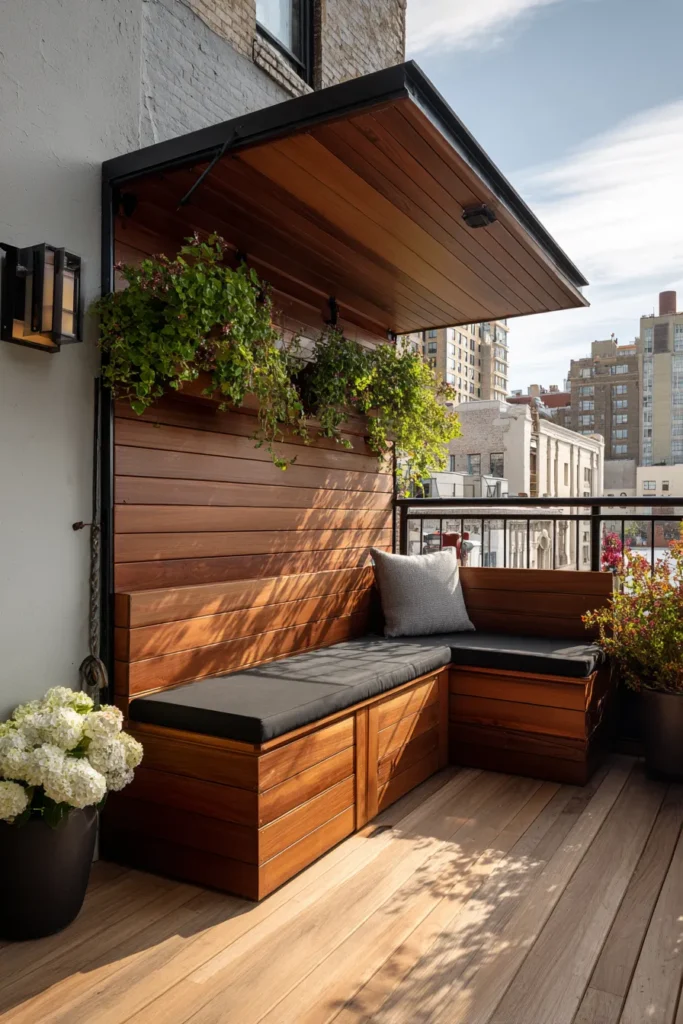
Marine-grade plywood seating with integrated storage transforms dead corner space into the highest-value real estate on apartment patios—providing comfortable seating for 4-6 people, weather-resistant storage for 200+ liters of cushions and accessories, and architectural permanence that makes small patios feel intentionally designed rather than haphazardly furnished.
The construction method borrows from yacht joinery. Pressure-treated framing supports 18mm marine plywood panels sealed with penetrating epoxy resin—creating a furniture-grade structure that withstands moisture exposure without the warping and delamination standard plywood suffers. Built-in seating also circumvents the weight restrictions that limit freestanding furniture options; once installed, structural loads transfer to building foundations rather than floor surface limits.
Designer’s Secret: Incorporate a continuous 25mm drainage gap between the seat deck and back support. This seemingly minor detail prevents the water pooling that rots built-ins from the inside out within three years. Water enters through cushion seams and hardware penetrations regardless of how careful you are—accepting this reality and planning drainage routes accordingly extends your built-in’s lifespan from 3-5 years to 15+.
Design Breakdown:
- Structure: Pressure-treated 50mm x 100mm framing with marine-grade 18mm plywood cladding
- Finish: Three coats penetrating epoxy sealer plus exterior-grade paint in semi-gloss
- Dimensions: 1800mm L x 600mm D x 450mm H seating, plus 400mm high back support
- Storage: Lift-top seat deck with piano hinge and hydraulic assist
Best For: Owned units where permanent installations add property value; small patios requiring space-efficient multi-functional furniture.
Related Design: This built-in approach echoes strategies used in small living room layouts where custom millwork maximizes limited square footage.
Suspended Pendant Drop Lighting
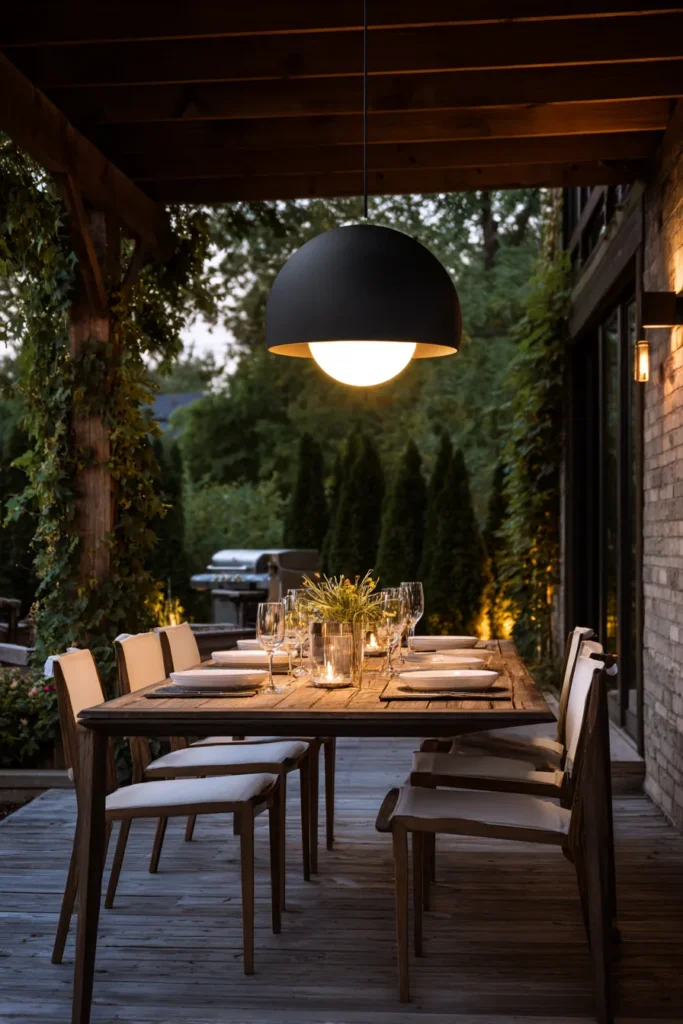
IP65-rated pendant fixtures suspended at 2100mm height above dining surfaces provide the task lighting apartment patio dining zones require—delivering 200-300 lux illumination that makes evening meals functional rather than theatrical gestures performed in semi-darkness.
The IP (Ingress Protection) rating is non-negotiable for outdoor fixtures. IP65 certification guarantees protection against dust ingress and water jets from any direction—meaning seasonal rain storms won’t destroy your lighting investment within months. Globe or drum shade geometries in powder-coated metal or UV-stable acrylic provide even light distribution without the harsh shadows directional spotlights create.
Designer’s Secret: Wire pendant fixtures to a plug-in cord rather than hardwired circuits. This approach seems less professional, but it’s actually more versatile for apartment patios where electrical access is limited and lease terms prohibit permanent modifications. Modern braided cord covers in outdoor-rated materials make the plug-in connection visually refined while maintaining the flexibility to relocate fixtures as furniture arrangements evolve.
Design Breakdown:
- Fixture: IP65-rated pendant in matte black or bronze finish, 300-400mm diameter
- Bulb: LED 10-12W (800-1000 lumens), 2700K warm white, dimmable
- Suspension: 1500mm adjustable braided cord with inline dimmer switch
- Installation: Ceiling hook or shepherd’s crook floor stand for plug-in operation
Best For: Dining zones requiring dedicated task lighting; patios where overhead coverage permits fixture exposure to weather.
Shop the Look: Weather-resistant pendant lighting includes plug-and-play options suitable for rental installations.
Monochromatic Palette Zoning
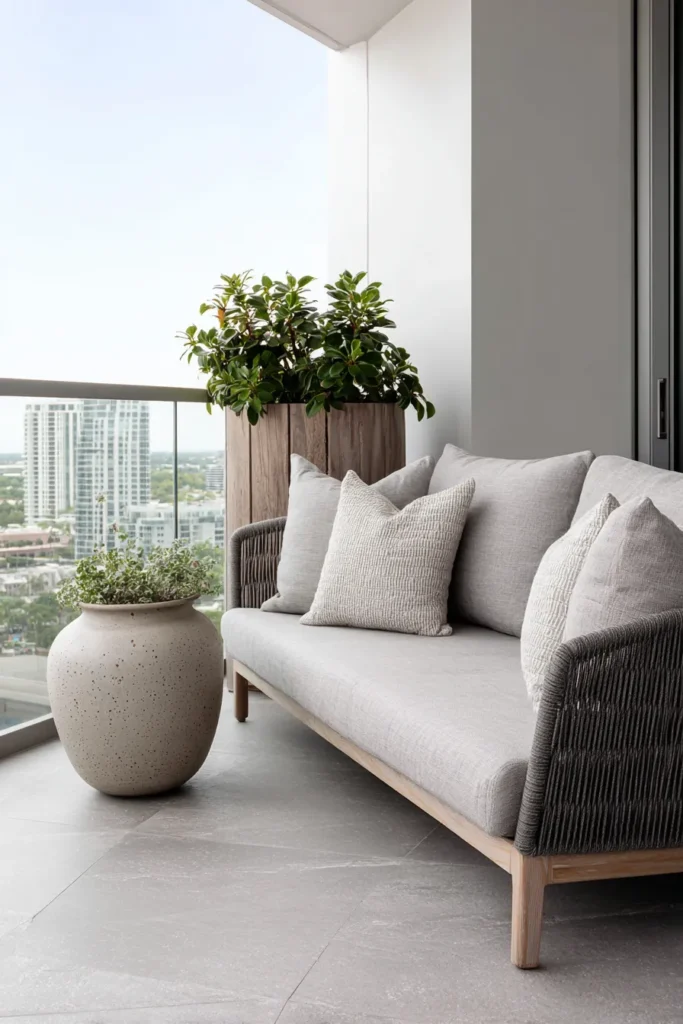
Single-hue color schemes executed across three distinct surface finishes—matte, semi-gloss, and textured—create visual sophistication that multi-color palettes rarely achieve on space-constrained apartment patios where too many colors read as cluttered rather than curated.
The technique exploits how human perception processes tonal variation versus hue shifts. A palette of ‘Warm Gray’ executed in smooth powder-coated metal (furniture), rough stonewashed linen (textiles), and honed porcelain (flooring) registers as layered and intentional because the eye tracks surface quality changes rather than seeking color contrast. This approach also photographs exceptionally well—critical for urbanites who share outdoor spaces on social platforms.
Designer’s Secret: Choose your single hue from the warm neutral spectrum (greige, taupe, warm gray, sand) with an LRV (Light Reflectance Value) between 40-55. This midtone range provides enough contrast against both shadows and bright sky to prevent the “washed out” effect very light palettes suffer outdoors, while avoiding the oppressive darkness of LRV values below 30 that make small spaces feel smaller.
Design Breakdown:
- Base color: ‘Greige’ (gray-beige hybrid) at LRV 45-50 as unifying hue
- Surface 1: Powder-coated aluminum furniture in semi-gloss finish
- Surface 2: Stonewashed linen cushions in matte textile with visible slub
- Surface 3: Honed porcelain flooring with subtle texture variation
- Accent: One organic element (natural wood or live plants) for material contrast
Best For: Design-conscious minimalists prioritizing cohesion over eclecticism; small patios where color restraint creates visual breathing room.
Styling Approach: This monochromatic strategy mirrors techniques explored in minimalist bedroom design, where material texture creates interest within limited color palettes.
Freestanding Fireplace Integration
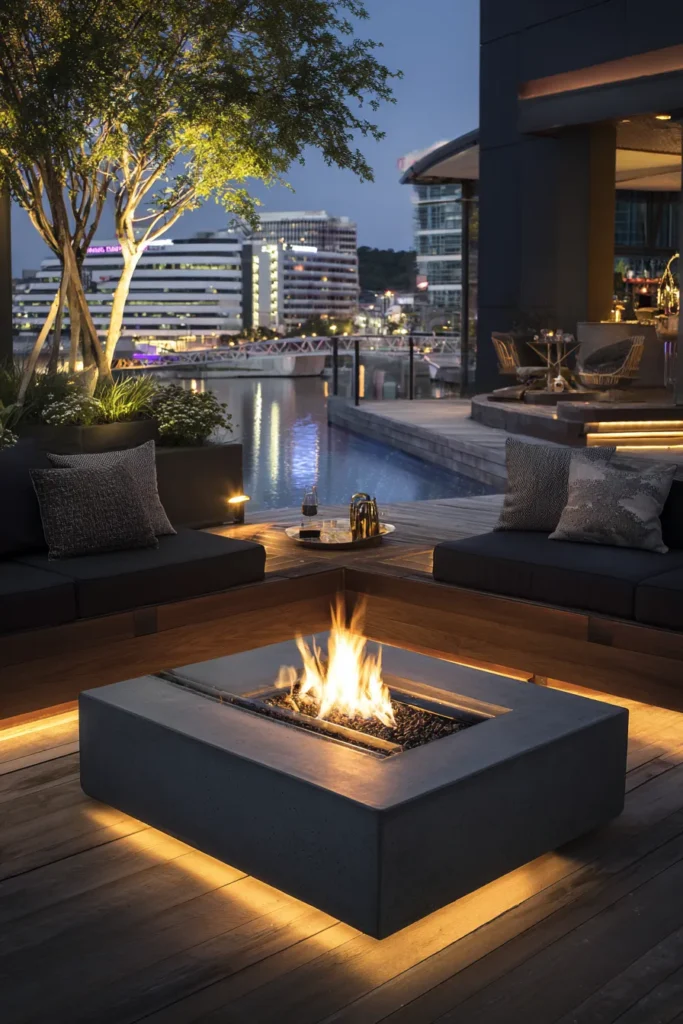
Bioethanol tabletop fire features provide the warmth and focal point apartment patios need for extending outdoor season into shoulder months (March-April, October-November) without requiring the permanent gas lines, venting systems, or building permits that make traditional fire pits impossible in multi-unit residential buildings.
The technology is elegantly simple: liquid bioethanol fuel burns cleanly without smoke, ash, or residual odor, producing 2000-3000 BTU heat output—sufficient to raise ambient temperature 10-15°F within a 2-meter radius. Steel or concrete housings contain the flame safely while providing sculptural forms that function as table centerpieces when not lit. Unlike wood-burning or gas alternatives, bioethanol units are truly portable and require zero infrastructure modifications.
Designer’s Secret: Position fire features at coffee table height (400-450mm) rather than the ground-level placement most manufacturers suggest. This elevation brings flames into primary sightlines when seated, creating intimacy and focal point drama that ground-based installations lack. The higher placement also improves heat distribution—radiating warmth at torso level rather than ankle level where it’s least effective for human comfort.
Design Breakdown:
- Fuel type: Bioethanol liquid (2000-3000 BTU output)
- Housing: Powder-coated steel or cast concrete vessel, 300-400mm square footprint
- Flame height: 150-200mm for visible presence without safety concerns
- Placement: Coffee table height (400-450mm) for optimal sightline integration
Best For: Three-season outdoor use (April through October) in temperate climates; evening entertaining where fire provides both warmth and ambiance.
Shop the Look: Portable heating elements include bioethanol and propane options for various apartment patio configurations, extending outdoor enjoyment similar to patio furniture arrangements designed for year-round use.
Acoustic Absorption Treatments
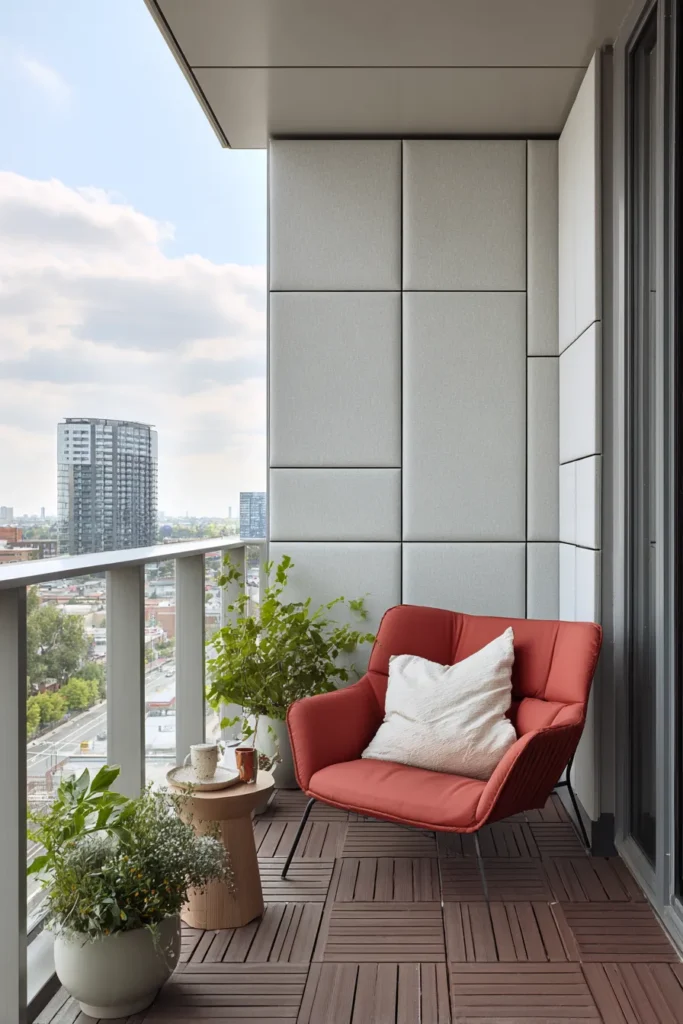
Foam-backed outdoor fabric panels mounted to perimeter walls reduce ambient noise pollution by 15-20 decibels—transforming urban apartment patios from spaces dominated by traffic rumble, construction cacophony, and neighboring conversations into functional sanctuaries where normal-volume conversation doesn’t require shouting.
The acoustic physics is straightforward: soft, porous materials absorb sound energy rather than reflecting it back into space. Outdoor-rated acoustic panels combine 25mm thick open-cell foam cores with solution-dyed acrylic face fabrics—providing NRC (Noise Reduction Coefficient) ratings of 0.75-0.85 while withstanding weather exposure that destroys interior acoustic treatments within weeks. Panel coverage of 30-40% of perimeter wall surface achieves measurable noise reduction without creating visual claustrophobia.
Designer’s Secret: Mount acoustic panels in the upper third of wall surfaces only (above 1800mm height) rather than covering walls floor-to-ceiling. High-frequency traffic noise and human voices—the most annoying sound pollution—travels in direct lines at head height and above. Low-frequency rumble (HVAC systems, distant construction) is nearly impossible to absorb without industrial-grade barriers. By targeting the noise spectrum you can actually control, you maximize acoustic improvement while minimizing material costs and visual impact.
Design Breakdown:
- Core: 25mm open-cell acoustic foam, NRC rating 0.75+
- Face fabric: Solution-dyed acrylic in coordinating palette colors
- Dimensions: Modular 600mm x 600mm panels for flexible coverage
- Mounting: Z-clip hanging system for damage-free wall attachment
- Coverage: 30-40% of perimeter wall surface, concentrated above 1800mm
Best For: Patios adjacent to busy streets or neighboring units; spaces where conversation and relaxation depend on reduced ambient noise.
Complementary Spaces: Acoustic treatments create quieter zones similar to strategies used in home office design where sound control enhances functionality.
Minimalist Water Feature Focal Points
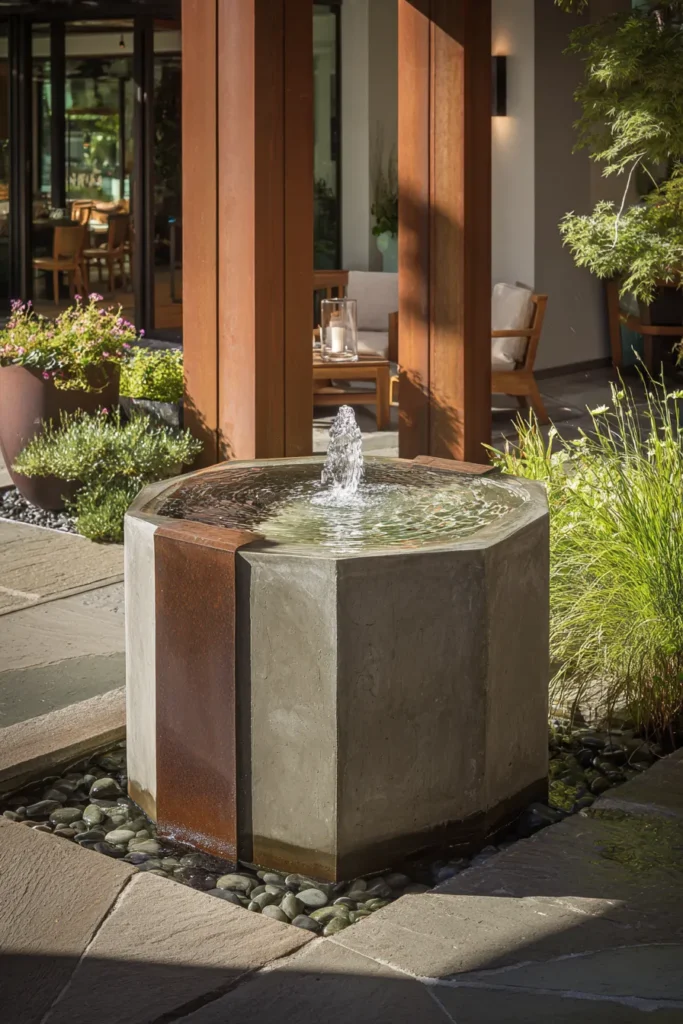
Self-contained recirculating fountains with 40-60 liter reservoirs provide the sound masking and humidity micro-boosting apartment patios benefit from—raising relative humidity 5-8% within a 3-meter radius while producing white noise that psychologically separates outdoor zones from urban soundscapes.
The mechanism is deceptively simple: submersible pumps cycle water through sculptural vessels at 200-400 liters per hour, creating gentle water sounds in the 40-60 decibel range—loud enough to mask intermittent street noise but quiet enough not to dominate conversation. Modern designs in cast concrete, corten steel, or powder-coated aluminum provide architectural forms that function as sculpture when viewing angle obscures water movement. Winter storage is minimal; drain, clean, and cover for 3-4 month dormancy.
Designer’s Secret: Position water features in corner locations rather than as central focal points. The counterintuitive placement allows water sound to reflect off perpendicular walls, amplifying the acoustic masking effect by 20-30% compared to freestanding placement. Corner positioning also solves the practical challenge of concealing electrical cords—running them along two wall edges is visually cleaner than bisecting open floor space.
Design Breakdown:
- Reservoir: 40-60L capacity for week-long operation between refills
- Pump: Submersible 200-400 LPH flow rate, energy-efficient 15W motor
- Housing: Cast concrete or corten steel in geometric forms (column, sphere, basin)
- Sound: 40-60 dB output—audible without overwhelming conversation
- Placement: Corner location for acoustic amplification and cord concealment
Best For: High-stress professionals seeking psychologically restorative outdoor spaces; patios where water sound provides natural white noise masking.
Shop the Look: Water features and planters include self-contained fountains suitable for compact patio installations.
Designer’s Warning: Weight Load Miscalculation
The single most expensive mistake apartment patio designers make is exceeding structural load limits—specifications buried in building codes that limit dead load (permanent fixtures) and live load (people, furniture, plants with saturated soil) to 60-75 kg per square meter for typical residential balconies.
Violations manifest slowly. A patio furnished with heavy concrete planters, stone pavers, and substantial built-ins may perform flawlessly for months before micro-cracks appear in supporting cantilever beams—structural damage costing $15,000-40,000 to remediate. Before committing to any material-intensive design concept, obtain your building’s structural load specifications from property management. As a safety margin, design to 70% of stated limits; buildings constructed before 1990 often have reduced actual capacity compared to original engineering specifications due to concrete degradation and rebar corrosion.
Calculate loads accurately: porcelain pavers add 25-30 kg per square meter, saturated soil weighs 1800 kg per cubic meter, and large-format planters can exceed 100 kg individually when fully planted and watered. The cumulative effect is deceptive—what appears to be modest beautification can double or triple total floor loading. When weight concerns arise, prioritize vertical installations (wall-mounted planters, hanging lights) over heavy flooring and furniture interventions.
These 15 apartment patio concepts represent the 2026 design consensus: outdoor spaces must perform as climate-adapted, multi-functional extensions of interior living rather than seasonal decoration zones. The shift from aesthetic gesture to functional microclimates reflects maturation in how urban designers approach compressed outdoor space—applying the same rigor traditionally reserved for interior architecture to spaces once considered peripheral. Success follows from material specification discipline, spatial efficiency planning, and recognition that every square meter must justify its existence through measurable performance gains.
For more inspiration on maximizing small outdoor spaces, explore our guides on balcony decor and entryway design, where similar space optimization principles create impactful results.